Asset Management
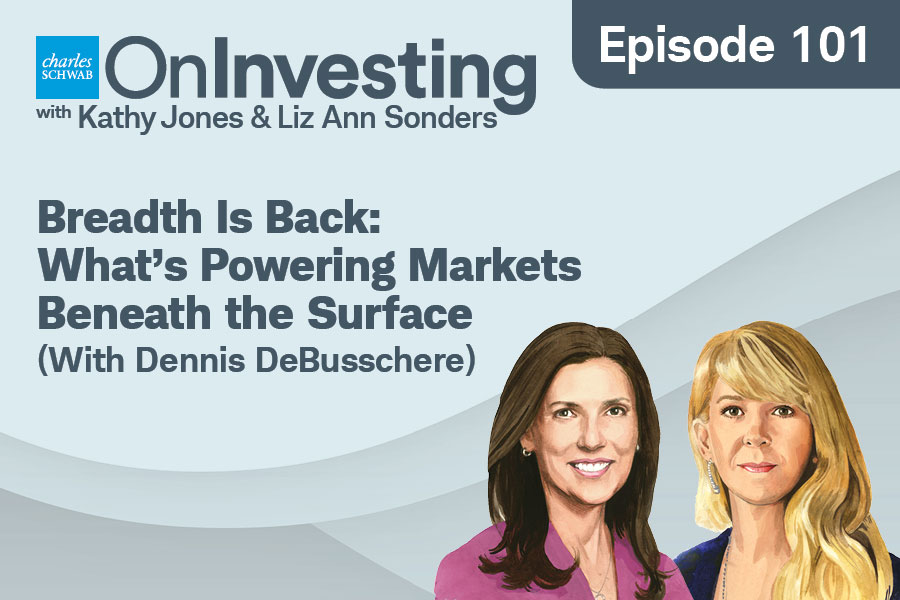
Breadth Is Back: What's Powering Markets Beneath the Surface (With Dennis DeBusschere)
Transcript of the podcast:
LIZ ANN SONDERS: I'm Liz Ann Sonders.
KATHY JONES: And I'm Kathy Jones.
LIZ ANN: And this is On Investing, an original podcast from Charles Schwab. Every week we analyze what's happening in the markets and discuss how it might affect your investments.
So Kathy, since we last spoke, we did get President Trump's nominee to replace Jerome Powell as the chair of the Federal Reserve, and it's Kevin Warsh. So assuming he's confirmed, what do you think personally, or what do you think the market thinks about the pick and maybe what his actions are likely to be?
KATHY: I think appropriately the market's taking a bit of a wait-and-see approach. Bond yields really haven't moved all that much. There's a little bit of an initial move when his name was put out there, but it was quickly sort of reverted back to a pretty calm bond market. Despite all the crazy stuff that's going on in terms of policy and the economic data coming and going, bond market's been pretty quiet, low volatility.
I think in terms of Warsh's nomination, there is good reason to wait and see because he has a lot of ideas about how the Fed should be changed. And the biggest one is that the Fed should have a smaller balance sheet, which he believes is helping Wall Street. And then by reducing that, I think he seems to believe that there's room then to cut interest rates, which would help Main Street.
So that sounds like a good slogan, but it's going to take some convincing, I think, to change the Fed's operating structure. You know, there's a lot of staff at the Fed that works on these economic models that informs the decisions that the various governors make. And I think he's going to have to have a pretty robust set of models to say, "You're doing it wrong. It needs to be done a different way."
So the first will be, well, let's prove that a big balance sheet is actually contributing to asset price inflation. That correlation isn't there. And so that's kind of the first hurdle. And then there's other hurdles along … prove to me that lower interest rates won't just give inflation a push, and that's bad for Main Street, because the average household feels inflation much more than, say, corporations do.
LIZ ANN: Well, not to mention that if the long end doesn't come down alongside the fed funds rate, the fed funds rate isn't really tied to consumer borrowing rates or things like mortgage rates.
KATHY: Right, exactly. And they have had a big focus on housing. And as you say, mortgage rates are tied to 10-year Treasury yields. And if you reduce the balance sheet, presumably you're going to get rid of some of the mortgage-backed securities the Fed owns, which is not going to help the mortgage market. So again, I think there's just a lot of persuading that will need to be done. And so the market had an initial bit of a reaction, and now it's kind of sitting and waiting and biding its time.
And we'll see how the economy develops over the next couple of months as he goes through the confirmation process. And then we'll have to see where we are at that stage of the game. So I'm not surprised. Dominant trend in the bond market really has been steeper yield curve. So we've got long-term rates edging higher because we've got fiscal stimulus coming, stubbornly high inflation, and global yields rising, a somewhat weaker dollar. All those things have kind of pushed up long-term yields. On the other hand, the short-term market is still discounting another rate cut by the Fed later this year. So that's really kind of the sum total of what's going on, and this nomination just reinforced that trend.
LIZ ANN: I have one more question for you. Do you think Jerome Powell is likely to stay on as a Fed governor? And depending on your view, did it change when Warsh was announced as the nominee?
KATHY: I thought that he was most likely to step down when his chairmanship was over, as most people do, but it wouldn't surprise me if he remains on as a governor. And I think my reasoning on that, and I'm just guessing, but if he believes that the institution of the Federal Reserve is somehow at risk of too much influence from the administration or from the outside, I think he is an institutionalist when it comes to the Fed and would stay as a way of counterbalancing that. So initially I didn't think he would. Now I think there's a chance that he would. Again, this is likely to be a much slower process than anybody … you know, markets like to react in the moment to news.
LIZ ANN: You think?
KATHY: I think this is a slower process. Maybe a little bit, you might know about that. But yeah, I think it's going to be a slower process. But yeah, I think there's a chance Powell does stay because he's very dedicated to the Fed as an institution.
So what about you? So if I had to sum up where things are right now, which is not easy, but economy is doing well. Inflation is pushing a little bit higher. Corporate profits are great, but valuations might be a little high. Where does that leave you in the whole market outlook?
LIZ ANN: You know, we benefit in this environment from being in earnings season. So even absent a jobs report, which we're not going to get on Friday, although we'll get it at some delayed point, yet again, like during the last government shutdown, and this one already ended, of course, and it was only partial, we had the benefit of earnings season. And the takeaway so far from earnings season is that earnings growth continues to be strong. But I think part of what explains some of the market action in the last several months, this broadening-out trade, equal weight outperforming cap-weighted in the case of the S&P, small caps outperforming the large cap brethren like the S&P 500®, international performing well and beating the S&P. I think it's breadth within earnings that is a factor there, but also the direction of travel.
So Kevin and I just wrote a piece on earnings season so far, and we have a table in there that gets updated on usually a couple of times a week by the folks at IBES[1] as earnings are being tracked. And one thing you'll notice if you take a look at that is the broadening out in terms of where earnings growth can be found. It's not as one-sided or biased towards sectors like technology and communication services. We're starting to see that earnings growth gets spread amongst a broader swath of industries and sectors.
And in the case of the Magnificent Seven, which still tends to be in focus, you have a decelerating pace of earnings growth for a cohort like that or for maybe a slightly broader AI basket, mega cap, tech, there's lots of ways to slice and dice it, but you're seeing an accelerating pace of earnings growth for the rest of the market, the other 493 as it's often called. So I think that that has provided support for this broadening-out trade, which, as you know, we've talked about it on many episodes here, we think has legs, not necessarily in a linear fashion. I think there will still be bouts of outperformance by, whether it's the Mag Seven or components thereof or tech. Comm services continues to perform fairly well. But I think it's in the context of opportunities being a little broader right now. Over the past year, only 17 or 18% of the constituents within the S&P have outperformed the index itself.
And over the past month, that's actually a little more than 50%. So that's another way to measure breadth. The fact that all sectors. … This was as of two days ago, and at the point where this gets posted, this episode, I'll admit that this will be slightly out of date, but as of a couple of days ago, all but one of the 11 sectors within the S&P had at least 50% of their stocks trading above their 50-day moving average. And that's been a relatively rare occurrence in the last couple of years, certainly in the era of that period when there was such heavy concentration in cohorts like the Magnificent Seven.
So I continue to think that that's a healthier backdrop when you have, I hate using the war analogy, but it's a common one, when you have more soldiers at the front line and not just the generals. Even if the generals go into some retreat, which has been the case with some of these mega-cap leaders, if you've got soldiers marching up toward the front line, then you still have a decent front. So I think that's the experience.
One thing I wanted to tie back to around the announcement of Kevin Warsh. And by the way, full disclosure, I've known Kevin for more than 20 years. I do think he's very smart. I think he's an honest operator. But you're absolutely right to point out the varied views he's had in the past. So we'll all have to see what comes about. But one of the dots that can be connected in the immediate aftermath of that announcement brings you to the recent extreme volatility in precious metals prices. And as you know, you and I just did a webcast yesterday for a large group of advisors on our platform, and we get to see the questions as they're coming in. And there was just a rash of gold and silver questions.
And I don't know if you found it, too, but my last several client events, not just in the last few days covering that span of time where you saw the big plunge in silver and gold, and then you had a bit of a rally. But the kind of parabolic phase of gold and silver prices that started in mid-January just was causing, you know, first, second, third hand up in audiences saying, you know, "What do you make of it? Should I jump on the bandwagon?" Those types of questions. And I think what we learned through the short-term major reversal is, there's a couple of forces at play.
One, I think, positioning had gotten incredibly one-sided. FOMO had kicked in. You were seeing it in terms of retail trader flows, just classic performance chasing. Then you had, I think it was on January 29 or January 30, the CME decided to raise margin requirements for gold and silver. So there had been a lot more leverage at play, and levered players were seen to maybe have been forced to liquidate positions that fed on itself in terms of the performance chases. So we sort of had this violent clearing event, and that established the ability then for a bit of a rebound.
Not being a precious metals analyst, so take this with a grain of salt, I think volatility is probably going to be with us. I think there's still fundamental support for … certainly for gold, you know, central bank diversification and geopolitical instability concerns. But I would expect there to be more volatility. And some of that volatility can simply come because of positioning and forced changes and margin requirements and margin calls, etc. So I don't think this is the end of the full story behind why silver and gold have done well. Silver also has an industrial use aspect to it. There's more of a supply/demand imbalance.
But maybe we're past the perceived really easy money part of this story, and I would expect volatility to maybe continue to rule the day a bit.
KATHY: It harkens me back to when the Hunt brothers cornered the silver market back in '79 and '80. And the fever didn't really break until the margins were raised on futures positions. And then all the leveraged players started to have to come undone and bail out. And one thing led to another, and it was same thing, straight up, and then straight down, and then bounce and bounce and bounce. And you know, it's sort of like the people who participated on the way up were convinced it was going to go back up any day now. And the people who caught the ride down were convinced it was going to go to zero. And the truth was somewhere in the middle. But you do get … and I think people underestimate the power of raising the cost of leverage.
And that certainly was a huge factor in seeing that correction in the market. I don't know where it goes from here either, but fundamentals in precious metals are very hard to measure. That's my experience in commodity markets over the years. People talk about supply and demand. Do people really have a good handle on what that means? I don't think so.
LIZ ANN: And there's the real rates piece of it, too. Part of the reason why when real rates go up, which of course are inflation-adjusted rates, why precious metals like gold will often go down is that gold doesn't have a yield. So when you have more attractive real yields in the fixed income space, then arguably there's less incentive to own a non-yielding asset like gold.
KATHY: Yeah, a lot of players in those markets also use financing. So it's not just no yield. It can be a negative yield, right? So you have to have the momentum and the price to offset the cost of carry. And that that gets to be difficult in an environment where the price is plunging. So you know, we've wiped out a lot of people who are in on the way up. We'll see where it goes from here. But I do think it'll be volatile for a while. I agree with you.
So Liz Ann, tell us about our guest this week.
LIZ ANN: Sure. So I've known Dennis for a long time. So Dennis DeBusschere is president and chief market strategist of 22V Research. And prior to helping found 22V Research, he began his career in sales at Merrill Lynch.
Dennis then went on to head Evercore ISI's Portfolio Strategy Research and Quantitative Research teams and sit on the firm's Investment Policy Committee. Dennis is a fellow Blue Hen, having graduated from University of Delaware, although he's a little bit younger than me. He has a degree in political science and economics, also sounds familiar because those were my degrees. And his daily market note covers major macro and micro events, analyzing their tactical/short-term impact on markets as well as their implications for longer-term market themes.
Well, Dennis, it's such a thrill to have you here. And as our listeners heard in the introduction, they now know we're both Blue Hens, having gone to University of Delaware, although I think I was there, I don't know, maybe a generation earlier than you were. But I want to start by just … having you tell us about the founding of your current firm, 22V Research, and the significance of that number?
DENNIS DEBUSSCHERE: Well, thank you. Great to be here. Great to see you, Liz Ann. Yeah, so we're starting our fifth year of 22V. The significance of 22V is the reference to 22, my dad's number. He played for the New York Knicks many moons ago, and the 22, and the colors of the firm are basically Knicks blue and orange, and the 22 is basically the design of the Knicks jersey, how you would see the number on the jerseys, and V is for victory. So that's the story of 22V.
LIZ ANN: So for our listeners who are wondering why the last name might sound familiar, now you know, Dave was the dad. So Dennis, I want to start big picture, just in terms of how you think about the economic backdrop now, whether this is going to continue to be a bit of a unique cycle and how you're framing it, especially in the context of so much sort of geopolitical instability and uncertainty. So give us sort of the broad macro lay of the land, and then we'll dive in on some tangents.
DENNIS: Yeah, and thank you for asking that because I think it's an important setup to the rest of the conversation. So first and foremost, as it relates to geopolitical tariffs, let's call it shocks, the U.S., and this has been the case since the initial post-COVID period, is in an unusually firm position from a financial accounts point of view … that's way too fancy. Basically, the private sector is in surplus.
You've had deleveraging within the private sector, you have a positive household financial and corporate balance, and all things equal, that makes it easier for the U.S. economy to absorb shocks, right? So that's been the case. That's point number one. Related to it, and we could say we lucked into it, we could say we didn't luck into it, meaning what I'm about to say, productivity growth has been extremely strong, right? And it has not been related to AI yet. It does appear that coming out of COVID … and this is a this is a theory, so I don't want to say this with too much confidence, but that COVID was a forcing function to move companies closer to the efficient frontier, using existing technologies not too dissimilar than what we're doing right now. Taken across the economy, that could explain the uplift in productivity, but it's happened. You should probably not fade it because it's more than just, you know, a one or two quarter thing.
So this combination of strong productivity and a U.S. positive financial balance, which is the other side of the deficit, is your structural supports for the economy. And that's different than the post-global financial crisis period, where you had very weak productivity, and it was just the worst part of the deleveraging cycle.
LIZ ANN: And we need that productivity to continue given the lower labor-force growth by virtue of the crackdown on immigration. So you know, the simplest definition of GDP is labor force growth times productivity. So do you have that longer-term productivity confidence as an offset to what is probably going to continue to be weak labor-force growth?
DENNIS: Yeah, so I think you need that confidence. Otherwise, it's going to be a very weak economy. I'm kind of joking, but you bring up a really important point that's different now. The break-even payroll growth rate, so the level of payroll that is needed to keep the unemployment rate flat, is estimated to be close to or near zero. And that's related to the immigration crackdown and low fertility rates in the U.S. So it looks very much like Japan and Europe, from a demographic point of view.
The difference between the U.S. and those countries, well, Europe and Japan, is that productivity growth has been significantly stronger. Should we extrapolate that to continue? I think it's fair to say yes, since AI has not necessarily contributed to productivity yet. There does appear to be a lot of capital deepening going on now. Presumably that is not going to be all wasted. So yeah, we should have maybe, call it 2% to 2.5% productivity growth, which would mean economic growth would be around 2% to 2.5% percent. And if productivity growth ends up disappointing, it's going to be a problem, meaning you'll have very weak economic growth with no real offset from labor.
LIZ ANN: Now I want to ask you a little more about AI, but before I do that, another big, big-picture theme has really come into the spotlight in the last few weeks is the continued weakness in the U.S. dollar, a sharper decline recently and related to that, the massive flows we've seen into precious metals, gold and silver, and what we're seeing in terms of international outperformance. So talk a little bit about the implications of what I assume you think might continue to be weakness in the dollar. So talk a little about your views on the U.S. dollar, the why behind what we're seeing. And I'll ask you to extrapolate or think about what the near term looks like and implications across asset classes.
DENNIS: Yeah, so stepping back on the dollar, we tend to fade the idea that there is an anti-U.S. trade going on, in the sense that there's very real macro forces that justify a weaker U.S. dollar. It's not just that a bunch of European investors or foreign investors are like, "We hate the U.S,. and we're taking our money away." And so what I mean by that is we have a sizable deficit that's going to increase, and we have a current account deficit, which means the amount of money that is essentially Treasuries that are essentially absorbed by the rest of the world. That's roughly 3% of GDP and could go higher.
Now typically when you're in a situation where you have both a fiscal deficit going up, and you need to fund a trillion-plus a year through foreign investors, some asset in an economy needs to reprice. So what I mean by that is typically you have three assets: the dollar, bonds, and stocks. The U.S. economy is relatively closed, so bonds and stocks shouldn't necessarily reprice. Typically you would see the U.S. dollar reprice, which is exactly what is happening. So we have a very, what I like to call, inside-the-box macro reason for the U.S. dollar to be biased lower.
Now, as far as near-term catalysts, I'm going to be less helpful on that. Like I don't know if the Davos meeting was a big catalyst or … and obviously there's intervention talk with Japan. And yes, I think those are reasons, or more of an excuse, just to accelerate a trend. So that's point number one. There's a tail. Related to AI, by the way, there does appear to be reasons to own rest-of-world assets relative to the U.S. now. And the same logic that applies to owning emerging markets or European stock also applies to owning small caps and mid-cap stocks in the U.S.
And that is, what we like to call in my joking fashion, you know, you have Godzilla and King Kong battling out in hyperscalers. We know that the implied earnings volatility within the hyperscalers or mega caps are much higher right now because it does appear to be a death match for domination. Two years ago, that was not an issue. It was just AI capex much bigger than expected, own them all. Now it's about "Will Google win versus the OpenAI stack? Will anybody be successful at challenging Nvidia's margins?" I have no idea if Nvidia's margins are going to be challenged, but I do know people are asking that question, which was not a question that was asked two years ago. So it's getting harder to pick winners and losers within the mega caps, which have absorbed a lot of capital. And so that's coming out and probably helping justify some rest-of-world outperformance, which by extension means a little weaker dollar, all things equal.
LIZ ANN: So are you a believer in the broadening-out trend, both within AI and more broadly across asset classes, as we think about 2026 as a year, which already January has felt like a full year. I don't know about you, but …
DENNIS: It has. The short answer is absolutely yes. And not just because I think small caps are going to outperform, just because the macro backdrop is significantly different. It has everything to do with the narrative shift of winners and losers within AI. So everyone seems to agree, and we would agree with this, and we've done a lot of research on this, that there are significant power constraints to this build-out. Yet this build-out will continue. So what do we know? We know that there's capex is likely to continue for the next two plus years.
That could change if there's some shock, but we know that's going to happen. We also have a fair degree of confidence that winners and losers are tougher to define right now. But the capex will happen at the same time. By extension, the winners of that capex, which tends to be not only some other larger caps but a lot of mid- and small-cap stocks that are in the energy, industrial, material spaces should benefit. There's probably some diversification away from AI, which would favor, say, banks and retail stocks, as this battle is fought, so to speak.
So I see no reason why that wouldn't continue over the next year. It could be proved wrong. It could just be like, hey, we just figure out in the next month that, I doubt it, that hyperscalers are all just going to keep on working, in which case our outlook would look less good, but I highly doubt that's going to be the case.
LIZ ANN: Yeah, and I also think some of the broadening out is a function of being in the … what I've been calling the cultivate phase of AI, the … a little bit of a shift toward a focus on "All right, who are the beneficiaries of AI? How are companies across the spectrum of industries, sectors, you know, large, small, how, how are they using AI? What … are we actually seeing the fruits of that labor in whether it's profit margins or productivity," and I think that's been one of the fundamental underpinnings for this broadening out.
DENNIS: So you're better at my job than I am, because that's a major part of the story that I should have mentioned. So AI usage, right, which is clearly accelerating—what I mean by that is when we look at the data, companies mentioning increasing use of AI tools within, say, banks or healthcare names, etc., that is increasing. You're also seeing margin expansion within those names, which is a justification for the broadening out.
LIZ ANN: I wanted to tap you a little bit more on the notion of factors. So we're big believers in factor-based investing. And for our listeners who haven't heard prior programs where I've talked about it, "factor" is really just another word for characteristic. So instead of making monolithic investment decisions, you know, "Do I want to own or not own the Mag Seven, or do it at the sector level?" that actually invest based on characteristics. And you have thoughts, I know, on factor trends, because I read your work, but an interesting separation of what you define as sort of risk-on factors, which aren't really fundamental factors. It would be, you know, momentum and sort of the behavior of the stocks versus fundamental factors. So how do you view the factor landscape for this year?
DENNIS: So in the current kind of economic regime, which would be defined as a normal economic expansion, fundamental factors, which would be your earnings momentum as opposed to price momentum as a quick example, not necessarily a pure beta factor, typically does a lot better, which has been the case—the fundamental factors have been outperforming, and you would expect that to continue. That could be GARP, value, growth, etc. Then you make a choice whether it's going to be value or growth …
LIZ ANN: GARP, by the way, for those who are not old school: "growth at a reasonable price."
DENNIS: Yeah, yes, it's making a comeback. So the current economic regime, which would be defined as somewhere between trend GDP, call it 2% to 2.5% GDP growth, with inflation that is non-problematic would typically favor fundamental factors at the expense of risk factors. Risk factors are ideal in an environment of a change from, say, tight to easy financial conditions, like the Fed just eases aggressively coming out of a recession, something like that.
Last year, by the way, was very odd historically, where from like the August period through October, we saw an aggressive easing of financial conditions in a normal economic expansion. And that was associated with a lot of momentum-based factors, meaning the non-fundamentally based factors outperforming. That has faded.
I wouldn't be short, not that investors here are doing that, I wouldn't be short the riskiest baskets. I want to make that clear, because in a normal economic expansion, some of these risky factors should underperform, but being really negative on them is difficult because I don't have a reason to say financial conditions will tighten. So I just want to make that distinction.
LIZ ANN: Speaking of financial conditions, I want to widen the lens again a little bit and get your thoughts on monetary policy, the Fed. I'm guessing you don't have a litany of reactions to the latest Fed meeting. It was a little bit of a snooze, both in terms of what they did and what Powell said during the press conference. But what are your thoughts on the trajectory for monetary policy?
DENNIS: So I guess we're out-of-the-box in making this statement. I think monetary policy is probably going to be very orthodox, much more so than people think. So it's very popular in the press. I think just financial commentary in general, whether you find that on a different platform outside of traditional media, would suggest that the economy is going to be run hot, that the Fed is going to be pushed around by the administration and lead to consistently higher inflation.
Stepping back, there's some structural reasons why that's probably not going to happen. The regional Fed presidents were just reappointed to five-year terms, and that was a unanimous vote. So they can vote against the chair if they feel like it, and they will if the economics justifies that. We assume the Lisa Cook case, Supreme Court case, goes in favor of Lisa Cook. I won't get into the details, but that's common knowledge, I would say. So those two factors are important, but even leaving that aside for a second, you're going to get orthodox policy whether you like it or not. And what I mean by that is if inflation is such a level that it would justify the Fed increasing interest rates and they don't, the 10-year yield will go up significantly, and it will tighten financial conditions, all right? And we've seen this repeatedly in other countries. And why we think we're going to avoid it, I have no idea. You've seen it in the U.K., you've seen it France, and you've seen it very recently in Japan.
LIZ ANN: I think I read a note from you very recently, as it relates to what the bond market is saying about monetary policy, and that maybe part of the reason for the relative calm in the bond market is that it is discounting pretty orthodox monetary policy.
DENNIS: Yeah, so short rates have priced out the aggressive cuts that were presumed going back to September. Those aggressive cuts were associated with an increase in the unemployment rate. The unemployment rate has come back down. And as the unemployment rate went from 4.6 to 4.4%, and the economic data looked a little bit more secure post- the government shutdown, guess what? We had less cuts priced. And a little flattening of the yield curve, which is completely orthodox monetary policy being priced. Additionally to that, inflation expectations are stable.
If we were pricing unorthodox monetary policy, one, you would not have seen odds of rate cuts come down. That's number one. And number two, you would have seen inflation expectations go up a lot. So cross asset, you're seeing orthodox monetary policy priced.
LIZ ANN: Now, as you think about risks, and we're all paid to both assess opportunities and risks, that's what we do, certainly in our roles, that's our job, whether it relates to monetary policy, but maybe specific to running the economy hot, how do you assess the risk/reward landscape here?
Assuming the economy, for whatever reason, robust productivity, the AI story, continues to run hot, but the Fed stays on hold. I know you've written about risks that the economy can't grow above trend without igniting inflation. So what are the risks associated with inflation becoming unanchored in an environment where you don't have commensurate significant improvement in growth? How do you assess that potential outcome?
DENNIS: So the first part would be, if that were to happen, which I do think is the bigger risk relative to, say, a recession or some other shock. Well, shock you don't know, but our view is the governing factor on the cycle is inflation, not growth worries. And if you were to run in an environment where we're running hot, and productivity actually disappoints a little bit, and inflation was to start trending towards, say, 3% or above on core PCE, you would have an aggressive tightening of financial conditions that would lead to a decline in all stocks, probably led by the AI names because you would question capex ability in in a much-tighter-financial-conditions backdrop.
What are the odds of that? I would say probably, you know, 1-in-10, 2-in-10 type, you know, it's maybe a little bit higher than base-case recession because what we're talking about is ultimately a recession. Financial conditions tighten aggressively because of inflation, and you lead to weaker demand, higher unemployment rate, and recession ensues. So I would call it 1 in 10, 2 in 10, you know, something like that, call it 20% odds. So it's not insignificant. That's why we don't have an inflationary forecast, but I spend a lot of time worrying about it.
LIZ ANN: I'm glad you brought that up because it makes me think of work that we have done on long-term secular eras. To me, clearly having exited the great moderation era from the mid-to-late '90s up until the early part of the pandemic, and I think the distinction that's important, in terms of what was happening in that era versus what was happening before, maybe the way to think about the future is a relationship between bond yields and stock prices.
So for much of the great moderation, because bond yields were more often keying off of the growth side of the equation, not the inflation side, higher yields meant higher stocks and vice versa. For the 30 years that preceded that, because yields were tied more to what was going on in a more volatile inflation backdrop, bond yields and stock prices were inversely correlated. So higher bond yields, weaker stock prices. So do you think about that relationship on a going-forward basis? Do you think we're in some sort of transition? And do you think the environment thinking in a secular way is more likely to look like that great moderation era or maybe the time prior, or something completely different?
DENNIS: A higher conviction or high conviction, the time prior. So we are in a fire regime relative to an ice regime. So when you have a positive correlation between bonds and stocks, you're in what I would call an ice regime, where you have higher bond yields. And in this regime, which is a more of a fire regime, you have higher yields, and stocks tend to underperform. So bonds are not diversifying, right?
So the way we think about it now is in the context if bonds are not diversifying, stocks tend to do well, which assuming you have an economic expansion, and they tend to outperform, but other assets tend to do well, which I know you didn't ask this, but that might explain alternative assets like gold. So you tend to look for alternative assets if bonds are not diversifying. It also might explain why … I just saw something that came across where Blackstone was saying that the dam's about to break on IPOs. And then I immediately got a question from a client: "Who's going to fund all that? Where's the money going to come from?" I'm like, "Well, bonds." I mean, they're not diversifying anymore, right? So there is going to be assets to purchase IPOs, and it's probably coming from credit and bonds over time if, in fact, they're not diversifying in a portfolio.
LIZ ANN: And do you think that will happen in fits and starts or really be a true trend? Because, you know, decent returns in a bond market that doesn't have massive volatility, and you're earning the coupon, and I think for certain investors, it's still a valuable sort of portion of the portfolio, even, if in a classic sense, it's not a diversifier by virtue of the changing relationship between yields and stocks.
DENNIS: And it is still a … I shouldn't imply that you just want to dump bonds because it's still a recession hedge, right? And you have massive returns on a recession because you will see that correlation come back, which is to say bond yields down, or a diversifying impact. Fits and starts would be the answer. So when you have kind of quote-unquote "inflation scares," when the unemployment rate goes back down, bond yields would go up, right? Stocks down, so they're not diversifying in that scenario.
Let's assume we avoid the recession for whatever reason, unemployment rate goes down, bond yields up, inflation scare, financial conditions tighten a little bit, and from that point, you probably reset bond yields at a higher level, still have a decent return, but you lost on the way just during that one period.
LIZ ANN: Two more questions I have for you. One is just a tie into some of what we've been talking about with regard to the Fed. And so I think it's relatively recent that you guys came up with a Federal Reserve sentiment score. So talk a little bit about that.
DENNIS: Yeah, so the quant team, we put together a sentiment score based on all the important factors the Fed would focus on, which is your inflation, your labor market, your geopolitical outside factors, as an example. And what's interesting about the Fed sentiment score is by far the largest driver of Fed sentiment, which informs your forward outlook for financial conditions, has been the labor market.
So when you think about what they've been saying in all their speeches, that could be your FOMC statement, the individual Fed governors, regional Fed presidents, what they're saying publicly, clearly skewing towards worries around the labor market and no real concerns around inflation. Why that's so interesting to us comes back to a point where I mentioned before why I worry about inflation, or less easy financial conditions this year, which might be an issue for certain stocks.
If labor-market sentiment starts to improve, which is really driven by the unemployment rate, so when you look at the sentiment scores that the Fed really focuses on, it's much more unemployment-rate-based than it is payroll-growth forecast. So I think, as an American investor, we're not used to dealing with a world where you could have close to zero payroll growth, right? A lower unemployment rate and the Fed sounding pretty positive on the labor market.
And then you'll see maybe the short end of the curve … giving you a potential and not necessarily a forecast, but let's just say then the short-end of the curve goes up, and everyone's like, "What is going on? You have zero percent payroll growth, an unemployment rate that went down, the short end that went up, and the Fed sounding pretty good about the labor market, how is this possible?" Well, it's just possible for reasons we already went over, but that's just something to think about, that labor sentiment is the single biggest driver right now, which does inform your outlook for financial conditions.
LIZ ANN: All right, so I guess it's a little bit of a two-part question that I want to close with. When thinking about the tails, and I'll have you start with what do you think is maybe a big underpriced risk or risk that is … has some reasonable chance of happening? But then I'll have you finish with what are you most optimistic about? Where do you think that upside? These days, there's so much sort of dour sentiment that I like to try to do my best to end our episodes on a somewhat optimistic note. So start with the left tail and maybe talk about the right tail.
DENNIS: All right, and it's going to be the same focus, just two different versions of it.
LIZ ANN: OK, interesting.
DENNIS: OK, so the left tail, which would be, you go through this year, and you realize that AI is not impacting productivity yet, and productivity just slows aggressively. All right, so what happens is you have much higher inflation per unit of growth. We end up with like 3% inflation on a core basis, or something very high, and 1% GDP.
And there would be a significant perception gap relative to current expectations that would be shocking and negative for the market. Let's just put it that way, or it could be zero growth, and the same issue and tighter financial conditions in a market that goes down, you know, 15 to 20% because you have no growth and still you'll have inflation purely based on the fact that productivity is significantly weaker than we expected.
Now the idea behind this, which we'll get to the positive, is if AI is not impacting productivity now, and the post-COVID kind of companies moving to the efficient frontier is short term in nature, which historically it should be, then you could have a gap in productivity before AI impacts it. And what if that gap is this year? Pure speculation, right? It's not something we can forecast. OK, here's the counter. And this is, if you're on that kind of part of the J curve, right, where you're not even getting the AI productivity impacts, but productivity is strong now.
If it stays strong, and then next year we're starting to forecast even higher productivity because the AI contribution is starting to hit, you could have a really positive outlook, if that makes sense. You can sustain higher wage growth without inflation being an issue. You could probably draw in even more labor than would otherwise be justified by the breakeven payroll rate. Incomes would far outstrip payroll growth. Real incomes go up, all right?
We're talking about a situation where you could be looking at, let's call it, blue sky it, at 3% or something higher productivity. All right, that's a really positive backdrop. That helps everybody. So it's just that kind of … how you think about this transition from non-AI to AI productivity might determine your tail risks.
LIZ ANN: Do you put higher, I won't ask you to give me odds, but do you put higher odds on the right tail or the left tail?
DENNIS: Much higher odds on the right tail.
LIZ ANN: OK, well that's good.
DENNIS: Yeah, we've been productivity bulls for a long time. And by the way, forecasting this stuff is nuts. But we lean much more on innovation.
LIZ ANN: Well, that's great. It's always good to end these, especially in this day and age, on a positive note. So Dennis, thank you so much for joining us. This was a short but robust conversation, and we're really appreciative of your time.
DENNIS: Thanks so much for having me.
KATHY: Well, it's time to look ahead to next week. And thanks to the government shutdown, partial and temporary as it was, the Bureau of Labor Statistics has announced that this week's JOLTS report, Job Openings and Labor Turnover Survey, and Friday's unemployment report would be postponed and rescheduled once the government reopens.
That kind of leaves us with more scrutiny, I guess, on earnings season and other sources of data. What do you think, Liz Ann?
LIZ ANN: Yeah, I do think it sort of elevates the importance of some of these parallel indicators. The Bureau of Labor Statistics hasn't announced, you know, the government essentially opened back up after the partial shutdown, at least as of you and I recording this. We haven't seen what the date is going to be of the release. At least they're not canceling it altogether. But we did just get the ADP version of payrolls, and that was a bit weaker than expected. Continue to see a very big divergence within data like that, in terms of where jobs are being created and where they're lost. So what you saw, again, and this has been a theme, this is not a new phenomenon, a big increase in payrolls in the more kind of defensive areas like education and health services, but the biggest drop was in professional services. So I think that has continued to be a theme.
One of the things of note when we do get the official jobs report is that this is the report that will have the benchmark revisions in it. We got a preliminary look at those several months ago, but this will be the final look at those revisions, and it is expected to be a meaningful downward revision, not to the same degree that was thought to be the case around the time we got the initial benchmark estimate. But that's going to be something worth watching because it's not just the monthly jobs report, but it'll be an analysis of what the labor market looked like for the full year ending in March of last year.
The other thing I wanted to mention that was interesting is some of the, sort of funky things, that have been happening in some other economic reports.
So just before we had the microphones rolling here, we got the ISM Services Index, which is a PMI, as they're called, Purchasing Managers Index. It's survey-based data, so Institute for Supply Management surveys purchasing managers, both on the services side of the economy and what they call non-services, which generically people generally call manufacturing. And the services reading that came out today was relatively subdued, kind of flat, but you actually saw a decline not into sub-expansion territory, but a move down, a move lower, in both the new orders component and the employment component.
In contrast when we got the ISM manufacturing index a few days ago, that was much stronger than what was expected pretty much across the spectrum of the headline reading. New orders was stronger. Employment was stronger. So that may mean we're finally starting to see a little bit of convergence in those two. But as we talked about recently on an internal meeting that we had, what was really stark when the ISM manufacturing index was reported is they also released summaries of the verbatim comments by the companies that they are surveying. And almost universally, they were incredibly dour. And we've often talked about that in the context of the consumer, as it relates to the consumer, don't just listen to what they're saying, watch what they're doing. And we certainly have seen a wide gap these days between very weak consumer confidence, yet consumption trends being much healthier.
We may now need to continue to apply that on the corporate side of things, where don't just listen to what they're saying, but watch what they're doing. I think there may be some fluky stuff in the reading that could reverse itself a little bit. So I'm skeptical that this big pop in manufacturing back into expansion territory per that one reading is the sign of a really important and sustainable inflection point. But we'll have to see as we get additional releases.
KATHY: Yeah, I think there's a lot of things that could contribute to that kind of downbeat sentiment despite the fact that business is rolling along and just unpredictability, right? I just think, you know, even, and I hate to say, you know, markets hate uncertainty and all, but if you're running a business, and you're making investments, and you're hiring people or letting people go, or you're trying to anticipate what the rules of the game are going to be, and they keep shifting on an unpredictable basis, then you do get downbeat. Because it's sort of like, "Well, I don't know what to do. I don't know where I'm going. I don't know how to plan." And that is not a great backdrop for feeling confident and positive about the future.
And to the extent that those surveys take in just a lot of different types of businesses. You could be getting verbatim comments from a handful of businesses at the lower end of the spectrum, the smaller, or the upper, get very different readings on what's going on. Regionally there's big differences in how the economy is performing. So I can understand, just based on the lack of predictability about policy right now, that businesses could be very cautious despite the fact that things are going well. They just don't see the clear path ahead or not with enough confidence to continue to make investments.
LIZ ANN: It's in keeping with one of the themes of our 2026 outlook is instability. And that really can compress optimism and a willingness to commit longer term.
Well, that's it for us this week. Thanks for listening and thank you to everyone who has left us a rating or review on Apple Podcasts or Spotify. They really do help, and we are so appreciative of your support of our show. Kathy and I also post regularly and often on social media. You can find me, the real me, make sure it's not an imposter, @LizAnnSonders on X and LinkedIn.
KATHY: And I'm @KathyJones on X and LinkedIn, and that's Kathy with a K. And you can always read all of our written reports, including lots of charts and graphs, at schwab.com/learn. We'll be back in a week with a new episode.
LIZ ANN: For important disclosures, see the show notes, or visit schwab.com/OnInvesting, where you can also find the transcript.
[1] Institutional Brokers' Estimate System (IBES)
Follow Kathy and Liz Ann on social media:
" id="body_disclosure--media_disclosure--215766" >Follow Kathy and Liz Ann on social media:
In this episode, Liz Ann Sonders and Kathy Jones discuss the market's reaction to Kevin Warsh's nomination for Fed chair, the potential rationale for lowering interest rates, and the drivers behind recent volatility in precious metals, while highlighting a broadening in market performance thanks to more widespread earnings strength.
Then, Liz Ann is joined by Dennis DeBusschere, president and chief market strategist of 22V Research. They discuss the implications of the declining dollar, the impact of AI on productivity, factor-based investing trends, monetary policy, some potential risks and opportunities in the market, and much more.
On Investing is an original podcast from Charles Schwab.
If you enjoy the show, please leave a rating or review on Apple Podcasts.
About the authors
Liz Ann Sonders