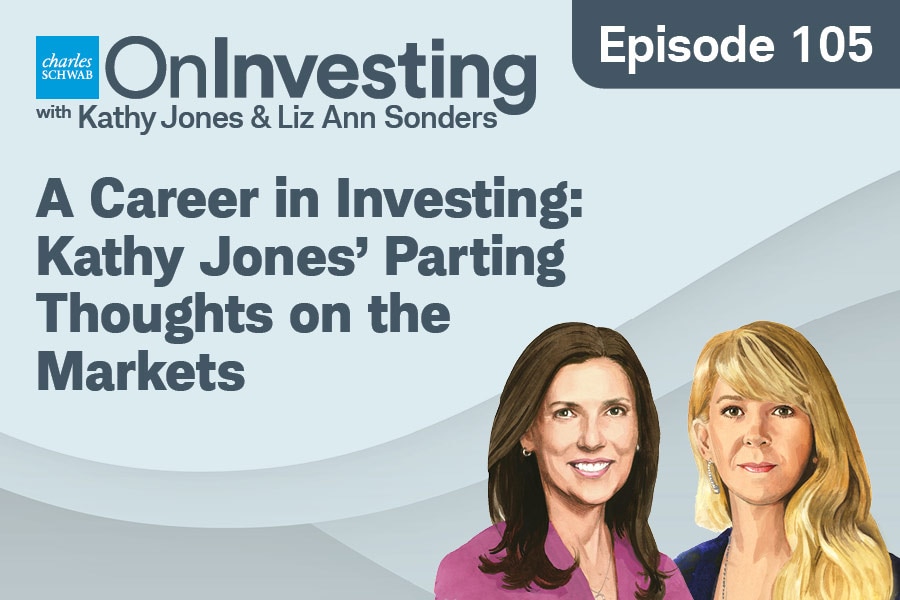
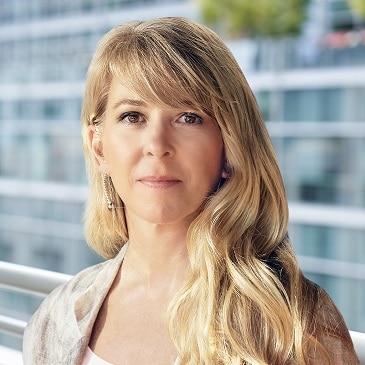
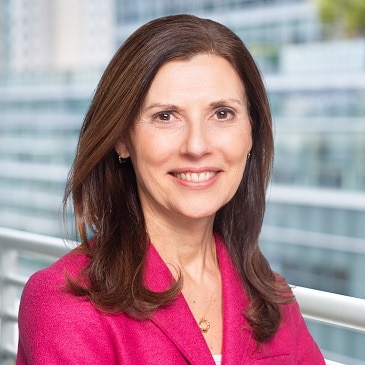
KATHY JONES: I'm Kathy Jones.
LIZ ANN SONDERS: And I'm Liz Ann Sonders.
KATHY: And this is On Investing, an original podcast from Charles Schwab. Every week we analyze what's happening in the markets and discuss how it might affect your investments.
LIZ ANN: Oh, I cannot believe, unless you come on as a guest, that this is the last time for a while that I'm going to be saying, "Well, hi, Kathy," which is always how we have started these shows. And as we announced last week on the show, you are retiring from … not just from Schwab, just retiring. And I'm sad to say that this will be our last episode together here today. So wow.
KATHY: Yeah, that's right. I'm going to miss spending this time with you. I think most people don't realize that we don't actually have a chance to do this very often outside of the podcast. I mean, we're usually ships passing in the night. You off in one direction, me in another. We're trading off information via email instead of in person. So this has really been a great experience for me because it's been an opportunity to just sit down and chat about the markets without a lot of time constraints and a lot of structure around it. But the good news is that our friend and colleague Collin Martin will be taking over as co-host of the show, and our listeners are in very capable hands. I think he's going to do a great job. You guys are going to have a fun time.
LIZ ANN: Yeah, totally agree. So this week on the episode, we will touch a little bit on the obvious events that are driving markets and psychology out of Iran. So we'll touch on that a little bit later in the episode. But I really want to use this episode as an opportunity to get your insights, Kathy, on what you've learned over your career in this business. It's been, I think, 50-ish years that you have been doing this. So I've heard this story from you before, and it's a fun one, so how did you end up in finance in the first place? What was your first job in this world of investing?
KATHY: Well, I always say that I sort of stumbled in by accident. So I was in college, and I worked through college to pay the bills. And I was looking for a job that paid better than the one I had, which was making deli sandwiches at a shop underneath the L-tracks in Chicago. And as it turned out, through a friend, I found out about the Chicago Board of Trade. And his exact words were, "They'll hire anybody, so you have a shot." And so I was like, "OK, cool." It paid well. And went down and worked as a runner on the floor of the Chicago Board of Trade. And from the minute I got in, I thought, "This is just the most entertaining place I have ever seen."
It was fast moving, it was somewhat chaotic, at times, and then ridiculously boring at other times. But I didn't know anything when I walked in there other than it paid well, and I would not go home smelling of salami and provolone. And that was good for me.
LIZ ANN: Was there a smell of order tickets? There was a little more paper involved back then, no?
KATHY: There was a lot of order tickets, there was a lot of smells, I will say.
LIZ ANN: Yeah, and other smells maybe that we won't mention.
KATHY: That's right. At times it did smell a bit like a boys' locker room in middle school. But those were the days, everybody crammed together in a place. But really it was such a wonderful learning experience. It was pure-market, open-outcry trading, which meant even though I walked in, I had no clue what they were doing, I just thought, "This cast of characters is wild."
The action was fun, and every day was this huge learning experience. And over time, then I went into research. And actually, I got the job in research as a research assistant because I could type. That was my advantage over the other candidates. Because in those days, when you produced a research report, you actually had to type it up, take it to the printer, and get it typeset and laid out and sent out.
But I had a wonderful … I mean, I had the great, good fortune to work for some really smart, really decent, kind people who taught me, wanted to teach me, were willing to teach me even though it was kind of unusual for there to be a woman in the business at that time, but great good fortune to learn from them and, you know, one thing led to another, and I just have followed what I thought was interesting over all these years.
LIZ ANN: You know, when you said typing, I giggled in my own head. I saw something flash across X not all that long ago. It was just one of those open-ended questions, "Does anybody remember when they used to teach typing in high school?" And I replied, "Yes, I absolutely do."
KATHY: Yeah!
LIZ ANN: And I could type more than 100 words a minute. And so I was able to work as a temp in high school and make a lot more money than what my other fellow students were making simply because of that typing. So I hear you there. Kathy, I know that you have put together an interesting list of some lessons that you learned in those early years of your career. So let's start with number one. What was the first lesson that you learned and how you think about that today?
KATHY: Well, I don't want to offend anybody, but my first lesson and foremost is you're probably not that smart. So and what I mean by that is the market will outsmart you more often than you can count, over the years. So just when you think you have it all figured out, something comes along to teach you that it's not that easy. I mean, the number of times I had to learn this in the early years is sort of painful to think about. But on the other hand, you know, I think you just have to respect the wisdom of the markets is going to be greater than most individuals are able to come up with.
And so when you think about it, you think about how markets change over time, factors change over time. And really the number of people who can actually beat markets consistently over a long period of time is very, very small. And so I think if you start out with the attitude that what you really want to do is just get a good risk-adjusted return and be part of the trend, but not necessarily think of yourself as the next market wizard, you're probably much more likely to drop the anxiety and succeed. And it really wasn't until I figured out, like, "Yeah I just want to be in the market. I just want to be participating. I want to get the benefits of it. But I don't want to think that I'm smarter than millions and millions of other people who are participating any day of the week."
LIZ ANN: All right, give us number two.
KATHY: This is one definitely from my trading days, but I find useful, and that is the trend really is your friend. And what I mean by that is not, you know, that you have to have some trend-following system or something like that, although mid-career, I did some vetting of hedge funds for some investors, and I was amazed at how many did actually just use trend following primarily and leverage to achieve their results. But what I use the trend for is to keep myself out of trouble. So you could do all this extensive fundamental research and think that you understand what's going on. And I do that. And then sometimes I will just look at the chart, and the chart's doing exactly the opposite. And for me, that's a wakeup call. That's a call for me to say, "Well, you've done all this work, and you think it should go up, but it's going down." I think the market's trying to tell me something about my analysis that's probably not correct. And so for me, it's a way to kind of double-check myself and say, "You know what? Something's going on here that I don't understand." And so for me, it's a form of discipline and enlightenment at times when I think that I figured something out and I really haven't.
LIZ ANN: Now I know there's more lessons. Have you published them, Kathy?
KATHY: No, I guess I haven't.
LIZ ANN: I'm not now throwing work on your plate, but boy, that might be something that'd be interesting to see. Any other lesson on your list that you want to call out?
KATHY: This is something I learned in the trading pits. You date your investments; you don't marry them. It's good to be a long-term investor, but there are times you have to let go. Sometimes you have to break up with a trade. It's enough. Valuations get stretched. And Liz Ann, you talk about it all the time, the value of rebalancing. It's just when your head-over-heels in love with something, it's probably about the time to …
LIZ ANN: Time you want to do some trimming.
KATHY: … to step back. And that leads to probably the most fundamental lesson that I've learned is that managing risk is the most important factor in investing success. So when I started out on the trading floor, I used to watch people, very, very successful traders, and sometimes they would take this enormous risk in like a blink of an eye. And it seemed extraordinarily reckless.
But then after time, I would talk to them and interview a number of investors. I learned that they were able to make those decisions because they were really prepared before they went into the trading pit. They had a game plan. And that game plan often included estimating the odds of various scenarios, knowing what they were willing to risk in both money and time.
And most importantly, they knew how to size their positions. So you can take a lot of risk in a small position or a small amount of risk in a big position, but you can't mix up the two. And you really need to have an exit strategy. So it isn't surprising to me that a lot of great investors are also good at games like bridge and poker and backgammon, because those are skills that you put to work in those sorts of games. And I think that really is probably the number one lesson is to learn to manage risk.
LIZ ANN: It's such an important lesson now, too, because I find over the past several years as we've seen the birth and growth of the shorter-term retail trader that kind of grew out of the pandemic era, and it certainly has crossed the chasm into the betting markets. And I find oftentimes that they're not thinking about the risk side. It's not a disciplined approach. It's a "wing it" approach. I think that lesson resonates particularly well in this environment.
KATHY: Yeah, I mean, there's the old saw about not confusing a bull market with investing genius, right? I mean, you can have a lot of good luck over a period of time, but if you don't have some discipline, you don't manage the risk. It's not going to be fun. And then my last one, I'll just throw this in there. "Just let it go." When you've made a bad investment and it doesn't look like it's going to come back, just let it go.
You know, holding onto a losing position or investment is just … on hopes that someday it'll pay off, it's just a waste of your capital and your energy. And psychologically, it's difficult and can inhibit you from doing something that, you know, is better with your money. So the stress just isn't worth it. And that's something I had to learn the painful way, is just sometimes it's like, "OK, put that away. Stop thinking about it. It's over. Move on to the next thing."
LIZ ANN: Well, you know, sometimes the best lessons are ones we learned through pain and mistakes. So I think we just have to understand that that's part of this investing life, but take advantage of the lessons that are taught through some of those mistakes. Kathy, I also wanted to give you this opportunity to maybe think about people who, within Schwab, that have had the most impact on you and give you an opportunity to maybe toss out a "thank you" or two.
KATHY: Gosh, you know there are so many people I would like to thank at Schwab. I've been here 15 years now and really had the great good fortune to work with so many terrific people at Schwab. I want to just acknowledge first of all my boss, Mark Riepe. When I came to Schwab, he really provided me with the support and the autonomy and the resources to build the fixed income team.
And he's been a great advocate for us. And I have appreciated his integrity throughout the years, which goes hand-in-hand with his sarcastic sense of humor, which I've also appreciated. But I think without him being an advocate for us and giving us the resources we need, it would have been a much more difficult task to build what we've built. And all the folks in fixed income at Schwab who welcomed me so warmly when I came were very encouraging and supportive of our efforts. I can't tell you what kind of delight it was when I would show up at one of our trading centers, like in Denver, and they'd all be like, "Hey, welcome. We're so glad you're here." And I was like, "Wow, that is fantastic." And it has been a great experience.
I do want to say for this podcast, I want to thank Matt Bucher, our producer, Patrick Ricci, our executive producer, and Kory Hill, our technical editor. They've done the heavy lifting to get this podcast off the ground and going, you know, they booked these fabulous guests. They've put together the agenda. They've managed the process. Kory's even managed to make me sound good through my many bouts of laryngitis, which is not an easy task. So really a shoutout to them.
And then of course you, Liz Ann, for partnering with me in so many ways over the years. It's been a wonderful relationship. And then, finally, most importantly, my team, Simoa Santiago, Collin Martin, Cooper Howard, and Diane Jacobs. Behind every presentation, article, media appearance, whatever we do, as you know, with your team, these are the people who make it happen. They're not just colleagues; they're really dear friends as well. So I can go on and on, but mostly I want to say that Schwab's a really special place to work, and it's because of the people.
LIZ ANN: Well said.
All right, now maybe back to the slightly more mundane, although there's not much that's going on in the world these days that one would describe as mundane. But since you aren't actually retired yet, so how are you thinking about the obvious news that erupted over the weekend, military conflict in Iran, and maybe how you're thinking about that in the next week or two and what's on your radar as the key markers in your world of fixed income that you're paying most close attention to given all this geopolitical volatility.
KATHY: Yeah, I think there's such a wide range of potential outcomes. This is a time when you have to sort of think through scenarios, right? What makes sense to happen? What doesn't make sense to happen? What could happen? And how should the market react? So it was interesting to me that the initial reaction to the original attacks over the weekend, the bond market didn't move all that much. But having said that, it had moved well in advance because this has been on the radar.
So yields had fallen. And anyone, I think, who was inclined to move to Treasuries for safety had probably already done much of that. And so then we … once the reality hit, actually yields bounced back. And we're back in the same old range. But we have to think through now, well, "What is the impact on the economy, both domestically and globally? What's the impact on inflation? And how does the Federal Reserve respond?" And there's a big range of possibilities because we don't know how long it's going to last, how much damage it's going to do, how much energy prices will be affected. So I think for us in fixed income, the one good thing is you can kind of cling to a safe spot or relatively safe spot, I might say, and go into some high-quality intermediate-term Treasuries or high-quality bonds and kind of sit it out, and not have to be in the … either end of the distribution in terms of taking risk.
And I think with wars, my biggest concern is there's a kind of belief that this will be over fairly quickly, which we all hope so. We don't want wars to go on. But we don't know. People have thought that many times in history, and that's not necessarily how it turns out. So when we're thinking about it, we're thinking about, "Well, where's a place where people can stay for a while and not be exposed to the tail risks that come with all this?" And for us, at least, it's probably easier than it is in the equity world to say, "OK, we're going to stick with some high-quality bonds, intermediate-term duration, and we're just going to ride it out and reassess when there's information that we can't assess." But it's a tough. These are very tough situations. Everyone wants to look at history and model out this and that. And wars are not things that are easily modeled. So that's a tough part. What about you?
LIZ ANN: Well, a bit more volatility in the equity market in the aftermath of this. We've had the obvious initial knee-jerk sell-off alongside the spike in oil prices, but we've had some intraday rallies off of those low points. I really do think it's the channel of oil prices through to the equity market that's probably key. You and I have spent a lot of time on this program talking about the connectivity between the bond market and the equity market.
And that's all related, but I really do think that it's … any stability that we might find in oil prices, I think, lends stability to the equity market. In the meantime, we're seeing incredible swings. We're seeing at the sector level. We're seeing it at the sort of broader overall asset class of equities-level, huge sell-off in the Korean stock market, which had been the best performing international market, and other Asian markets getting hit, given that a lot of the oil that comes out of the region tends to be exported to Asian nations. So that has increased a cause of concern with the last couple of days as you and I are taping this.
We've seen … it's not a record, but pretty close to it, a spread of outperformance of the U.S. market relative to non-U.S. markets—in stark contrast to what has been the international markets handily outperforming the U.S. market, not just recently, but going back over the last couple of years. And so you can see these things just turn on a dime. I'd say that one maybe interesting way to think about mitigating some of this volatility, especially for the stock pickers out there that maybe take a more active approach, is that there are many ways to measure and screen for factors. But one of the broad factors that we track at Schwab is a stability factor. And that has been, maybe no surprise, given just the label of it, has been a bit of an anchor to windward in this tougher environment.
I'd say in light of what, I think, will continue to be a lot of churn and rotation and narrative changes that can really change the prospects of what's happening on a day-to-day basis, even intraday, is try to make sure that you're not taking too much risk within the equity side of your portfolio. And if you do take a factor-based approach, maybe keeping a close eye on those stability-type factors to help ride through what I expect to continue to be a significant amount of volatility. If we really could start to see stabilization in oil prices, I think that that probably helps to stabilize the equity market. In the meantime, you know, interestingly, as you know, the economic data continues to be pretty decent.
As you and I are taping this, just today, we got a stronger-than-expected ADP report on job growth. We've got an upcoming jobs report. That's the big deal. And the ISM non-manufacturing, so ISM is Institute for Supply Management. It's a version of what's called the PMI, Purchasing Managers' Index. It's survey-based, and ISM does it both for manufacturing and services, and both were stronger than expected. So you know, so far, so good in terms of just the backdrop of the U.S. economy, and it's resilient, but of course oil prices is a feeder into those channels, too, and it bears watching not just for market performance but economic performance.
KATHY: Yeah, I think that that, you know, underlines the conundrum for the Federal Reserve, right? So on the one hand, you have a sturdy economy with low unemployment, and it looks like employment's stabilizing. We'll find out the numbers, but it looks like it's starting to stabilize. And that's good, but the unemployment rate, fairly low. And you have fiscal stimulus coming through from the tax cuts that could boost consumer spending and maybe offset the rising price at the pump for gasoline for a lot of consumers.
So there's this narrative that they have built and the expectation that was in the market that they will cut rates later in the year as inflation comes down. But inflation's remained elevated. Now we have a boost to oil prices. And war is inflationary. The longer it goes on, the more, you know, metals prices and all these things tend to go up because demand for goods that go into war production goes up. And so now the Fed is confronted with, "Well, is this an environment in which it's possible to cut rates? Is this an environment to even think about hiking rates?" I think not. I don't think that's the most likely outcome. But again, we don't know how long this goes on.
On the other hand, higher energy prices are a hit to economic growth, in many ways. So a real conundrum for the Fed policy, and I think that this is going to be a challenge, particularly with changing of the guard at the Fed right now. New leadership coming in, new focus on how it should operate. Though it's really a somewhat chaotic kind of backdrop to be trying to focus in on what policy setting we're looking at going forward.
LIZ ANN: No question. I think the next few Fed meetings are going to be quite interesting. Unfortunately, we won't have your wisdom directly via this podcast channel or the other methods. But I'm guessing, knowing you, that maybe you'll take a little bit of a break from being such an avid Fed watcher, but I'm guessing you're not going to completely turn your mind off to the … what's going on with our Fed.
KATHY: That's going to be a hard habit to break. I'm afraid I will be, I will probably be watching, but I'll try to be lurking and not, you know, in the mix on things.
LIZ ANN: So let me just conclude by saying hopefully you and I will stay in touch, and I can maybe continue to impart some of your words of wisdom either directly or through Collin, but we are really going to miss you. I know our listeners are really going to miss you. And I just want to say that I hope you have just a wonderful retirement. You have been a gem to work with, so thank you.
KATHY: Thank you, Liz Ann. It's been an honor, pleasure and an honor.
LIZ ANN: And to our listeners, thank you as always for tuning in. As a reminder, you can keep up with us in real time on social media. I am @LizAnnSonders on X and LinkedIn. The imposter problem is increasing again, so please make sure you are following the real me.
KATHY: And I'm @KathyJones on X and LinkedIn. And you can always read all of our reports, written and otherwise, including lots of charts and graphs at schwab.com/learn.
LIZ ANN: And if you've enjoyed the show, please consider leaving us a review on Apple Podcasts, a rating on Spotify, or feedback wherever you listen. And please tell a friend or more about the show. We are taking next week off from the podcast, but we will return with a new episode with my new co-host, Collin Martin, on March 20.
KATHY: For important disclosures, see the show notes, or visit schwab.com/OnInvesting, where you can also find the transcript.