
Asset Management
How to Manage Cash: A Goal-Based Approach

Key takeaways
- Organize your cash into everyday bill pay, an emergency fund, and funds for near-term opportunities.
- Aim for about a month of expenses for bill pay and three to six months for your cushion, adjusting to your life.
- Trim spending, automate savings, and consider borrowing against assets or selling securities when it makes sense.
- Holding too much can quietly erode your purchasing power and risk falling short of long-term goals.
- The next article in this series explores different cash solutions to help meet specific needs and goals.
Why your cash deserves a plan
For many investors, cash has three important roles to play—covering regular spending, providing an emergency fund, and planning for near-term opportunities (such as a large purchase). Gaining clarity around these different functions can help you segment your cash by goal and choose the most appropriate investments and account types.
Think of it like organizing your kitchen: the measuring cups, everyday plates, and fancy serving platters all have a job. When you know where each item lives, cooking gets a lot easier. Your cash works in a similar way. When every dollar has a clear purpose and is in the appropriate place, you may wonder less whether you have "enough" and start feeling more confident that you’ll have what you need when the time comes.
Three buckets of cash to consider
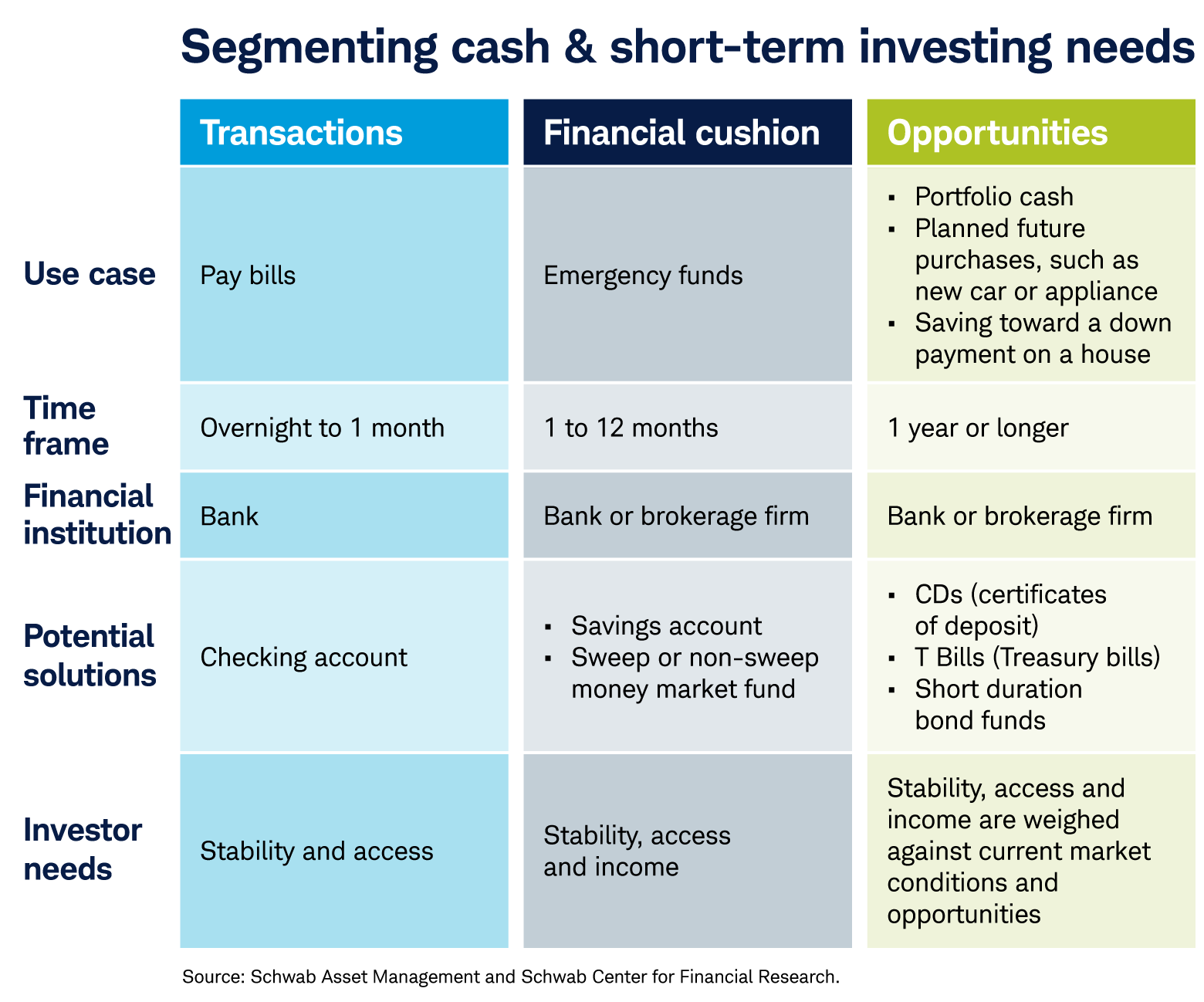
A simple, practical way to bring order to your cash is to sort it into three buckets: cash for everyday expenses and bill pay, a financial cushion for emergencies, and accessible funds for near-term opportunities. Let's walk through each one.
1. Transactional cash — for everyday expenses and bill pay
This is the cash you live on day to day—the money that covers your rent or mortgage, groceries, utilities, and all the ordinary expenses that keep your household running. A good guideline is to keep at least a month's worth of ordinary living expenses in an easily accessible checking account, and potentially more if your income arrives irregularly (think freelancers, commission earners, or seasonal workers). The goal here is convenience and peace of mind: you want your bill-pay cash where you can reach it quickly and without friction.
2. Financial cushion — your emergency fund
This is money you don't need for immediate bills or transactions, but it's there when life throws you a curveball—a sudden medical bill, a car repair, or an unexpected gap in income. For emergency funds, consider keeping at least three to six months of living expenses in a savings account or money market fund. A hallmark of financial wellness is having at least three months' worth of income in an emergency fund to weather layoffs, health events, or other financial shocks. You may need to keep more, depending on your personal circumstances. For example, if you're self-employed, work in a less stable field, or live in a higher-cost metro area, you may need up to a year's worth.
3. Accessible funds for near-term opportunities
This bucket holds money you've set aside for known, near-term expenses or purchases—an upcoming vacation, new appliance, wedding, or down payment on a house. It's cash with a plan. The key is to evaluate any upcoming potential purchases and save for them deliberately. So when the moment arrives, the money can be available—helping to keep your goals on track.
Strategies for raising cash and keeping it accessible
Once you know what each bucket is for, the next question is how to fill them. Here are some friendly, practical strategies for each.
For your transactional cash
- Review your budget and look for ways to trim: Take a fresh look at where your money goes each month. Small, repeatable cuts—canceling a subscription you no longer use, switching to a slightly cheaper phone plan—can quietly free up more cash over time.
- Avoid carrying a credit card balance: Try to avoid using high-interest credit cards and consumer loans when you can. If you do use a credit card, aim to pay it off in full every month so you never carry a balance. Alternatively, consider a debit card that may offer travel benefits or rewards points if those matter to you. The point isn't to avoid credit cards entirely—it's to make sure they work for you, not against you.
For your financial cushion
- Automate your savings: One of the easiest ways to build your emergency fund is to make it invisible. Contribute a small amount from each paycheck automatically, before you ever have a chance to spend it. Even a modest, consistent transfer can grow into a meaningful cushion over time—and you'll hardly notice it's happening.
For accessible funds and future opportunities
- Consider borrowing against assets: For short-term borrowing needs, you might consider borrowing against assets you already own, such as securities in a brokerage account or your home equity. This strategy is usually better for bridge loans—short-term liquidity needs that can be repaid quickly. It can be a handy tool, but it's one to use carefully and ideally with guidance, as borrowing against assets can put your collateral at risk if you're unable to repay the loan.
- Consider selling securities to raise cash: If you hold investments in a brokerage account, selling some can be a way to raise cash. Before selling highly appreciated assets, though, chat with your tax professional. They can also talk you through tax-loss harvesting—strategically selling some investments at a loss to offset gains—which can help manage your tax bill.
A word of caution: can you have too much cash?
It can be tempting to keep too much money in cash or short-term investments in your overall portfolio. When markets feel volatile or the economy seems uncertain, cash can feel like the safest place to hide. And it's true that cash has an important role—covering bills, supporting emergency spending, and offering reassurance when markets are unsettled.
But there's a catch. If your portfolio becomes overly conservative, you could experience what's known as shortfall risk—the risk of not meeting your long-term goals, such as planning for a 30-year retirement. Inflation reduces purchasing power and poses a long-term risk to wealth accumulation. The same dollar that buys a full grocery cart today may buy noticeably less a decade from now. In plain terms: holding too much cash and not enough of other assets that may offer long-term growth potential, such as stocks and stock funds, may inhibit your ability to reach future goals.
The takeaway isn't to avoid cash—it's to make sure each dollar of cash has a clear job, and that money meant for long-term growth isn't sitting idle when it could be working harder for you.
What's next
Knowing how to segment your cash is just the beginning. Next in this series, we'll explore where to invest your cash and how to manage it as your life evolves—so your money keeps pace with your goals at every stage.
Read next

Return to series home page: Putting Your Cash to Work
" role="dialog" aria-label="Next article: Cash Solutions for Investors
Return to series home page: Putting Your Cash to Work
" id="body_disclosure--media_disclosure--294456" >Next article: Cash Solutions for Investors
Return to series home page: Putting Your Cash to Work
About the author
