
Asset Management
Jevons Paradox and the Economics of Crypto Tokens

Key takeaways
- Jevons Paradox describes what can happen when a resource becomes cheaper or more efficient to use: total consumption of it tends to rise rather than fall.
- When it comes to cryptocurrencies, token value accrual depends on adoption outpacing dilution. Unlike artificial intelligence (AI), where value is typically captured through equity, blockchain value can accrue directly to token holders when network usage grows faster than token supply.
- Scalability might create a potential second source of value accrual. Networks that continue lowering transaction costs and reducing frictions may benefit from both increased adoption and continued movement down the Jevons Curve, while networks already operating at scale rely increasingly on usage growth. Jevons Curve is a curve plotting transaction costs against network usage, which shows Jevons Paradox at work: as costs fall, usage rises. However, lower costs may not produce sustained usage growth, and further scaling could require trade-offs among scalability, security, and decentralization.
- As an example, Ethereum may retain more room for future scaling than peers. Ethereum's ongoing scalability roadmap and efforts to reduce user friction could provide an additional source of value accrual beyond adoption growth alone, while Solana and BNB appear increasingly dependent on network adoption outpacing token inflation. However, Ethereum's scaling benefits may accrue primarily to layer-2 networks or applications rather than ether, while competing networks could capture incremental activity.
While tokens unlock utility in both artificial intelligence (AI) and blockchains, their investment economics differ. AI tokens generally function as units of compute (processing power) consumption and often require ongoing token issuance to support usage growth. Investors aim to capture the resulting value through equity as lower inference costs potentially increase usage and revenue. Crypto tokens, on the other hand, are investable assets themselves, so value accrual depends on whether increased network activity drives token demand faster than token supply grows.
Jevons Paradox is an economic theory that says when something becomes more efficient and scalable (like AI or blockchains, for example), people tend to use more of it, rather than less of it. This paradox provides a common framework for comparing the two technologies. In AI, improvements in compute efficiency can lower inference costs (the cost of running a trained AI model to generate outputs, often priced per token) and increase adoption. In blockchains, scalability improvements can lower transaction costs and increase network usage. These effects are also related to scaling laws, as continued improvements in efficiency can expand a system's capabilities and utility. However, as AI models and blockchain networks mature, the marginal contribution from additional scaling may diminish, and value creation may depend increasingly on adoption growth.
For the purposes of this analysis, blockchain usage is measured using a combination of total transactions, active addresses, total value locked (TVL), stablecoin supply, and decentralized exchange (DEX) trading volume. Viewing AI and blockchains through a tokenmaxxing (maximizing token usage) lens helps to identify where the economic benefits of scaling and adoption ultimately accrue. The Schwab Center for Financial Research refers to the observed relationship between transaction costs and network adoption as the so-called Jevons Curve (generally speaking, when you plot a resource's cost against its total consumption on a graph, you get a Jevons Curve). A blockchain's lifecycle begins at inception, when blockchain transactions are relatively expensive and network usage is low, before progressing further along the curve as transaction costs fall and usage rises. One important risk to acknowledge is that lower costs do not guarantee durable adoption or token appreciation, and scaling may shift value to other parts of the ecosystem rather than the underlying token. Additional risks are explained below.
AI tokens vs. crypto tokens
- AI Token
- Crypto Token
-
What it isAI TokenMetered unit of computeCrypto TokenMetered unit of blockspace (the limited capacity in each block for recording transactions)
-
Jevons triggerAI TokenInference cost fallsCrypto TokenTransaction cost falls
-
Jevons resultAI TokenUsage could potentially increaseCrypto TokenUsage could potentially increase
-
SupplyAI TokenUnlimited—tokens can be created as neededCrypto TokenConstrained—fixed supply or low inflation (slow issuance of new tokens)
-
Who captures valueAI TokenShareholders (equity)Crypto TokenToken holders, if usage grows faster than token supply
-
Investment is:AI TokenThe stockCrypto TokenThe token itself
-
Value mechanismAI TokenHigher usage can increase revenue, which can support equity value.Crypto TokenHigher usage can increase demand for a token with limited supply, which can support token value.
This analysis focuses on Ethereum, Solana, BNB Chain, and Avalanche because they are among the most widely known smart contract layer-1 networks and launched at different points along the Jevons Curve, from relatively high to relatively low transaction costs.
To address scaling limitations, Ethereum introduced upgrades that reduced transaction costs on the main network, while layer-2 ecosystems were developed to improve throughput (the number of transactions a network can process over a given period) and efficiency. Layer-2 networks are separate blockchains built on top of a layer-1 (main) blockchain such as Ethereum; they process transactions away from the main chain at lower costs and periodically settle the results back to it.
Competing blockchains designed to address these challenges were able to launch further along the Jevons Curve, with lower transaction costs and greater scalability from the start. As a result, networks that still have room to move further along the curve may possess an additional source of value accrual beyond adoption growth alone.
Comparing Ethereum, Solana, BNB Chain, and Avalanche along the Jevons Curve
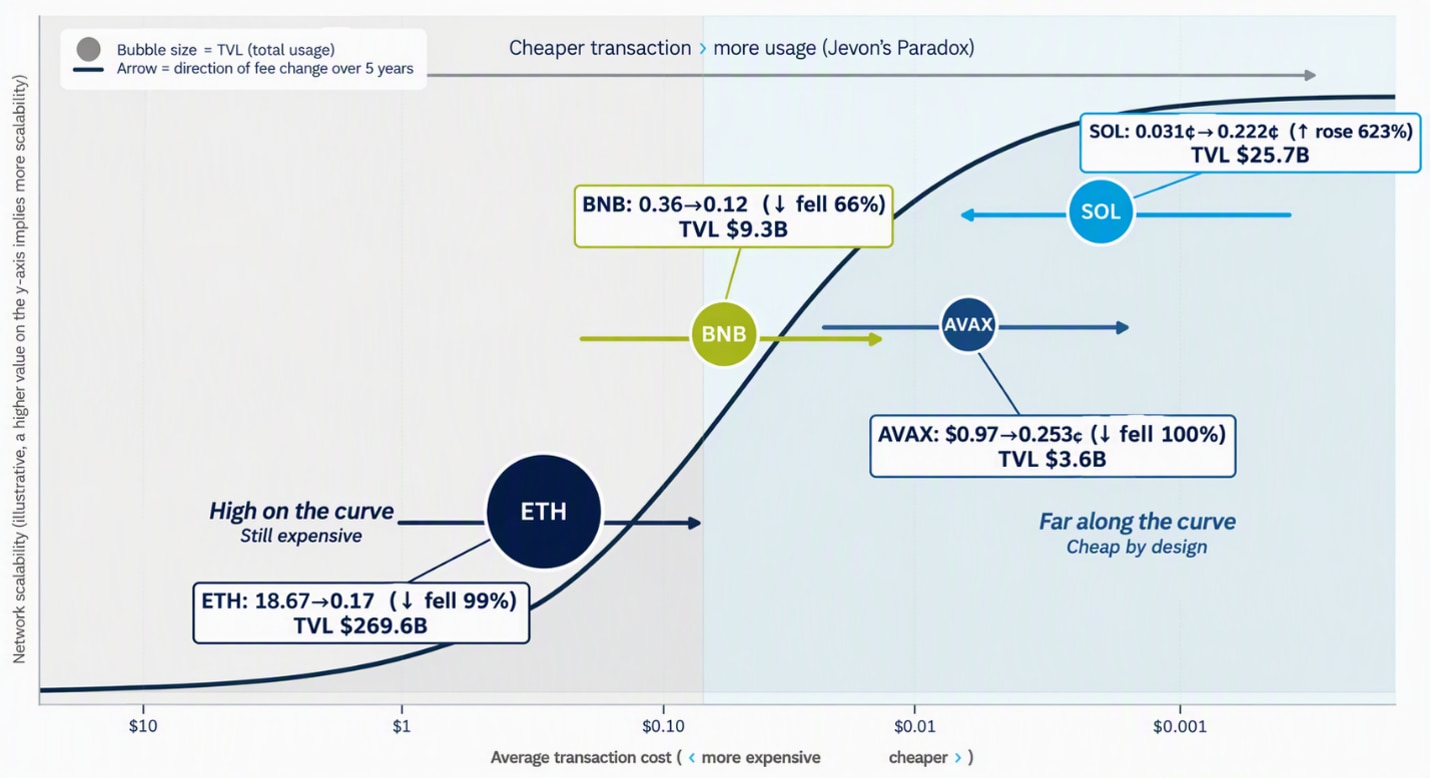
Source: Schwab Center for Financial Research, as of 9/30/2026.
Blockchain networks represented here include Ethereum (ETH), BNB Chain (BNB), Avalanche (AVAX), and Solana (SOL). Average transaction represents the average transaction cost as of 9/30/2026. The change in costs is calculated by dividing the transaction cost as of 9/30/2026 by the transaction cost from the same period five years ago.
Bubble positions spread for legibility. Only horizontal (average transaction fee) axis is quantitative. This is a relative-value framework, not a price forecast. Y-axis is illustrative. A higher position on the y-axis implies more scalability.
Total Value Locked (TVL) is the total value of cryptocurrency assets deposited in a decentralized finance protocol's smart contract, serving as a key indicator of liquidity, user trust, and platform activity.
For illustrative purposes only and is not a recommendation, offer to sell, or a solicitation of an offer to buy any investment. It is not intended to be, nor should it be construed as, a recommendation to buy, sell, or continue to hold any investment. This illustration should not be used as a basis for any investment decision.While Ethereum established an early lead among developers and users, much of the incremental network value accrual has been captured by layer-2 ecosystems. Solana is unique in that its average transaction cost has risen over the past five years, according to data from Glassnode as of Sept. 30, 2026. Because Solana's base fee is fixed, this increase reflects higher priority fees, which users can choose to pay to have their transactions processed faster, often during periods of heavy trading activity. This doesn't mean Solana has run out of room to improve scalability. Rather, rising fees despite ongoing scalability initiatives could suggest that network demand is growing at least as quickly as available capacity. Similar to scaling laws in AI, incremental efficiency improvements may continue to create value, but the marginal benefit increasingly shifts toward adoption growth rather than scalability gains alone.
From an investment perspective, Ethereum may occupy a differentiated position as a mature network that could still benefit from additional scaling. While layer-2 ecosystems have contributed to network growth, they've also captured a portion of the network economics. If Ethereum continues to move further along the Jevons Curve through ongoing layer-1 scaling improvements, potentially resulting in greater activity across the Ethereum ecosystem, more value could accrue to ether.
Solana and BNB may have less room to benefit from lower transaction costs, but further network improvements can reduce other frictions, such as finality times. Ultimately, these improvements still need to translate into sustained usage growth that outpaces token issuance. This is reinforced by the recent approval of SGP-0002, a Solana governance proposal approved by validators in August 2026 that doubles the network's annual disinflation rate (the pace at which new token issuance declines) from 15% to 30%.
Although Solana's average transaction costs have risen over time, the network continues to pursue scalability improvements through initiatives such as Firedancer (a second, independent validator client for Solana; a validator client is the software validators run to process transactions and produce blocks), localized fee markets, state compression, and lower-latency network upgrades. This might suggest that even networks already positioned further along the Jevons Curve may retain some additional scaling runway, although future value accrual is likely to depend increasingly on adoption growth rather than scalability gains alone.
While BNB's network fees have fallen over the most recent five years, according to data from Glassnode as of September 30, 2026, they have risen over shorter horizons as PancakeSwap (a decentralized exchange on BNB Chain) became the primary driver of network activity. Because PancakeSwap transactions consume more gas (the unit that measures the computational work required to execute a transaction) than simple transfers, fee pressure has increased despite the network remaining inexpensive relative to other layer-1 blockchains.
The chart below places each network along two dimensions. The horizontal axis reflects our qualitative assessment of demand durability, or how likely usage is to persist even as fees rise, based on factors such as security, track record, developer and application ecosystem, and composability (the ability of applications to work with one another). The vertical axis reflects a network's potential for cost-driven growth, meaning how much additional adoption could come from lowering transaction costs further. Network placements are subjective and illustrative, not precise measurements.
Networks descending the Jevons Curve may benefit from an additional source of value accrual, although lower costs do not necessarily translate into sustained adoption or greater token value
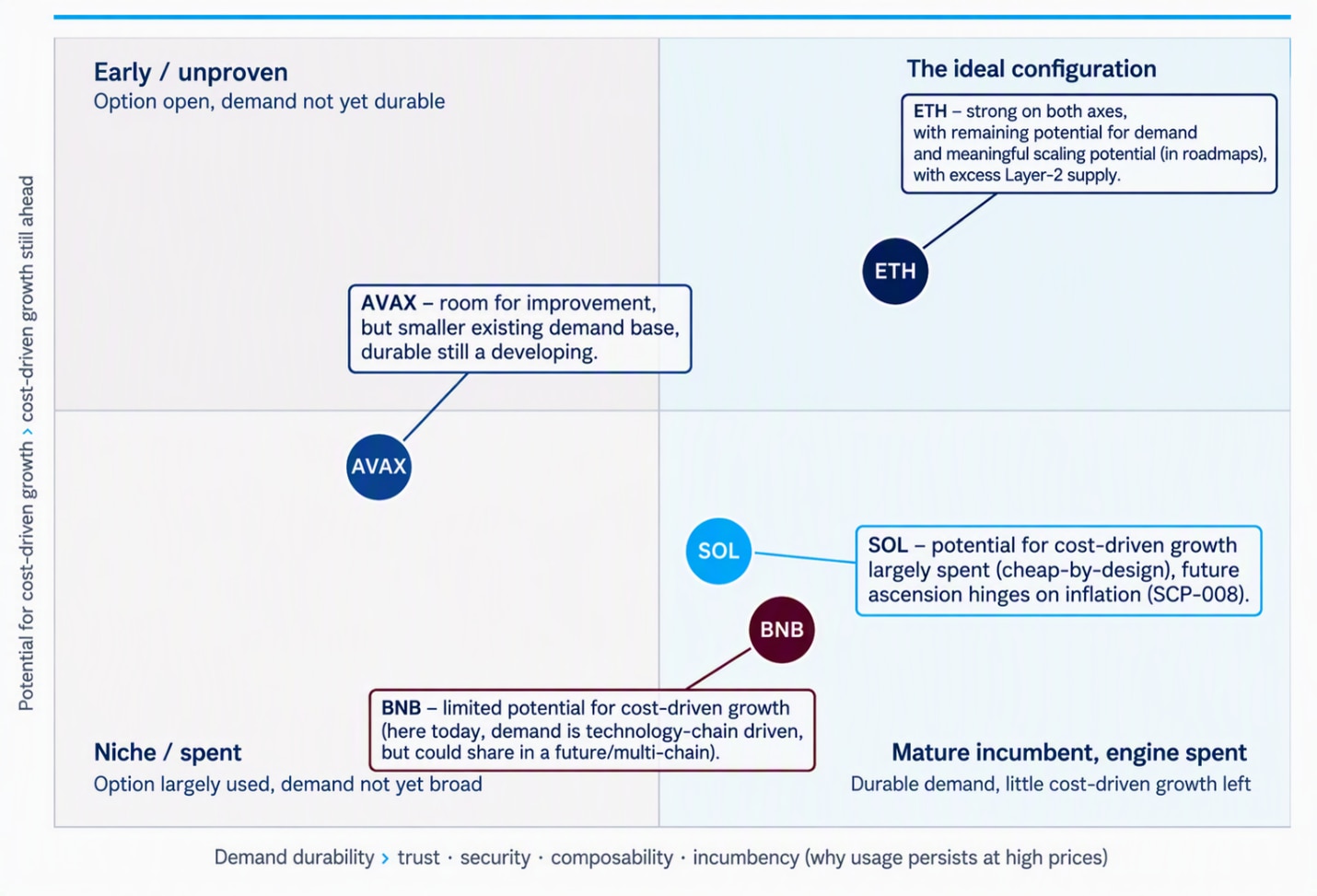
Source: Schwab Center for Financial Research, as of 10/7/2026.
Blockchain networks represented here include Ethereum (ETH), BNB Chain (BNB), Avalanche (AVAX), and Solana (SOL).
Matrix definitions: The horizontal axis is a qualitative assessment of demand durability, with greater durability to the right. The vertical axis is a qualitative assessment of potential cost-driven growth, with greater potential higher on the chart. The four configurations are early/unproven, the ideal configuration, niche/spent, and mature incumbent/engine spent. The ideal configuration describes the combination of comparatively durable demand and meaningful remaining potential for cost-driven growth. Placements and callout statistics are illustrative assessments based on the factors described in the text, not quantitative scores, price targets, or recommendations.
Risks: A network placed higher or farther right may not realize the expected benefit. Usage may fail to grow, demand may shift to competing networks, scaling may compromise security or decentralization, or economic value may accrue to applications and infrastructure rather than the underlying token.
For illustrative purposes only and is not a recommendation, offer to sell, or a solicitation of an offer to buy any investment. It is not intended to be, nor should it be construed as, a recommendation to buy, sell, or continue to hold any investment. This illustration should not be used as a basis for any investment decision.In our view, Ethereum combines durable demand with meaningful remaining potential for cost-driven growth. Solana and BNB Chain appear to have more established usage, but less room to grow by lowering costs further, while Avalanche has potential for cost-driven growth, but has yet to establish the same level of demand.
While transaction costs are one thing, barriers to usage can add additional cost. One friction to using blockchains is having to establish a wallet and hold native tokens to interact with network ecosystems. Some applications now provide custody on behalf of users, eliminating the need for direct wallet management. Vitalik Buterin, co-founder of Ethereum, has discussed payment abstraction, whereby users could pay transaction fees in assets other than ether, which are automatically converted behind the scenes as needed. This could reduce friction associated with blockchain usage by allowing users to transact without first acquiring or holding ether directly.
From an economic perspective, however, payment abstraction doesn't eliminate the need for ether. Transactions would still ultimately require ether to compensate the network for execution, meaning activity generated through payment abstraction may still contribute to demand for ether, even if end users never hold the asset themselves. Lowering frictions could therefore expand the addressable user base while preserving ether's role within the network's economic model.
Risks to this thesis
While Jevons Curve provides a framework for evaluating how scalability and adoption may influence token value accrual, several risks could challenge this thesis:
- Adoption may not follow improved scalability. Lower transaction costs and greater network efficiency do not guarantee increased usage, particularly if competing blockchains, traditional financial systems, or alternative technologies capture future growth.
- Value may accrue elsewhere in the ecosystem. Network activity does not necessarily translate directly into token value. For example, Ethereum's layer-2 ecosystem has captured a portion of the economic benefits associated with network growth, and future value creation could similarly accrue to applications, infrastructure providers, or other ecosystem participants rather than the underlying token.
- The blockchain trilemma may constrain future scaling. The blockchain trilemma refers to the challenge of achieving scalability, security, and decentralization at the same time, since improving one often comes at the expense of another. As networks mature, further reductions in transaction costs may become more difficult to achieve without sacrificing decentralization, security, or both. This could limit the extent to which networks continue moving down the Jevons Curve.
- Token supply dynamics remain important. Even if network adoption grows, token value accrual ultimately depends on demand growing faster than token supply. If usage growth fails to outpace issuance, dilution could offset the benefits of increased network activity.
Tying it all together
To summarize, layer-1 smart contract token value is primarily driven by usage growth outpacing token inflation. Networks that continue to scale retain what we call an embedded "Jevons Call Option," or the potential for additional adoption, and value accrual, if transaction costs continue to fall. Ultimately, continued descent along the Jevons Curve is not guaranteed indefinitely, as Solana's and BNB Chain's rising average fees illustrate. Eventually, a blockchain must confront the blockchain trilemma, where further scaling must be balanced against maintaining decentralization and security.
About the author
 Jim FerraioliDirector of Digital Currencies Research and Strategy