
Asset Management
Building More Intentional Bond ETF Allocations

Why active bond ETFs now
Interest rates are on the move again. In September, the Federal Reserve raised the Fed funds target rate for the first time in over three years, which might represent the start of a new rate-hiking cycle. But every cycle is different in speed and duration, and history shows that a hiking cycle doesn’t necessarily mean uniformly higher yields across the maturity curve. The variety of potential outcomes heightens considerations in timing and yield curve positioning for fixed income allocations now. And while today’s yield environment is more attractive than it was for much of the past decade, tighter than average credit spreads, shifting interest rate expectations under a new Fed chairman, and uneven liquidity in global bond markets have raised the bar for how advisors need to consider implementing fixed income across clients’ portfolios.
As a result, advisors may need tools that support income objectives through active interest rate positioning, credit selection, and liquidity management to account for today's shifting market dynamics. Vehicle choice and associated liquidity and management fees can further shape the client experience. Fortunately, active fixed income ETFs are engineered to help bring these decisions together by pairing professional management with transparency, liquidity, trading flexibility, and in many cases, comparatively lower fees, that are hallmark advantages inherent to ETFs.
Key takeaways for client portfolios
- Portfolio role should drive selection. Active fixed income ETFs may help provide shorter-duration allocations, credit exposures, liquidity sleeves, or other exposures not as prevalent in typical core bond products.
- Active bond ETFs can potentially help advisors translate market views into portfolio action. Duration, sector allocation, credit quality, liquidity, and security selection can all influence outcomes when conditions shift.
- Build a repeatable framework. Map current bond exposures, identify where a manager has added value through active ETFs’ flexibility, and keep an eye to implementation costs, fees, and tax-impacts.
Finding the right portfolio fit for active bond ETFs
Investors who have considered or had exposure to a product benchmarked to the Bloomberg US Aggregate Bond Index (the Agg) likely know that today it generally represents a long duration, very high-quality part of the broad U.S. bond market. But how has this changed over the years?
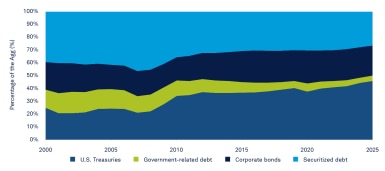
In Exhibit 1, we've tracked the major sector mix of the Agg over the past 25 years. As the exhibit illustrates, it has migrated to a very high quality, Treasuries-dominated allocation over the years, with this weight in the index climbing from approximately 21% at the end of 2002 to 46% at the end of 2025. At the same time, embedded interest rate risk has increased, with duration climbing from 3.8 years to 6.0 years.1
Exhibit 1: The Agg has become increasingly weighted toward Treasuries
Sources: Charles Schwab Asset Management®, Bloomberg. Data as of 09/30/26. Indexes are unmanaged, do not incur management fees, costs, and expenses and cannot be invested in directly. For more information on indexes, please see schwab.com/indexdefinitions. Past performance is no guarantee of future results.
So as a first cut, how might advisors guide clients to position fixed income allocations beyond what’s available in an index product benchmarked against the Agg?
- For clients concerned about volatility sourced from the duration exposure of most core bond indexed products, active short- or intermediate-duration ETFs may help manage interest-rate sensitivity while still pursuing income. These strategies can be useful for clients with conservative risk profiles, upcoming cash needs, or discomfort with volatility typically associated with interest rate duration.
- For clients seeking diversity of income, active credit-oriented ETFs constructed primarily from higher yielding sectors like investment-grade and high yield corporate bonds, taxable municipal bonds, or non-agency securitized credit may fit the bill. But manager research and risk controls are especially important here: the goal should be to evaluate whether incremental income is appropriate given the client’s risk tolerance and the compensation available for credit and liquidity risk.
- For clients looking to diversify their return drivers, exposure to global bonds of issuers outside of the U.S. may help broaden sector and macroeconomic exposure. Varying yield environments driven by asynchronous monetary policies of individual central banks around the world can complement a client’s domestic bond portfolio relegated to domestic macro drivers and starting bond yields.
Navigating credit, concentration, and non-core bonds
Broad market fixed income indexes can be useful anchoring points in constructing a fixed income portfolio, but they don’t offer the flexibility of an otherwise complementary solution—that is, active choices around overall duration exposure and curve positioning, sector weighting, issuer quality, security structure, and liquidity. And looking at sectors away from Treasuries should be part of the conversation, given the trends demonstrated in Exhibit 1. Here are a few select strategies to potentially explore:
1. Consider focusing on the subset of a broad benchmark
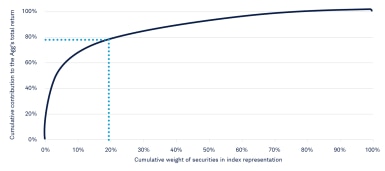
Duration is one implementation lever of active management—but it's not the entire story. Credit selection (at both the sector and security level) is another example. The starting point for many investors’ bond allocation starts with a product typically benchmarked to a broad index like the Agg, which includes more than 14,000 individual fixed income securities. In Exhibit 2, we map the cumulative aggregate 2025 total return of the members of this index, starting with the biggest contributor to overall return and adding securities with decreasing contributions from there.
What falls out perhaps not so coincidentally might sound like a familiar rule of thumb— approximately 80% of the overall return of the index was driven by just 20% of its securities. As a result, one lever for a skilled active manager is to focus on a smaller subset of a broad benchmark or investible universe where they believe their edge from credit work may afford a bigger payoff in an attempt to deliver repeatable and consistent alpha—an investment strategy's risk-adjusted outperformance of a given benchmark.
Exhibit 2: Just 20% of securities drove nearly 80% of the Agg’s Return in 2025
Sources: Charles Schwab Asset Management® ; Bloomberg, data as of 09/30/26. Methodology consists of ranking contribution of each security’s return to the Bloomberg US Aggregate Bond Index for 2025 from highest to lowest and then summing up total contribution to return with each additional security. Indexes are unmanaged, do not incur management fees, costs, and expenses and cannot be invested in directly. For more information on indexes, please see schwab.com/indexdefinitions. Past performance is no guarantee of future results.
2. Manage exposure to the biggest debtors
In the equity market, many investors have been focused on the concentration risk that has come from the outperformance of a particular sector or handful of companies over the last several years. The Magnificent 7, hyperscalers, and AI-related infrastructure companies come to mind. But there is a similar type of risk in the fixed income market. Simply put, most broad bond market indices hold issuers weighted by the par value of their debt outstanding. The largest debtors therefore end up as the largest exposures in these indices. But therein lies a potential risk as highly indebted issuers may present outsized credit risk to an indexed portfolio if regulatory, company-specific, or macro-related challenges dent the issuer’s credit worthiness. A skilled active manager can choose to limit such exposure by creating an "underweight" versus the benchmark based on their credit assessment.
3. Seek opportunities outside traditional "core bond" sectors
Traditional core bond sectors include Treasuries, government agency, quasi-sovereign, agency-backed securitized, and investment-grade corporate bonds. But opportunities also 0% 20% 40% 60% 80% 100% 0% 10% 20% 30% 40% 50% 60% 70% 80% 90% 100% Cumulative contribution to the Agg's total return Cumulative weight of securities in index representation exist in non-agency securitized credit, high-yield bonds, preferred securities, and taxable municipal bonds, potentially offering unique combinations of starting yield, volatility, liquidity, and upside/downside payoffs. This second cohort can serve as yet another lever of active decisions as ‘off benchmark’ but otherwise potentially high credit quality drivers of potential portfolio alpha when mapped to the Agg, as an example. When spreads—the yield difference between two bonds, typically Treasuries versus another similar-maturity security—are tight, active managers may emphasize core, higher-quality issuers, reduce exposure to deteriorating credits, manage sector concentrations, or maintain more liquid holdings. If spreads widen, they may look to selectively add exposure through offbenchmark sectors where compensation appears attractive or where short-term market technicals or seasonal effects have uncovered an attractive risk- or liquidity-adjusted opportunity.
The point is not that active managers will always make the right calls in all these areas. Rather, active fixed income ETFs may allow supplementing existing allocations with active views on a smaller subset of index-eligible bonds, potentially limit exposure to highly indebted companies and consider securities not typically found in a broad market index fund.
4. Build a repeatable framework
A repeatable implementation process can potentially help advisors connect market conditions to client-specific decisions. The following framework might support portfolio reviews across models, households, and taxable accounts:
- Segment clients by objective and account type. Identify investors who may require taxable income, tax-exempt income, lower duration, greater liquidity, transition support, or more flexible credit exposure.
- Map current bond exposures. Review the role of each fixed income sleeve, including duration, credit quality, sector exposure, liquidity, benchmark concentration, and tax characteristics.
- Identify where active ETF flexibility might add value. Evaluate whether manager discretion, ETF tradability, or portfolio transparency could potentially improve execution for the intended role.
- Review implementation costs, management fees and tax impacts. Consider bid ask spreads, turnover, account location, capital gains, and transition costs. The decline in the average expense ratio of an active core bond mutual fund of 84 basis points in 2016 to just 31 basis points for the average core bond ETF today is an undeniable win for investors.2
Positioning active bond ETFs with purpose
The opportunity in fixed income today is less about making a single interest rate call, what the next Fed move may be, and when it might happen. Instead, consider focusing on building fixed income exposures that can be evaluated, adjusted, and explained as client needs and market conditions evolve. For advisors, active fixed income ETFs may offer one practical way to pair professional management with ETF access, transparency, and trading efficiency while supporting tax-aware decisions and alignment with client objectives.
About the author