
Asset Management
How Do Rising Rates Impact Global Equities?

Key takeaways
- Higher interest rates do not automatically mean lower stock prices. The reasons rates are rising, the speed of the move, and the strength of earnings matter more. Inflation, energy shocks, fiscal concerns, and sudden increases in yields pose greater risks than a gradual rise tied to stronger growth.
- Higher rates could impact market leadership. Companies with strong balance sheets, pricing power, and stronger cash flow growth have historically tended to perform better. Financials and selected energy, materials, and industrial companies may benefit, while heavily indebted and rate-sensitive businesses may face pressure.
- Cyclical sectors and high-growth stocks have tended to be less sensitive to rising interest rates, although expensive valuations might be vulnerable should higher discount rates reduce the value of future profits. But that doesn't guarantee weaker returns. Earnings growth can offset price impacts from falling valuation multiples, particularly when demand and profit growth remain strong.
- We believe the recent rise in interest rates has generally been for constructive reasons tied to economic growth and suggest investors remain invested in line with strategic asset allocations, but consider diversification across regions, sectors, and investment styles.
Interest rates on government bonds, corporate debt, mortgages, auto loans, and credit cards have risen across the global economy. Several forces are at work behind the rise: energy and supply shocks, tighter monetary policy, larger government borrowing needs, and strong demand for capital to fund the artificial intelligence (AI) buildout.
Rates are rising across many major economies
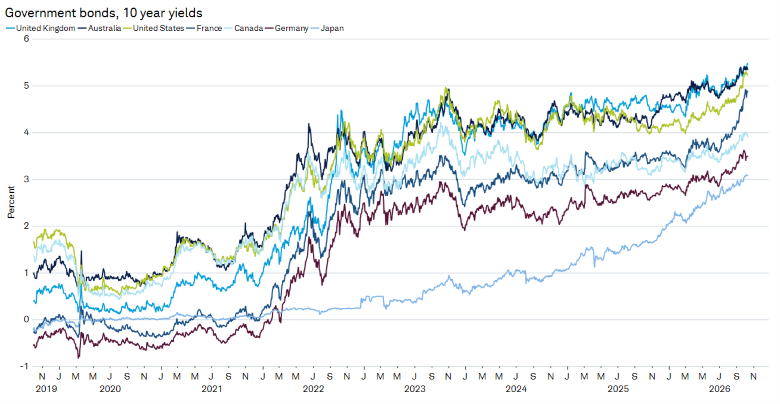
Source: Schwab Center for Financial Research, Macrobond, and the Federal Reserve, as of 10/7/2026.
Past performance is no guarantee of future results.
Are rising rates bad for stocks?
Not necessarily—but the reasons rates are rising matters. Higher rates can slow growth, reduce the valuation multiples investors are willing to pay, and make high-quality government and corporate bonds more competitive with stocks. Historically, stock and bond total returns have been negatively correlated when the yield on the 10-year U.S. Treasury bond is low, and positively correlated when the yield is higher, as seen in the chart below.
The higher the yield, the more likely stock returns fall with bond prices
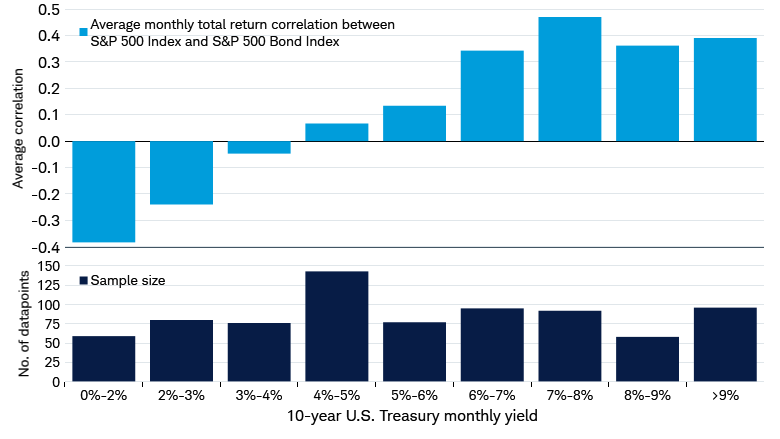
Source: Schwab Center for Financial Research, Macrobond, U.S. Treasury, and S&P (Shiller) data, as of 10/7/2026.
Correlation is a statistical measure of how two investments have historically moved in relation to each other, and ranges from -1 to +1. A correlation of +1 indicates a perfect positive correlation, while a correlation of -1 indicates a perfect negative correlation. A correlation of zero means the assets are not correlated. Past performance is no guarantee of future results.
As the 10-year yield continues to rise above 5%, there's more potential for negative stock returns, but the outcome for equities depends on why yields are rising, how quickly they move, and whether earnings can absorb the higher cost of capital. For investors, this is a reason to consider the investment environment and review portfolio composition rather than assume all periods of interest rate increases calls for a broad retreat from stocks.
Equity investors should consider the following factors to help separate rate increases tied to stronger growth from those tied to inflation, fiscal stress, or a sudden tightening in financial conditions.
- Constructive rate increases. Yields can rise when demand is healthy, productivity is improving, or capital spending is expanding. Earnings expectations may rise at the same time, offsetting some or all of the pressure on valuations. In that setting, stock prices and bond yields can rise together.
- Problematic rate increases. Yields can also rise because inflation expectations are worsening, energy prices are jumping, fiscal concerns are increasing, or investors are demanding more compensation to own long-term bonds. These forces can weaken growth and profit margins while pushing valuations lower. Stock and bond prices are more likely to fall together in this environment.
- The speed of the move matters. A rapid increase in yields gives companies and investors less time to adjust financing, spending, and portfolio decisions. Gradual increases are usually easier for markets to absorb.
We believe the recent rise in interest rates has generally been for constructive reasons tied to economic growth and while energy prices are higher, there are few signs of broadening inflation pressures and little market volatility.
Considerations when evaluating how rising rates may affect equities
- Signpost
- Constructive signal
- Risk signal
-
SignpostEconomic growthConstructive signalResilient demand, productive capital spendingRisk signalRising recession risk; stagflation; reduction in spending
-
SignpostInflationConstructive signalModerating toward developed market central banks' 2% targetsRisk signalPersistent tariff, wage, or energy price increases
-
SignpostRatesConstructive signalGradual, growth-linked increaseRisk signalYields rise quickly on debt concerns or a supply shock
-
SignpostEarningsConstructive signalPositive revisions and broadening profitsRisk signalMargin compression due to higher input prices
-
SignpostMarket structureConstructive signalBroader sector, company, and market cap size participationRisk signalNarrow equity leadership and weakening breadth of companies participating in market gains
-
SignpostBond-equity correlationConstructive signalNegative correlation: Bonds act as diversifier to equity sell-offsRisk signalPositive correlation: Stock and bond prices sell off together
The relationship between stocks and bonds
The global economy appears to be in a more temperamental period, with greater geopolitical instability. This raises the risk of larger swings in inflation and interest rates. When yields rise because inflation is becoming less predictable, the pressure on equities is usually greater and the diversification provided by bonds may weaken as the correlation between the two rises.
In addition, higher interest rates represent a higher cost of capital; companies must pay a higher cost of borrowing. Higher interest rates also reduce the present value of future cash flows, meaning that company valuations can decrease. A discounted cash flow (DCF) model is one approach to equity valuation. This approach models out expected future cash flows and then applies an interest rate—or discount rate—to estimate the current value of those future cash flows today. A higher discount rate reduces the net present value (NPV) of a firm. In our theoretical example below, we show how higher discount rates shrink the present value.
A higher interest rate reduces the present value of future cash flows
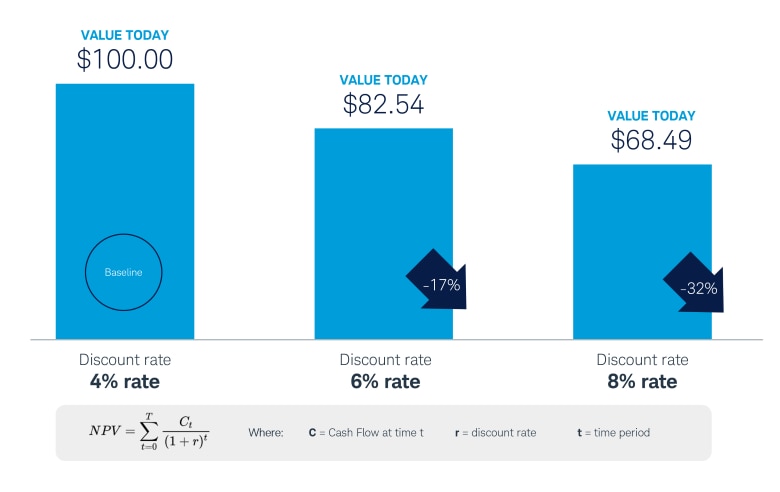
Source: Schwab Center for Financial Research, as of 10/7/2026.
This hypothetical example is only for illustrative purposes.
Earnings can matter more than rates for stock performance
Higher rates can reduce the valuation investors place on a company, but they're only one part of the return equation. Revenue growth, profit margins, and cash flow also matter. Stocks can still produce positive returns when earnings growth is strong enough to offset a lower valuation multiple. That distinction is especially important for companies tied to the AI infrastructure buildout, where current strong earnings growth may provide support amidst rate pressure. However, if the earnings outlook falters amidst rising rates, returns could be weak.
What regions might do better when rates are rising?
- Region
- Schwab Center for Financial Research View
- Rationale
-
RegionUnited StatesSchwab Center for Financial Research ViewConstructive / PreferredRationaleResilient earnings, AI and capital-spending tailwinds, and stronger economic growth relative to other regions. Balance opportunity against elevated valuations and AI capital expenditures (capex) concentration risk.
-
RegionEuropeSchwab Center for Financial Research ViewSelectiveRationalePotential opportunities in industrials, banks, and energy-security investments, but broader growth and energy sensitivity might be headwinds. Banks in France and the U.K. could experience tighter financial conditions if fiscal concerns weigh on government bonds.
-
RegionJapanSchwab Center for Financial Research ViewConstructiveRationaleShareholder-friendly governance reform and economic shift from an era of falling prices to a low rate of inflation. Banks could benefit if monetary policy normalization occurs at a moderate pace, but fast rate increases could be a risk. Industrials and technology companies have opportunities and concentration risks related to the global AI buildout.
-
RegionEmerging markets (EM)Schwab Center for Financial Research ViewSelectiveRationaleAI-linked markets, such as Taiwan and South Korea, may benefit, while country-level growth, policy, and commodity exposure could create wide dispersion. In aggregate, the MSCI Emerging Markets Index has a large concentration on AI capex-related earnings, which is a risk if concerns about AI capex grow.
Which sectors or factors tend to do best in a rising rate environment?
Rising rates may affect different sectors or factors in dissimilar ways.
Potential relative beneficiaries:
- Banks may earn more from some lending activities, although the benefit depends on funding costs, credit quality, and the shape of the yield curve.
- Energy and materials companies may benefit when commodity prices or supply constraints are contributing to higher inflation and interest rates but could suffer if underlying commodity prices don’t keep up with inflation.
- Industrials may benefit from infrastructure, manufacturing, and data center investment.
- Companies with durable earnings, strong cash flow, healthy balance sheets, limited refinancing needs, and pricing power may be better insulated from higher borrowing costs.
Potential relative laggards:
- Heavily indebted companies and businesses with near-term refinancing needs could face higher interest expense and tighter access to capital.
- Small capitalization companies with thin margins or greater dependence on debt markets may be more exposed to tighter financial conditions.
- Real estate and utilities tend to be vulnerable because they are capital-intensive and often compete with bonds for income-oriented investors.
- Long-duration growth stocks (those where expected profit growth is further into the future) may face valuation pressure as their earnings are discounted to the present day at a higher interest rate. Strong earnings growth can still offset that pressure, as it has for some companies enabling the AI infrastructure buildout.
Investor takeaway
The Federal Reserve raised its policy rate for the first time this cycle in September 2026. Initial rate increases can create short-term turbulence, but the path that follows depends on growth, inflation, and recession risk. The experience of 2022 is a reminder that outcomes can differ sharply when inflation remains high and financial conditions tighten quickly.
The policy rate is only part of the story. Borrowing costs have risen across economies and markets, and the reason for those increases matter. We believe the rise in interest rates has generally been for constructive reasons tied to economic growth, but we're watching whether the rise in bond yields eases or keeps going, and for any signs of increasing credit stress.
Higher rates are most threatening when they rise quickly, reflect worsening inflation or fiscal concerns, and coincide with weaker growth. Stocks can still perform well when yields rise alongside resilient demand and solid earnings. In that environment, portfolio leadership is likely to favor companies with strong balance sheets and cash flow, along with selective exposure to cyclical sectors.
We continue to suggest investors remain invested in line with strategic asset allocations as strong economic growth and earnings outweigh inflation and interest rates, but diversification across regions, sectors, and investment styles can help reduce the risk of relying on a single outcome.
Heather O'Leary, Senior Manager, Equity Research and Strategy, contributed to this report.
About the authors
 Chris FerraroneHead of Equity Research and Strategy
 Michelle GibleyDirector of International Equity Research and Strategy