
Investing Amid Geopolitical Fragmentation

Key takeaways
- The secular theme of Geopolitical Fragmentation has roots in the shift to a multipolar world order where governments and companies are placing more weight on security, resilience, and political alignment when making trade and investment decisions.
- In our view, globalization is being reorganized, not reversed, and could make growth, inflation, and corporate earnings more volatile. Duplicated capacity, larger inventories, and higher-cost supply chains may improve resilience but reduce efficiency.
- Fragmentation does not call for major changes to strategic portfolios. Rather, it may strengthen the case for diversification and more active positioning across countries, sectors, and companies as investment opportunities shift.
From globalization to fragmentation
Geopolitical fragmentation is redirecting trade, investment, technology, and supply chains toward national security and strategic resilience. Globalization is not ending, but its structure is changing. Some cross-border ties may weaken while others could deepen within regions or among politically aligned power blocs.
For much of the period between the end of the Cold War and the Global Financial Crisis (GFC), the United States sat at the center of a largely unipolar geopolitical system, where no other country or regional bloc commanded comparable military, economic, or political power. During this time, international institutions helped establish common rules, China's 2001 entry into the World Trade Organization accelerated globalization, and supply chains expanded rapidly.
That model began to change after the GFC. The COVID-19 pandemic, Russia's invasion of Ukraine, conflict in the Middle East, and intensifying competition between the United States and China exposed the risks of relying on a limited number of suppliers, transport routes, technologies, and energy sources. Governments and companies responded by placing greater value on national interests, strategic reserves, and domestic capacity, ushering in an era of greater strategic competition.
Globalization has plateaued since the Global Financial Crisis
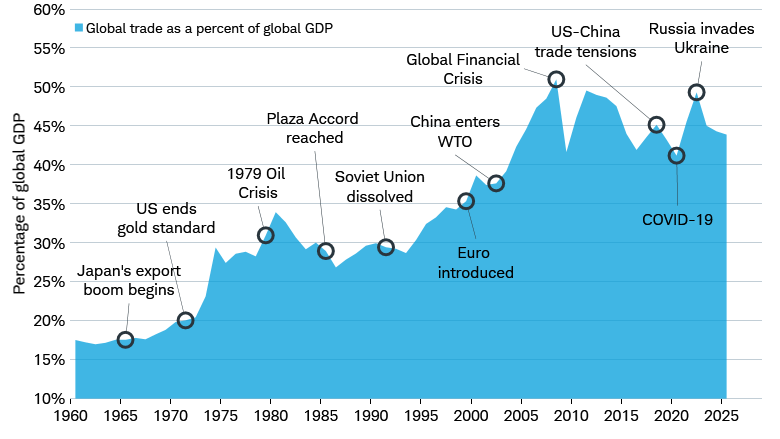
Source: Schwab Center for Financial Research, World Bank, and Macrobond.
Annual global GDP data from 1960 through 2025, as of 9/18/2026. For illustrative purposes only.
Why has the world become more multipolar?
Economic and strategic influence has broadened beyond the United States. China has developed from an export manufacturing hub into a strategic competitor in technology, artificial intelligence (AI), industrial manufacturing, clean energy, critical minerals, and defense. India and Southeast Asia account for a growing share of manufacturing, trade, and technology activity, while Middle Eastern countries, Brazil, and Mexico have gained influence through their commodity resources.
The role of multilateral institutions is also changing. Within NATO, according to the Associated Press, public debates over burden-sharing between country leaders have contributed to higher defense-spending commitments across several major economies as governments respond to a more contested security environment.
Today's alignments are unlikely to resemble the two-sided structure of the Cold War. Many countries may trade with both the United States and China while pursuing their own economic and security priorities. The result is a more complex system in which geopolitical considerations may have a greater influence on long-term investment risks and opportunities.
From a unipolar system to regional power blocs
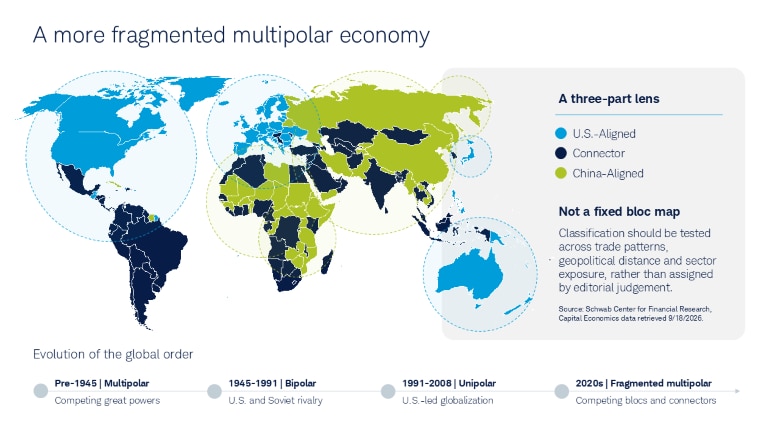
Source: Schwab Center for Financial Research, Capital Economics, and the U.S. Federal Reserve, as of 9/18/2026.
Connectors are countries that are geopolitically and/or economically unaligned with a single bloc. A multipolar global economy is when several major powers possess enough strength that no single state can dominate the system. A bipolar global economy is when two economic and political powers dominate the system. A unipolar global economy is where one state possesses overwhelming military, economic, technological, financial, and political power relative to all other countries. A fragmented multipolar global economy is when several major powers possess enough strength that no single state can dominate the system, but includes significant barriers and restrictions to cooperation between the various powers.
For illustrative purposes only.
Transitions between geopolitical systems can be unstable because established and rising powers compete over security, technology, resources, and influence, according to historians and geopolitical experts. Recent increases in armed conflict and defense spending are consistent with that broad risk, although they do not prove that multipolarity is the sole cause.
Defense spending has risen across several major countries
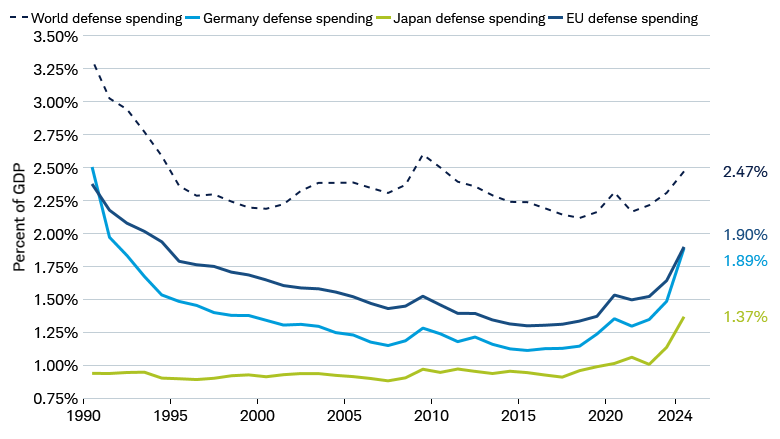
Source: Schwab Center for Financial Research and the World Bank.
Annual data from 1990-2024, as of 9/22/2026. For illustrative purposes only.
Economic growth may become more uneven
The global economy can continue to grow in a more fragmented system, but regional business cycles may become less synchronized. Globalization helped connect production, trade, and demand during the 1990s and 2000s leading to a more synchronized global business cycle. Since the GFC, slower trade integration, more domestically focused policies, and greater trade tension have contributed to wider regional differences.
Supply chains are also shifting through reshoring, nearshoring, and friend-shoring. These strategies move production closer to home, to nearby markets, or to trusted trading partners. They may improve resilience, but they also raise costs. Duplicated manufacturing capacity, larger inventories, new transport routes, higher-cost labor, and higher-tax jurisdictions can weigh on profitability.
Technology may offset part of that burden. AI, robotics, 3D printing, and automation can help companies redesign production processes and reduce some relocation costs.
Globalization is unlikely to reverse. Trade relationships are deeply established and remain economically productive, especially within regions and among aligned countries. We expect trade and investment to be rerouted rather than sharply reduced.
A more severe risk would emerge if geopolitical tension or abrupt trade restrictions disrupted supply chains. The immediate effects could include goods shortages, inflation spikes, and weaker growth. New investment opportunities could follow as companies and governments adjust, but the transition would likely be costly.
Supply-chain disruptions can amplify inflation
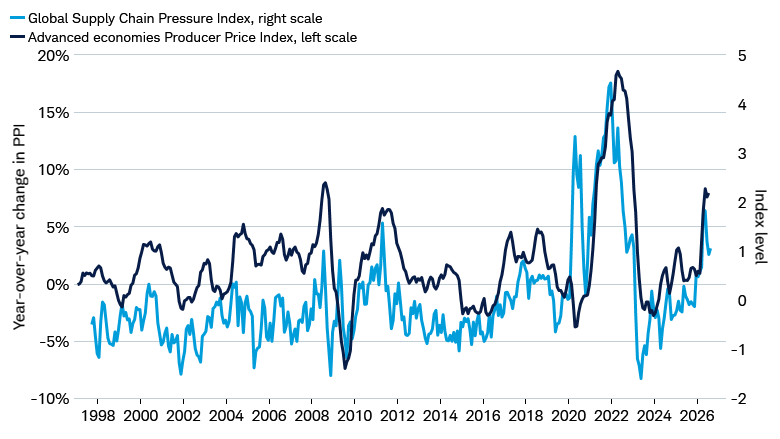
Source: Schwab Center for Financial Research, Federal Reserve Banks of Dallas and New York, and Macrobond.
Monthly data as of 9/22/2026. The Global Supply Chain Pressure Index combines transportation costs and components of manufacturing surveys across China, the eurozone, Japan, South Korea, Taiwan, the United Kingdom, and the U.S. For illustrative purposes only.
What are some differences in global trade between the globalization and fragmented periods?
- Globalization model
- Fragmented model
-
Globalization modelLowest-cost supplierFragmented modelDiversified suppliers
-
Globalization modelJust-in-time inventoryFragmented modelJust-in-case inventory
-
Globalization modelGlobal production networkFragmented modelRegional production networks
-
Globalization modelLimited government directionFragmented modelActive official industrial policies
-
Globalization modelScale and margin expansionFragmented modelResilience with higher costs
Where could capital spending shift?
Corporate strategy is shifting from just-in-time efficiency toward a balance of cost, security, and continuity. Firms may diversify suppliers, build regional production networks, hold more inventory, or bring selected operations closer to end markets. Some may invest more heavily in automation to offset higher labor costs.
Government policy is becoming a more important influence on capital allocation. Defense readiness, energy security, semiconductor capacity, infrastructure, and access to critical materials are now economic and national security priorities. Public incentives may support investment, but they do not remove execution risk, valuation risk, or the possibility of excess capacity.
Economic outcomes are unlikely to be evenly distributed. Infrastructure, workforce skills, trade access, energy availability, policy stability, and links to existing networks will help determine which countries capture lasting investment. Countries able to trade across several blocs may serve as important connectors.
Foreign investment has shifted toward selected manufacturing hubs
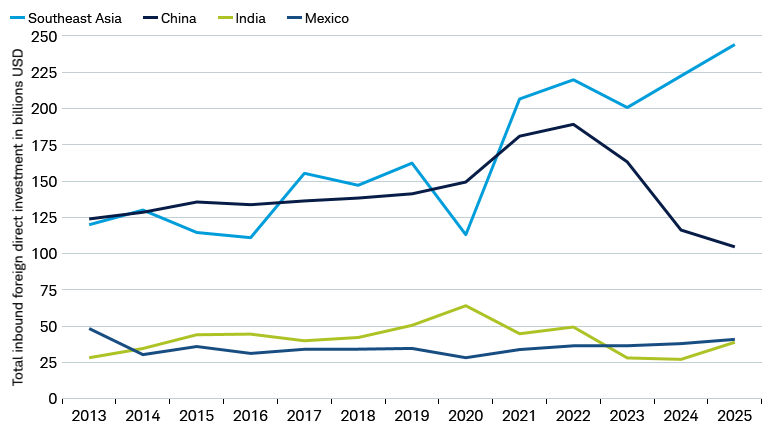
Source: Schwab Center for Financial Research, United Nations Conference on Trade and Development (UNCATD), and Macrobond.
Annual data as of 9/18/2026. For illustrative purposes only.
How fragmentation may affect the global economy and investors
- Area
- Possible effect
- Signposts to watch for
-
AreaGrowthPossible effectLess synchronized as specialization declines and capacity is duplicated. AI could be a positive offset.Signposts to watch forNew trade alignments and protectionist policy changes.
-
AreaInflation and interest ratesPossible effectMore volatile as supply chains, energy markets, and labor costs adjust. Inflation volatility could keep interest rates higher than they otherwise might be.Signposts to watch forEnergy prices, official inflation data, supply chain disruptions, income growth.
-
AreaTradePossible effectReconfigured with regional and political alignment; not a reversal in global trade. AI could be a possible accelerant to these trends.Signposts to watch forRegional trade alliances, supplier reconfiguration, and protectionist policy trends.
-
AreaCapital spendingPossible effectHigher in policy-supported areas such as infrastructure, defense, AI, energy, and strategic supply chains.Signposts to watch forGlobal industry investment trends, regulatory and policy changes.
-
AreaEmerging marketsPossible effectMore differentiated as foreign direct investment and technology transfer shift among regions.Signposts to watch forDomestic demand, strategic resources, supply-chain roles, and policy actions.
-
AreaCorporate earningsPossible effectHigh input prices and less efficient manufacturing and supply chains can erode profit margins. Increased use of AI could be an offset.Signposts to watch forLabor and raw material prices, changes to corporate manufacturing and trade practices.
-
AreaEquity valuationsPossible effectGreater macroeconomic volatility, higher rates, and pressure on profit margins can weigh on valuations.Signposts to watch forRisk asset performance, investor sentiment, corporate earnings trends.
Potential investment opportunities
Geopolitical fragmentation is already driving shifts in capital spending that could continue for an indefinite period. The list below provides examples of areas that may offer potential investment opportunities, but they are not investment recommendations. Policy support can encourage spending and attract capital, yet it can also draw new competitors and create excess capacity. Fragmentation may improve the economics of some companies while weakening the economics of others. We suggest investors still evaluate individual companies carefully as not every company tied to these themes will benefit equally.
- Defense and security: Higher spending on military readiness, aerospace, drones, space systems, and cybersecurity may support suppliers in the United States, Europe, and Asia.
- Energy and power infrastructure: Energy, security and rising electricity demand may require investment across power generation and transmission, natural gas, nuclear power, and renewables. Supply shocks could cause disruption similar to what we're seeing today with the Iran war.
- Technology: Efforts to participate in the growth of new technologies like AI have driven increased investment in domestic capacity of semiconductor equipment, fabrication, advanced packaging, data centers, AI infrastructure, and industrial automation. Statements from governing officials in the U.S., China, and other major countries cite these efforts as national security priorities.
- Infrastructure and logistics: New factories and regional supply networks require engineering, construction, electrical equipment, industrial real estate, ports, transportation, and distribution capacity.
- Critical materials: Competition for copper, lithium, rare earths, uranium, and processing capacity may raise the strategic value of resource-rich countries and the companies that produce or refine these inputs.
- Digital services: Software, cloud infrastructure, and cybersecurity may face fewer physical trade frictions than goods, although data rules, export controls, and security requirements could still divide technology ecosystems.
Fragmentation creates trade-offs rather than clear winners
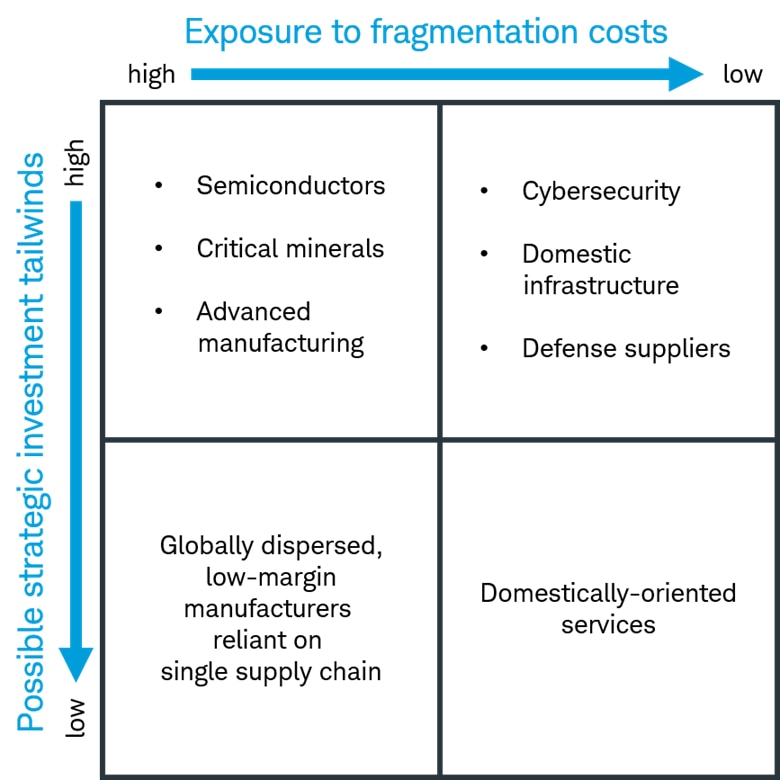
Source: Schwab Center for Financial Research, as of 9/23/2026.
For illustrative purposes only.
Exploring thematic investing
Thematic investing is a way for investors to invest in themes that tie to their ideas, personal values, or trends that don't necessarily fit into existing industry classifications.
Below is a sampling of investing themes that are directly or indirectly related to Geopolitical Fragmentation.
Sample investment themes related to Geopolitical Fragmentation
- Theme
- Description
-
ThemeCyber SecurityDescriptionThe Cyber Security theme focuses on companies that develop solutions to protect against cyber-attacks. These companies help to harden application, network, cloud, and endpoint security.
-
ThemeRobotic RevolutionDescriptionThe Robotic Revolution theme targets companies building robotic solutions, with a focus on the fields of manufacturing, logistics, and medical services.
-
ThemeU.S. National DefenseDescriptionThe Defense theme focuses on companies providing products and services to the U.S. Department of Defense (DoD). These include companies that supply weapons, military vehicles, rockets, satellite communications, and information technology (IT) services.
-
Theme3D PrintingDescription3D printing refers to processes used to create 3D objects from digital designs. The theme focuses on both the suppliers and users of 3D printing technology, including hardware and software producers, and the companies using these products.
-
ThemeBlockchainDescriptionThis theme focuses on the developers and adopters of distributed ledger technology. The theme includes companies that leverage blockchain technology to transform traditional businesses, provide secure transactions, and optimize their services.
-
ThemeChemicals from Natural GasDescriptionThese companies use natural gas byproducts, such as ethane and propane, as inputs to produce higher margin fertilizer and chemicals with low-priced natural gas.
-
ThemeCloud ComputingDescriptionThis theme focuses on companies building hardware, systems, and infrastructure behind the cloud. Cloud computing refers to the delivery of computing services—such as networking, servers, storage, databases, software, and analytics—over the internet.
-
ThemeDigital PaymentsDescriptionThe Digital Payments theme focuses on companies enabling digital financial transactions and includes firms developing cashless payment technology and infrastructure.
-
ThemeRenewable EnergyDescriptionThis theme targets companies expanding renewable capacity through new technologies. These technologies include solar and wind energy, biofuels, and other power sources not derived from fossil fuels.
Explore Schwab Investing Themes™
Schwab Investing Themes™ provide a way to invest in ideas and trends such as U.S. National Defense, Robotic Revolution, and Cyber Security. The Schwab research team uses proprietary research and technology to select stocks related to each trend, market insight, or innovation. Investors can use each theme as constructed or customize its stocks and weights.
Preview all 40-plus themes.
What could impede or accelerate fragmentation?
The pace of further geopolitical fragmentation is uncertain. On one side, the economic costs of rapid fragmentation are high. Existing financial and commercial ties tend to be difficult to unwind, and companies have strong incentives to preserve access to efficient global customers and suppliers. Productivity gains from technological advances—such as AI and automation—could offset some transition costs.
A more severe break between major blocs could accelerate change. Abrupt restrictions on energy, commodities, semiconductors, or other critical inputs could produce shortages, higher inflation, and weaker growth. The effects would depend on the breadth and duration of the disruption.
Regional equity correlations have declined from recent peaks
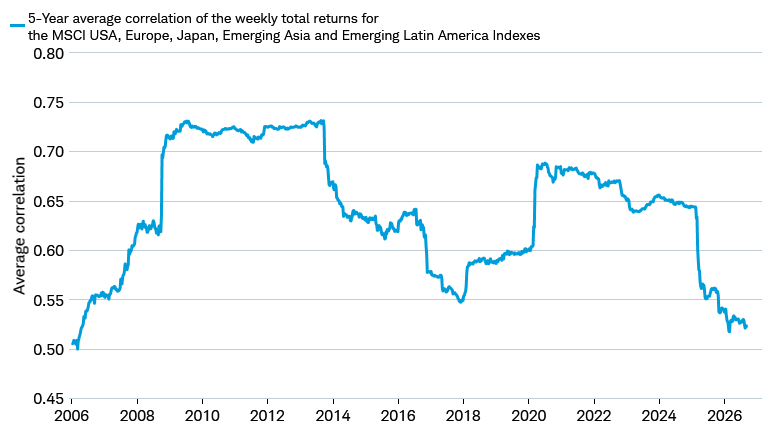
Source: Schwab Center for Financial Research, MSCI, and Macrobond.
Weekly data from 1/2/2006 to 9/25/2026. Correlation is a statistical measure of how two investments have historically moved in relation to each other, and ranges from -1 to +1. A correlation of +1 indicates a perfect positive correlation, while a correlation of -1 indicates a perfect negative correlation. A correlation of zero means the assets are not correlated. Index figures do not include trading and management costs, which would lower performance. Indexes are unmanaged, do not incur management fees, costs, and expenses and cannot be invested in directly. Past performance is no guarantee of future results.
What should investors consider?
A multipolar world does not call for changes to strategic portfolio construction. It may strengthen the case for diversification across regions, sectors, asset classes, and economic drivers. If growth and inflation become less synchronized, and new trading alliances are formed, differentiated geographic exposures may provide access to different sources of return and risk.
Investors may also look beyond broad market exposure to more targeted opportunities. Supply-chain position, end-market exposure, access to strategic inputs, pricing power, and sensitivity to government policy may become more important in separating potential winners from losers. The investment needed to reconfigure production may support nominal economic growth, but higher operating and investment costs could weigh on companies' inflation-adjusted profits.
The broad Geopolitical Fragmentation investing theme has many facets and is one that we'll be monitoring going forward. Globalization is unlikely to end, but any reorganization of it may tend to make the global economy less efficient and less synchronized. The effects will vary across countries, industries, and companies. Investors are unlikely to need to rebuild portfolios around any singular geopolitical theme or forecast. Broad diversification and careful analysis of policy, supply-chain, and geopolitical exposures remain the more durable response.
Frequently asked questions about investing amid fragmentation and globalization
What is geopolitical fragmentation?
Geopolitical fragmentation is the reorganization of trade, investment, technology, and supply chains around national security, resilience, and political alignment. It doesn't necessarily mean the end of globalization. It's more likely to produce a selectively interconnected system in which some cross-border ties weaken while others deepen within regions or among trusted partners.Is globalization ending?
Globalization is changing, not necessarily reversing. Companies and governments still have strong incentives to trade and invest across borders, but cost is no longer the only consideration. Security, supplier concentration, access to critical technologies, and political relationships are playing larger roles in decisions about where goods are produced and capital is invested.How could geopolitical fragmentation affect economic growth and inflation?
Fragmentation may make growth less efficient and uneven by reducing the efficiency gains from specialization and global scale. Reshoring, friend-shoring, larger inventories, and duplicate production capacity may improve resilience, but raise costs. That could make inflation more volatile, particularly when geopolitical events disrupt energy, commodities, transportation, or critical technologies.Which industries may have opportunities from a more fragmented global economy?
Potential areas that may see increased demand include defense and cybersecurity, energy and power infrastructure, semiconductors, industrial automation, logistics, construction, and critical materials. Public policy and the need for more resilient supply chains may support investment in these areas, but policy support does not eliminate valuation, execution, or competitive risks.Which countries could gain from supply-chain realignment?
India, Mexico, and parts of Southeast Asia may attract production as companies diversify supply chains. Resource-rich economies in Australia, Latin America, and the Middle East may also benefit from demand for energy and critical materials. Outcomes will depend on infrastructure, workforce skills, trade access, energy availability, policy stability, and connections to existing supplier networks.What could a more multipolar world mean for investors?
A multipolar world may widen performance differences across countries, sectors, and companies. Investors may want to diversify across regions, asset classes, and economic drivers while paying closer attention to global geopolitical issues and government policy changes. While nominal growth may be supported via increased investment, inflation volatility, corporate profitability pressures, and currency fluctuations could make the investment environment more challenging and lower asset valuations on higher risks.What are the main risks to this outlook?
The main risk from this broad theme is if fragmentation were to happen suddenly, possibly due to a catalyst like a military confrontation among major powers, potentially leading to supply shocks, trade embargoes, and spikes in inflation.About the authors
 Chris FerraroneHead of Equity Research and Strategy
 Heather O'LearySenior Manager, Equity Research and Strategy