
ThomasPartners® Strategies: The Power of Dividends

We see fixed income as a risk balancer.

Within fixed income, we seek to deliver reliable yields that appropriately compensate investors for the risks taken on their behalf, while also seeking to dampen overall portfolio volatility. We seek to accomplish this with careful analysis of the major fixed income sectors and opportunistic purchases of fixed income investments with yield characteristics that we believe fairly compensate investors for the risks to which they are exposed.
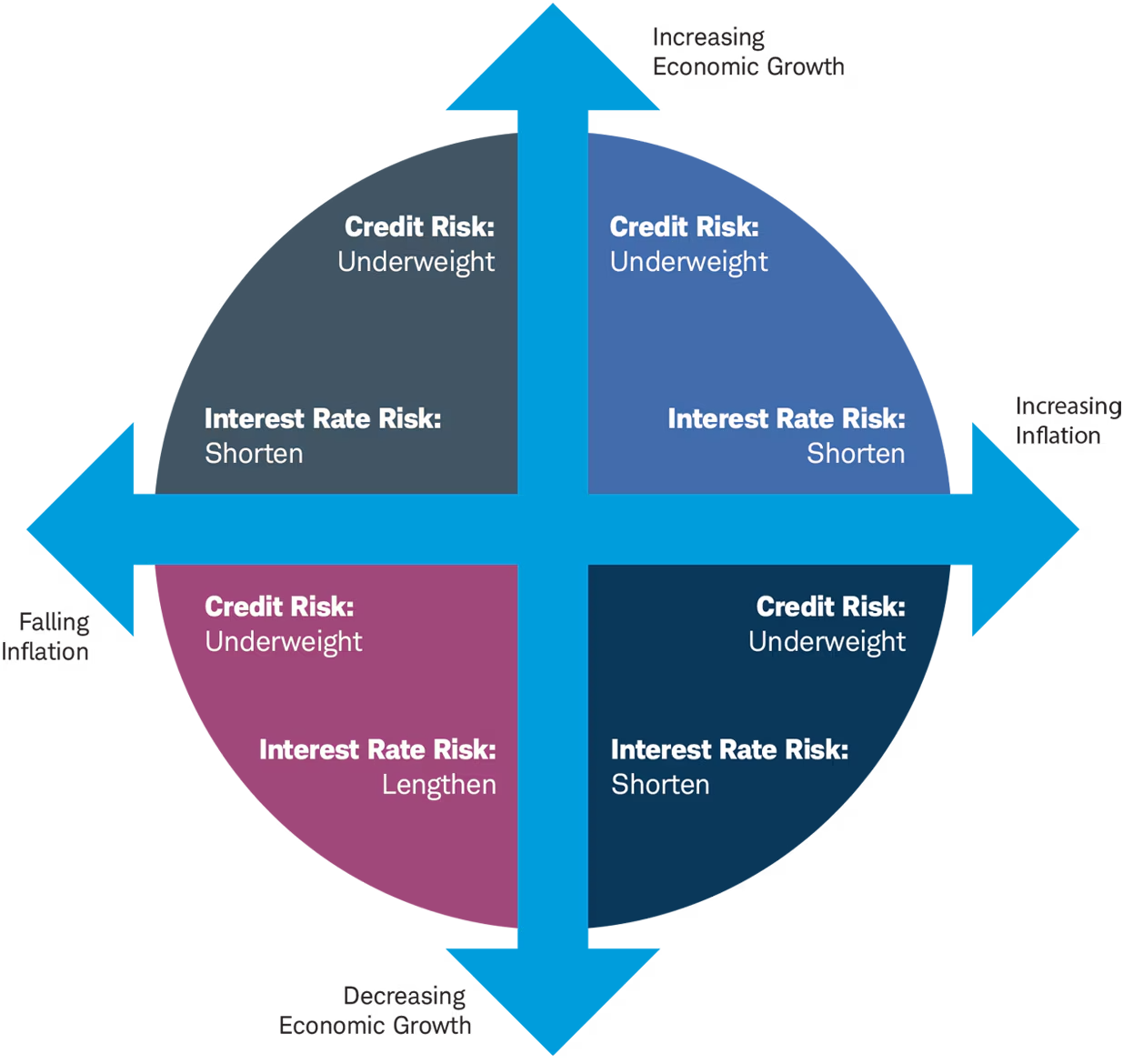
Falling Inflation Credit Risk: Underweight Interest Rate Risk: Shorten Credit Risk: Underweight Interest Rate Risk: Lengthen Decreasing Economic Growth Increasing Economic Growth Credit Risk: Underweight Interest Rate Risk: Shorten Credit Risk: Underweight Interest Rate Risk: Shorten Increasing Inflation

Growth of the S&P 500 Index, Reinvesting Dividends chart additional disclosures:

Historical Total Returns of Stocks chart additional disclosures: Starting with the first quarter of 2019, Charles Schwab Investment Advisory, Inc., the then adviser, changed vendors to Ned Davis Research, Inc. (NDR) for the generation of this study. The results of this transition produced different values for each of the dividend groups, in particular, the 'Dividend Cutters or Eliminators' group now show a noticeably higher total return than in prior charts. Factors that affected these results include a change in the data source from the CRSP® 1962 U.S. Stock Database to S&P Capital IQ Compustat and S&P Dow Jones Indices, a change in the rebalancing period from annually to monthly, a removal of the $1 billion inflation adjusted market cap requirement (the stocks included in the study are from the NDR Multi-Cap universe, which represent the top 97% of capitalizations in the NDR All-Cap Universe), and a shortening of the evaluation period(i.e., the NDR Multi-Cap Stocks Universe starts on 12/31/1980, while the previous study covered a 40 year period). As of the most recent evaluation period, the NDR Multi-Cap universe contained 6 stocks, or 0.4% of the universe, with a market cap less than $1 billion. The Dividend Paying Stocks chart shows the historical total returns of stocks based on their dividend policies. These stocks were grouped into four categories of dividend policies: NonDividend-Paying stocks, Dividend Growers and Initiators, Dividend Cutters and Eliminators, and Dividend Payers with No Change in Dividends. The methodology in creating this chart is as follows.

1) Dividend Paying vs. Non-Paying
Each company's dividend policy is determined by its indicated annual dividend. Ned Davis classifies a stock as a dividend-paying stock if the company indicates that it is going to be paying a dividend within the year. A stock is classified as a 'non-payer' if the company's indicated annual dividend is zero. Prior to July 2000, the indicated annual dividends were updated on a quarterly basis. Since July 2000, the indicated annual dividends are updated on a daily basis, so the most up-to-date information is used.

The annualized returns are calculated using monthly equal-weighted averages of the total returns of all dividend-paying (or non-paying) stocks during the 1981-2020 time frame. A stock's return is only included during the period it is a component of the underlying NDR MultiCap universe. The dividend figure used to categorize the stock is the company's indicated annual dividend, which may be different from the actual dividends paid in a particular month. Indices are unmanaged and cannot be invested.

2) Dividend Growing, No-Change-in-Dividend, and Dividend Cutting
Each dividend-paying company is further classified into one of the three categories based on changes to their dividend policy over the previous 12 months. 'Dividend Growers and Initiators' include stocks that increased their dividend anytime in the last 12 months. Once an increase occurs, it remains classified as a 'Grower' for 12 months or until another change in dividend policy. 'No-Change' stocks are those that maintained their existing indicated annual dividend for the last 12 months (i.e., companies that have a static, non-zero dividend). 'Dividend Cutters or Eliminators' are companies that have lowered or eliminated their dividend anytime in the last 12 months. Once a decrease occurs, it remains classified as a cutter for 12 months or until another change in dividend policy.

Source: Ned Davis Research. Refinitive. Dow Jones S&P Indices.

Copyright 2025 Ned Davis Research, Inc. Further distribution prohibited without prior permission. All Rights Reserved.

See NDR Disclaimer at www.ndr.com/copyright.html. For data vendor disclaimers refer to www.ndr.com/vendorinfo/.

Charles Schwab Investment Management, Inc. (CSIM), dba Schwab Asset Management, is a registered investment advisor and affiliate of Charles Schwab & Co., Inc. (Schwab). Windhaven Strategies, ThomasPartners Strategies, and Schwab Personalized Indexing strategies are managed by CSIM. CSIM and Schwab are separate affiliates and subsidiaries of The Charles Schwab Corporation. The ThomasPartners Strategies, Windhaven Strategies, and Schwab Personalized Indexing strategies are available through the Managed Account® Access programs. Please refer to CSIM's Disclosure Brochures for more information.

Portfolio Management for the ThomasPartners Strategies is provided by Charles Schwab Investment Management, Inc., dba Schwab Asset Management®, a registered investment adviser and an affiliate of Charles Schwab & Co, Inc. ("Schwab"). Both Schwab Asset Management and Schwab are separate entities and subsidiaries of The Charles Schwab Corporation.

Past performance is no guarantee of future results.

Diversification strategies do not ensure a profit and do not protect against losses in declining markets.

Investments in managed accounts should be considered in view of a larger, more diversified investment portfolio.

There are risks associated with any investment approach, and the ThomasPartners Strategies have their own set of risks:

First, there are the risks associated with investing in dividend-paying stocks, including but not limited to the risk that stocks in the Strategies may reduce or stop paying dividends, affecting the Strategy’s ability to generate income.

Second, investor sentiment could cause dividend-paying equities to fall out of favor and decrease in price.

Third, there are risks associated with investing in fixed income asset classes, including through the use of exchange traded funds (ETFs), that include but are not limited to: interest rate risk, credit risk, high yield risk, and government security risk.

Fourth, there are risks associated with investing in international stocks, including but not limited to: differences in financial accounting standards, currency fluctuations, geopolitical risk, foreign taxes and regulations, and the potential for illiquid markets.

Fifth there are risks with Master Limited Partnership (MLP) securities (units) that differ from an investment in common stock. Holders of the units of MLPs have more limited control and limited rights to vote on matters affecting the partnership. For example, unit holders may not elect the general partner or the directors of the general partner, and they have limited ability to remove a MLP’s general partner. MLPs may issue additional common units without unit holder approval, which would dilute existing unit holders. In addition, conflicts of interest may exist between common unit holders, subordinated unit holders, and the general partner of a MLP, including a conflict arising as a result of incentive distribution payments. As an income producing investment, MLPs could be affected by increases in interest rates and inflation. There are also certain tax related risks associated with an investment in units of MLPs, including that MLPs may convert to a C-Corporation. This conversion could cause a cut in distributions as well as an adverse tax event for long-time owners of the MLP.

Lastly there are risks associated with Real Estate Investment Trusts (REITs), including REITs will be subject to the risks associated with the direct ownership of real estate, including fluctuations in the value of underlying properties, defaults by borrowers or tenants, changes in interest rates and risks related to general or local economic conditions. REITs are also subject to certain additional risks, for example, REITs are dependent upon specialized management skills and cash flows, and may have their investments in relatively few properties, a small geographic area or a single property type. Failure of a company to qualify as a REIT under federal tax law may have adverse consequences on a client account. In addition, REITs have their own expenses, and a client account will bear a proportionate share of those expenses.

The material in this presentation is based on information from a variety of sources we consider reliable and should be used for informational purposes only. Charles Schwab Investment Management does not represent that the information is accurate or complete and expressly disclaims any liability, including incidental or consequential damages, arising from errors or omissions in this presentation.

Indexes are unmanaged, do not incur management fees, costs and expenses, and cannot be invested in directly.

The Russell 1000 Value Index, NASDAQ U.S. Broad Dividend Achievers Index TR (DAATR), S&P 500 Total Return Index, and Bloomberg U.S. Intermediate Government/Credit Index contain more securities positions than the ThomasPartners Strategies and, as a result, the performance of the strategies at times may be more volatile than the performance of the aforementioned Indexes. Please note that there are material differences between the indexes shown, including potential differences in holdings and in how each calculates dividend yield. Data shown for the S&P 500 Total Return Index is supplemental to the GIPS presentation shown at the end of this presentation. The ThomasPartners Strategies portfolio management team believes that although the S&P 500 Total Return Index does not seek dividend income as a primary objective, it is a suitable proxy for the overall market.

The NASDAQ US Broad Dividend Achievers Total Return Index (DAATR) comprises U.S securities with at least 10 consecutive years of increasing annual regular dividend payments.

The S&P 500 Total Return Index is a commonly recognized, market-capitalization-weighted index of 500 widely held equity securities, designed to measure broad U.S. equity performance.

The Bloomberg U.S. Intermediate Government/Credit Index is composed of U.S. dollar-denominated government, government-related and investment-grade U.S. corporate bonds with remaining maturities between one and ten years.

0326-MBMH