
Adding Cryptocurrency to a Portfolio? 2 Approaches

Key takeaways
- There is no "correct" allocation to cryptocurrencies, and we believe the decision is largely a personal one.
- A classic approach to incorporating cryptocurrency into a portfolio can be useful for investors who have a view on expected performance or would like to understand how different assumptions of return would translate into an allocation.
- A risk-budgeting-based approach can be useful for investors who either do not have a view of expected performance or would rather allocate based on a risk budget.
- Cryptocurrencies will likely increase portfolio volatility. Even small allocations to bitcoin or ether can significantly affect portfolio performance.
- There is no "correct" allocation to cryptocurrencies, and we believe the decision is largely a personal one.
- A classic approach to incorporating cryptocurrency into a portfolio can be useful for investors who have a view on expected performance or would like to understand how different assumptions of return would translate into an allocation.
- A risk-budgeting-based approach can be useful for investors who either do not have a view of expected performance or would rather allocate based on a risk budget.
- Cryptocurrencies will likely increase portfolio volatility. Even small allocations to bitcoin or ether can significantly affect portfolio performance.
Interest in cryptocurrencies has soared over the past decade. And given their remarkable price gains, you may be wondering whether cryptocurrencies like bitcoin and ether belong in your investment portfolio—and if so, in what amounts?
To be clear, cryptocurrencies and crypto-related products are not suitable for everyone. Among other risks, they tend to be highly volatile and it's possible to lose a substantial portion—or even all—of your investment. Cryptocurrencies may be subject to illiquidity, theft, scams and fraud. If investors decide to invest in cryptocurrencies directly, they should remember that there may not be an effective way to recover assets if they're stolen or lost.
However, for investors who have researched cryptocurrency and decided to invest in it, we will outline two common approaches to portfolio construction: a classic approach based on expected return, volatility and correlation, and a risk-budgeting-based approach that focuses on the contribution of cryptocurrencies to the portfolio's overall volatility. To illustrate key concepts we will use bitcoin and ether, two of the oldest and most widely held cryptocurrencies.
Before considering an allocation to cryptocurrencies or incorporating them into a portfolio along with more traditional investments, we believe it's helpful to ask yourself a few questions:
- What is the goal of your portfolio and over what investment horizon?
- Any allocation to cryptocurrency is likely to increase a portfolio's volatility. How comfortable are you with increased volatility and what capacity do you have for loss?
- How familiar are you with cryptocurrencies and digital assets?
- Are you interested in allocating to a particular cryptocurrency or looking for broader, more diversified exposure to this emerging space? Not all cryptocurrencies or blockchain protocols—the foundational rules that determine how data is recorded and shared on the blockchain network—are created equal, and price behavior can vary significantly across different coins.
There is no "correct" allocation to cryptocurrencies, and we believe the decision is largely a personal one. That said, here are a few things to consider about cryptocurrencies:
Cryptocurrencies will likely increase portfolio volatility
If you've paid any attention to cryptocurrencies over the years, you know their prices have been volatile. For example, between January 1st, 2015 and October 31st, 2025 bitcoin experienced annualized volatility of 72.1% and maximum drawdown (a price decline from a peak to a low point) of as much as 73.4%—considerably larger than the historical drawdowns that occurred in more traditional asset classes, such as stocks and bonds. And ether was even more volatile—98.3% on an annualized basis, with maximum drawdown of 87.8%. On April 3rd, 2026, bitcoin's price was 47% below its October 2025 all-time peak, according to data from Bloomberg. On April 3rd, 2026, ether's price was 59% below its August 2025 all-time peak, according to data from Bloomberg. Because of their tendency toward extreme volatility, even small allocations to bitcoin or ether could significantly affect portfolio volatility.
Bitcoin has been volatile compared to other investments
|
Asset class |
Annualized volatility |
Historical drawdown |
|---|---|---|
|
U.S. large-cap equities |
15.4% |
-50.9% |
|
U.S. small-cap equities |
20.4% |
-52.9% |
|
International large-cap equities |
16.4% |
-56.7% |
|
International small-cap equities |
17.6% |
-59.7% |
|
Emerging-market equities |
21.9% |
-61.6% |
|
U.S. real estate investment trusts (REITs) |
20.1% |
-69.3% |
|
U.S. Treasury Inflation-Protected Securities (TIPS) |
5.5% |
-13.6% |
|
U.S. core fixed income |
4.1% |
-17.2% |
|
U.S. short Treasury |
1.6% |
-5.3% |
|
Cash |
0.6% |
0.0% |
|
Bitcoin spot price (U.S. dollar) |
72.1% |
-73.4% |
|
Ether spot price (U.S. dollar) |
98.3% |
-87.8% |
A traditional approach depends on expected return
The basics of modern portfolio theory that underpin most portfolio construction and asset allocation approaches are made on assumptions of expected returns, volatility and correlations. Using this framework, an investor could make assumptions for expected returns while using historical volatility and correlations to determine how much cryptocurrency could fit in a portfolio. However, there are risks to this approach that are heightened in the case of cryptocurrency, including that investors tend to have vastly different views on expected crypto performance and that even a small allocation of crypto can have an outsize impact on performance.
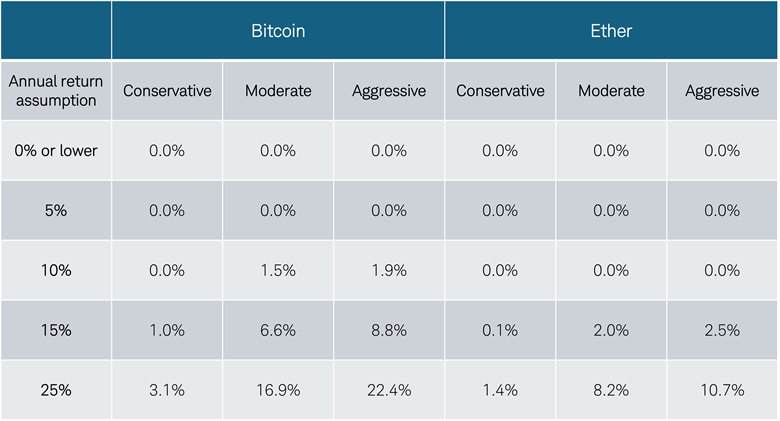
For example, based on our research, if an investor using a traditional approach assumed bitcoin would generate an annual return of 15%, it would suggest a 1.0% weight in a conservative (8% equity/92% fixed income) portfolio, a 6.6% weight in a moderate (64% equity/36% fixed income) portfolio and an 8.8% weight in an aggressive (96% equity/4% fixed income) portfolio (these figures are illustrative only and not recommendations, and investors should remember that past performance is no guarantee of future results).
For ether, which historically has been more volatile than bitcoin, assuming a 15% annual return would suggest a 0.1% weight in a conservative portfolio, a 2.0% weight in a moderate portfolio and a 2.5% weight in an aggressive portfolio, according to our research. Our analysis suggests that neither bitcoin nor ether offers a large enough risk-adjusted return to justify any allocation if return expectations are less than 10%, even for an aggressive investor.
Note that allocations are highly sensitive to, and dependent on, an investor's subjective view of expected return. For example, as you can see in the chart below, a moderate investor's exposure with a 25% expected return from bitcoin implies a 16.9% allocation, versus only 1.5% if the investor expects a 10% return.
Potential cryptocurrency allocation based on return assumptions
Source: Charles Schwab.
Analysis based on Schwab Asset Management capital market expectations as of 10/31/2025. See disclosures for additional information. Bitcoin analysis based on the period from 1/1/2015 to 10/31/2025. Ether analysis based on the period from 2/8/2018 to 10/31/2025. This is the most recent data available.
The three investor profiles are: Conservative (8% equity/92% fixed income), Moderate (64% equity/36% fixed income) and Aggressive (96% equity/4% fixed income). In all scenarios, the amount invested in cryptocurrency comes from the portion of the portfolio that would otherwise be invested in equities. This hypothetical example is only for illustrative purposes and is no guarantee of future performance or success. Diversification and asset allocation strategies do not ensure a profit and do not protect against losses in declining markets.
Our research suggests that cryptocurrencies may not offer a large enough risk-adjusted return to justify a meaningful allocation if return expectations are less than 10%, even for an aggressive investor. Also, "optimal" allocations are highly dependent on an investor's subjective view on expected return. For example, a moderate investor's exposure with a 25% expected return from bitcoin suggests a 16.9% allocation, based on our analysis, versus only 1.5% if the investor expects a 10% return.
A risk-budgeting-based approach focuses on desired risk contribution
A risk-budgeting-based approach—that is, designating a desired level of risk to each asset class and allocating accordingly—is another potential approach to cryptocurrency allocation. Rather than relying heavily on an estimate of asset performance, this method instead focuses on the investor's level of comfort with risk. While it may help investors to focus on a "known" variable—risk tolerance—rather than an unknown variable like expected asset performance, it's worth remembering that no approach is foolproof and that cryptocurrencies' historical volatility could result in greater-than-expected declines.
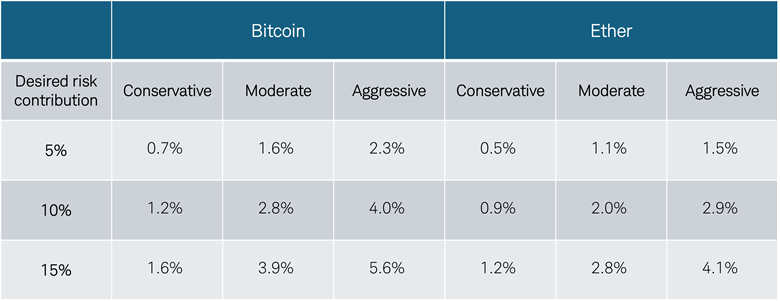
As an example of a risk-budgeting-based approach, in the chart below we show potential cryptocurrency exposure allocation based on desired risk contribution in three different hypothetical portfolios: conservative (8% equity/92% fixed income), moderate (64% equity/36% fixed income) and aggressive (96% equity/4% fixed income). We chose three levels of risk to be contributed from cryptocurrency: 5%, 10% and 15%. In each case we assumed the weighting to bitcoin or ether would be drawn from the equity portions of the portfolio, and the equity portion was reduced accordingly.
Because of bitcoin and ether's historically very high volatility, based on our research even a small allocation represents a large percentage of portfolio risk. For example, in the conservative portfolio it takes only a 1.2% allocation to bitcoin and a 0.9% allocation to ether to reach the 10% risk level. Even in the moderate and aggressive portfolios, it doesn't take much—2.8% and 4.0% bitcoin and 2.0% and 2.9% ether, respectively—to reach a 10% risk threshold.
Potential bitcoin and ether allocation based on desired risk contribution
Source: Schwab Asset Management.
Bitcoin analysis based on the period from 1/1/2015 to 10/31/2025. Ether analysis based on the period from 2/8/2018 to 10/31/2025. This is the most recent data available.
The three investor profiles are: Conservative (8% equity/92% fixed income), Moderate (64% equity/36% fixed income) and Aggressive (96% equity/4% fixed income). In all scenarios, the amount invested in cryptocurrency comes from the portion of the portfolio that would otherwise be invested in equities. This hypothetical example is only for illustrative purposes and is no guarantee of future performance or success. Diversification and asset allocation strategies do not ensure a profit and do not protect against losses in declining markets. Past performance is no guarantee of future results.
Bottom line
Investors who want to add cryptocurrency to their portfolios should give careful consideration to their high volatility and speculative nature, and consider how much crypto-derived portfolio risk they feel comfortable with. Above, we outlined two different ways of thinking about how adding cryptocurrency might affect a portfolio—a traditional approach using return expectations, or a risk-budgeting-based approach. Given bitcoin and ether's historical volatility, the suggested allocations are relatively small. At these levels, the primary drivers of total portfolio risk are still traditional equity and fixed income investments, but the addition of bitcoin or ether provides the possibility of enhanced portfolio performance (or loss).
Regardless of which approach you take, any investor adding cryptocurrency to their portfolio will be adding investment risk. Cryptocurrencies also come with other risks, including the possibility of potential encryption breaking and increased risk of loss. Cryptocurrencies are not backed or guaranteed by any central bank or government; are not deposits; are not FDIC insured; are not SIPC protected; and lack many of the regulations and consumer protections that legal-tender currencies and regulated securities have. Due to the high level of risk, investors should view digital currencies as a purely speculative instrument. Additional risks apply. Ultimately, the decision to include cryptocurrencies should be guided by personal goals, risk capacity, and familiarity with digital assets, exploring both approaches to make informed, tailored investment choices.
If you're interested in learning more about portfolio construction with digital assets, this white paper, "The next frontier: Portfolio construction with cryptocurrencies," explains our approach in more detail. We also suggest making sure you understand the many ways you can get exposure to cryptocurrencies, including direct ownership, exchange-traded products, cryptocurrency-related futures and options and crypto-related stocks.
About the author