
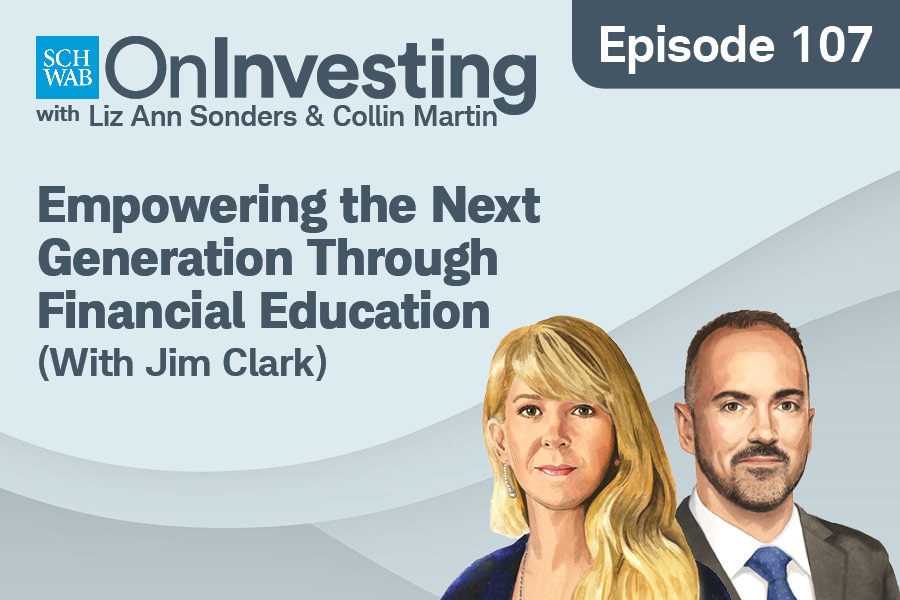
Empowering the Next Generation Through Financial Education (With Jim Clark)
Transcript of the podcast:
LIZ ANN SONDERS: I'm Liz Ann Sonders.
COLLIN MARTIN: And I'm Collin Martin.
LIZ ANN: And this is On Investing, an original podcast from Charles Schwab. Every week we analyze what's happening in the markets and discuss how it might affect your investments.
COLLIN: Hi, Liz Ann. Our last chat focused a lot on the uncertainty going on given the conflict in Iran. And I think that's probably the best place to start our conversation this week as well. It really seems like the markets are focusing more on what's going on in the Middle East rather than economic fundamentals right now. And for me, at least, the main question stems around the duration and what sort of impact this will have on the economy down the road, especially given the rise in oil prices we've seen. So what's your take on all of this?
LIZ ANN: Yeah, you know, it's been an interesting few days, trading days, in terms of what we're seeing in the speed of moves and the impact it's having on markets. So I think we're … given elevated oil prices, notwithstanding the swings up and down, I think we're at a point of asymmetry and the way traders are thinking about a potential end to the conflict, whatever the heck that looks like, what it would entail in terms of what the various sides would agree to, how long it will be before we actually get something concrete. I think, given where oil prices are, I think traders are betting that there's probably more quick downside to oil versus significant upside from here to the extent this persists. So that's why you're seeing some of these fairly dramatic moves on the downside. I think that's how traders are thinking about this.
And frankly, Collin, as you know, there's so much trading that is dominating market moves in this environment. There's so much what I've been calling short-attention-span money in the market right now. You see it with the influence that commodity trading advisors, systematic hedge funds, the long/short hedge fund community, retail traders, distinct from more traditional longer-term individual investors, and it really can just exacerbate some of these swings.
We're also seeing a lot more trading happening in things like exchange-traded funds. So ETFs' share of trading volume, just in the month of March, has been ranging, on a day-to-day basis, between about 37% and about 42%. That's an extreme high relative to history. So then you get the, you know, the other interesting facet here of a lot of short-term trading, active trading, happening even in these passive vehicles, and that can magnify moves.
And I suppose you could argue that it's a healthy trading environment for traders because of that subsurface volatility and the opportunities it creates. But I think it's an environment that is tricky and causing consternation on the part of longer-term investors.
There's also increasing troubling news. There was another report out of Axios talking about some of what's been happening in the betting markets and some big trades that have gotten put on just in advance of some of these announcements about progress in negotiations or lack thereof. So I wouldn't be surprised if that continues to garner more attention.
And then there's obviously a lot going on in your world, Collin, and it's not just domestically, but globally in terms of movements in yields and maybe a more muted movement in the dollar than one might have expected. So what's your take on all of this as it relates to kind of your dual world of the fixed income side of things, but also currencies?
COLLIN: Yeah, I really like the way you teed it up there and how you framed it around traders and investors. Because like you said, if you're a trader, there's probably opportunities here given the volatility. But I think this probably causes a lot of anxiety for long-term investors when you see these swings. And we've been seeing a lot of swings in the bond market, which I think catches a lot of investors off guard. When you think of bond investing, you know, bonds are boring. I love them. I think they're exciting, but I think for most investors, they're usually thought of as the boring part of your portfolio, but they've been anything but boring over the past three or four weeks, where we've seen yields move really sharply. Treasury yields have been whipsawing.
So for example, Liz Ann, we've seen the 10-year Treasury yield at the end of February, it fell under 4%. It fell to around 3.95%. And then as of Monday, it got up to around 4.44%. So roughly a half a percentage point move in yield in just a few weeks. And I think a lot of investors see these moves and they say, "What does this mean?" Well, if you're a bond investor, prices and yields move in opposite directions. And when the longer the bond's maturity, the larger the fluctuations you'll see with the values and prices. So there's a term we use to talk about that. It's called duration, and it's related to your bond's maturity, but it's not a one-for-one.
So for a 10-year Treasury, if we use that as the example, even though it has a maturity of 10 years, duration might be around 8, 8.5 or so. The simple calculation is if a bond's yield rises by 100 basis points, its value will fall by a magnitude of the duration. So if you're seeing something with a duration of 8, and its yield rises by a half a percentage point, that that could be a 4% decline, using that simple rule of thumb. And that's a lot. I think that probably gives investors a lot of anxiety right now.
Now, you mentioned the dollar as well. The dollar's actually held pretty steady. I think there's a few reasons for that. One is the rise in yields we've seen. If yields rise or interest rate differentials come in a little bit, investors globally might see more value in U.S.-dollar securities. They also might be coming here as a safe haven. If we see growth prospects fluctuating, the U.S. might be positioned a little bit better right now than, say, Europe, given the rise in energy prices and how that flows through to the economy. But we haven't seen the huge moves in the dollar that we've seen in U.S. Treasuries.
And then finally, this all flows into the Federal Reserve outlook, but we talked about this last week, Liz Ann, and uncertainty is still the name of the game. We've seen this shift in expectations of what the Fed might do going forward. What we expect is somewhat of an extended hold, meaning we think the Fed will probably hold its benchmark interest rate in the 3.5% to 3.75% range. The fed funds futures market—that's what we look at to get expectations of what might come next—markets are pricing in a small, very small, likelihood of the next move being a hike.
We think that the market's probably getting a little bit ahead of themselves because we think that there are some potential negative consequences to the economy the longer this goes on, and as we see oil prices and gas prices stay elevated. But what this means, if you're an investor, when the Fed holds rates steady for a while, it means short-term yields will probably hold steady. So if you're holding Treasury bills or money market funds, the risk of those yields coming down over the short run is probably a little bit lower right now the longer the Fed holds at its current rate.
LIZ ANN: You know, one other thing, Collin, I wanted to mention, because we've now talked about the equity market and oil and yields and the dollar, is I have been getting a lot of questions lately on gold and the reason for the big move down from what had been pretty parabolic highs prior to the war. And I think there's a couple of things going on there. And I should caveat this with: I'm not a gold expert. I don't, you know, live in the weeds of the precious metals market. But certainly in the past year or so, we all need to have our arms around kind of the "why" behind moves because it has been so eye catching and have been getting a lot of questions, "Should I get into gold now when it was in its parabolic phase?"
And I think part of what was reflected in that most recent parabolic move on the upside was performance chasing. And, you know, FOMO, fear of missing out, and it had become just a risk asset, alongside silver as well. And then when you get into an environment where there is more risk, and you start to see investors and traders paring back that risk, not to mention the gains that were embedded in some of those gold purchases, you see a move in the opposite direction. But there's also, I think, an important fundamental underpinning that only recently is starting to get some attention.
And that is that central banks have stopped being aggressive buyers. In fact, the latest data that I saw was that, and it's through January, was that the net purchases of gold for global central banks dropped by 80% in January relative to what the monthly average was throughout the course of 2025. So there is that fundamental change, too. So I just wanted to wrap precious metals into the mix, too, since in the last 10 minutes, we've managed to cover most asset classes, which you know, yay!
So the rest of our episode this week will be a little different. We are going back to the basics in some ways and talk about how people learn about investing in the first place. Now, full disclosure, before I tell you about our topic and our guest, I have been involved with the Boys & Girls Club for many years. I, over the past year, have served as a trustee for Boys & Girls Club of America. That's a national organization.
And I have also spent five years, the past five, or closer to six actually, involved with Nantucket's Boys & Girls Club, and I currently serve as vice chair there. And Schwab as a company also has a partnership with Boys & Girls Clubs, and in fact started the clubs' … nationally, their financial literacy program, and that's called Money Matters. So we're going to talk a bit about that today.
What's interesting is that since 2004, more than 1.2 million teens and tweens have learned critical money management skills through this Money Matters program.
Well, why should our listeners care? Well, for those of us who have kids or grandkids, I'm in the former category. I'm not yet in the latter category. Or really, young people in our lives in any way, we do care and should care deeply about how they learn about finances and things like the importance of saving money.
I know I … Collin, I don't know if I ever shared this story, I made myself such a pest with the principal of the high school that my kids went to in Connecticut about why they didn't consider bringing in a financial literacy program as a core part of the curriculum. And her response was typically, "Well, Liz Ann, we do have a stock-picking club." And my response to that was always, "That's not really what I'm talking about. I'm talking about the basics, how a credit card works and the stuff that gets taken out of our paychecks and compound interest and taxes and how to budget and etc., etc." So I don't know if you have thoughts on that as well.
COLLIN: No, I love this, Liz Ann. I think it's a really fantastic topic. I've become very passionate about the educational aspect of my role. And I love engaging with people about, not just the investing side of the equation, but big picture wealth management. But when I do events and meet with clients, before I can dive in and start talking about duration or convexity and throw out these probably confusing bond-market terms, I have to talk about the basics of bond investing. And I think that works with other areas of wealth management, financial planning, and if we can start even earlier and get teens and tweens involved, I think it's fantastic, and this is a great opportunity.
So on that note, Liz Ann, how about you give us a full intro for our guest this week?
LIZ ANN: Sure, so my friend, and I guess I would call board colleague, Jim Clark is actually the CEO of Boys & Girls Clubs of America. So he directs a network of 5,500 Boys & Girls Club sites that serve more than 4 million young people annually in all 50 states, and interestingly, also on U.S. military installations worldwide.
Under Jim's leadership, Boys & Girls Club of America ranked in the top 10 in Forbes list of "America's Top 100 Charities" and received premier rankings by Candid and Charity Navigator. And as someone who's been involved in charities for a long time, that's a good site and a good statistic.
Now, Jim began his career at the Milwaukee Journal-Sentinel in 1979, where he served in senior leadership roles in distribution, marketing, and customer service operations and ultimately advanced to senior vice president. And in 2004, he departed the media company after 24 years to become president and CEO of Boys & Girls Club of Greater Milwaukee, which he served as a board member for 10 years. And he has served as the CEO of the national organization since 2012.
So Jim, I'm so thrilled that you fit us into your schedule. So thank you so much for joining us today.
JIM CLARK: Well, Liz Ann, it's great to be here, and thank you for taking time to focus in on our young people and financial literacy and economic mobility. It's so, so important.
LIZ ANN: Couldn't agree more. And so let's start big picture. I'm intimately involved with Boys & Girls Club and have for many years as our company, Charles Schwab, has been. But let me ask you to share with our listeners the mission of Boys & Girls Clubs and talk a little bit about how financial literacy plays a part in that.
JIM: Sure, absolutely, and special thanks to you and to the Charles Schwab company for your investments in our young people and financial literacy because it is an important part of growing up, and growing up whether you're a young person, a teenager or a young adult, having the financial skills is so critical. So at Boys & Girls Clubs, you know, our mission is to enable all young people, especially those who need us most to reach their full potential. And that word "enable" is the operative word when we think about the work we do, the programs we have, the service we provide to make sure that young people are on a trajectory, in general, to have a great future. And of course, for that to be realized, a financial foundation of education is really, really important.
LIZ ANN: And, you know, I'll share a story from when my now-26-year-old daughter, who's our youngest, was in, I think it was 10th grade, and she spent hours and hours one afternoon doing some sort of map of ancient Mesopotamia. And the day before I had had a conversation with her about how the economy works and the simple stuff like budgeting and how a credit card works. And she knew very little.
And I thought, I understand history, but man, we should really bring financial literacy into schools. But absent that in any kind of consistent way, we should all be very grateful that the Boys & Girls Club has done that. And of course, I've been in this business for 40 years, and so the world of finance and investing has changed dramatically, even in the past 10 or 15 years. How has teaching young people about saving and investing changed?
JIM: Well, you're spot on, Liz Ann. It has changed, and I think if you step back and just look at society, particularly the last, I like your analysis, five to 10 years, there's been a couple big shifts that have happened. Of course, technology has been one of the big drivers and in some very, very different ways. And that's about access. You know, young people, all people really, adults and young people today have so many more tools and so much more information right at their fingertips when it comes to looking at financial information, seeing different advertisements, different tools that are out there. All of this is just so much more evident in front of young people today and in front of all of us.
So you know, the access is just so much more available, and so is the education piece of it, frankly. And I think the second big factor that's really changed things in recent history is kind of the application of what's going on in society today.
You think about it, young people really don't carry much hard cash anymore with them. I know my kids are in their 20s, and they rarely have a dollar bill or any type of hard currency that they carry with them. So they're using different devices, and sometimes it's not even a credit card, right? They're using their phone to pay for things or to have transactions. And I think that creates a whole different dynamic when it comes to education and information because they're not able to tangibly see, feel, or tell as directly when they're spending, when they're incurring debt, or when they're just, you know, managing however they do their paycheck or the finances that they have. So really this notion of hands-on has gone away. That line of sight has really gotten blurred. And today it's mostly device-driven.
So you know, when we think about that, it's obviously changed how we need to support young people at Boys & Girls Clubs. And you have to have hands-on sessions with young people, especially when it comes to financial literacy, economics, you know, just the basics, like you said, with your daughter today, because a lot of times they're not getting that at home. Your daughter is fortunate. She got that from you at home. That's your business.
LIZ ANN: Right.
JIM: A lot of parents today, they're not equipped. You know, they're struggling themselves when it comes to managing a budget or managing finances. And we see that all the time when we're working with young people at Boys & Girls Clubs. Sometimes they only have a single parent that's working, and they don't have the time to sit down with them. So we really focus on Money Matters, and that's the course, that's the initiative, the strategy from Charles Schwab that we built together over 20 years ago, and you know today millions of young people have benefited and taken advantage of that program. Hundreds of thousands every single year see that firsthand when it comes to how to manage money and how to save, how to start to build a financial plan.
LIZ ANN: Right. So it starts with the basics, just like saving and how to plan a budget. This is not … I think sometimes when people think about financial issues, they … "Oh, you're bringing learnings about the stock market." This is the basic, important things that everybody needs to know.
JIM: You know, Liz Ann, well said, because that's what we break it down to. And the other part of this is, it gets confusing. It is a large topic, and sometimes kids, young people, are afraid of it, just because of the enormity of it, the complexity of it, they don't understand it. So first and foremost, to your point, keep it simple. You know, keep it simple. So at Boys & Girls Clubs, Money Matters, the program, we keep it as simple as we can. And we then instill these simple, basic foundational items that you just talked about. Pay yourself first. Run a real budget. Match your goals to what you're trying to accomplish. Have an adult coach, somebody, if it's not a parent, you know, a supporter at a Boys & Girls Club or a volunteer, be with you. Because I think that starts to eliminate some of the fear as well. But you're so right. It's the basic tools that are critical. And if it's simple, easy to understand, they'll get it, and they'll absorb it.
LIZ ANN: And they'll absorb it, and it'll stick with them because obviously financial literacy is something that carries through every stage of life.
We hear our Schwab financial consultants work with clients on these issues every day, and you don't ever get to a point, "OK, I know it all, I can put this in the recesses of my mind." It's every stage of life that's essential.
JIM: No question about it. And I think whether you're a novice or have gained some level of expertise in this space, it's changing, and you need to stay up with it. So kind of having that coach or somebody you can turn to is really important, and when you get to be an adult, if you are comfortable learning that as a young person, you're more likely to go to a financial service or planner to get assistance because you've had that adult, that somebody in your life helping. So I think this is much further beyond just young kids and adults here in Boys & Girls Clubs.
LIZ ANN: You know, it's funny, speaking of young kids, you made the comment earlier about the younger generation not really thinking of money in the same way that we did. It's not as tangible. They're not carrying it around.
And I heard something hysterical recently that was a snippet from Amy Poehler's podcast that she does, Good Hang, and she was talking about thoughts about money at the different generations. And she started with the Baby Boomers, who have always had the view that money was important, and then the next generation sort of asks, is money really important? And then the generation below that is, where is the money? And then the youngest generation, what is money? And so I thought that was a great way. But you're right—that younger generation has a different relationship with what we think of as money.
And one other question here, there are certain moments in life when the things we learn, not just about finance and budgeting and our financial lives, whatever it is. In fact, so much else that Boys & Girls Clubs does that when it gets put into practice. So what maybe are a few of those key moments for young people that the clubs are doing such a wonderful job fostering?
JIM: Well, I think there are certain edges or cliffs in everyone's life, and a young person faces those, you know, really between the time they're in elementary school to the time they go into post-secondary, whatever that may look like. And at each of those points, whether it's the end of elementary school, middle school is critical. Those tween years are so, so important. And then high school, obviously, is just formative when it comes to what your future is going to look like.
So you know, the tween piece, let me just start there because when it comes to this topic, it's so, so important to have great foundational skills in place. That's when they are really paying attention. You know, these middle school, sixth, seventh, eighth, maybe even ninth, depending on the system you're in. Those years, they are just so formative and so transactional when it comes to a life. So we've zeroed in there. And in fact, Money Matters, just recently, a couple years ago, we reformulated part of it to also focus on those tween years because we found real quickly, to your point about what's happening in society that's getting pushed down, as well. You know, cash is not just teenagers; it's getting pushed down this cashless society into younger ages, too, and we've seen that. So it really does start there, and it starts with goal setting. It starts with, you know, what is savings? What is spending? You know, what is credit? You know, how does this really work to your point there you know what is money?
And then investing. And as I said earlier, keeping this all really simple and really basic gets that foundation in place earlier. And then when they do go on to the teenage and that high school era, yes, we start talking about what does a loan mean? What does debt mean? How do you start getting through that? How do you really make a budget, a life budget? And we use … through Money Matters, there's simulations that take place. It's not just all instruction. There are case examples that we work young people through so that they can actually understand what it'll feel like and what it could mean if they get it right or if they don't.
LIZ ANN: How young do the clubs often sort of get involvement in Money Matters? Is there a minimum age for involvement in that program or anybody at any age can do it?
JIM: Our key ages are really those middle school, high school years, but we do have an elementary program for Money Matters, as well. It's much more home-based, kind of to the example you used with your daughter, where we are providing tools for the caregiver or a parent to start just this introduction phase of what this is all about and what should you be talking about with really younger people at home. Sometimes this is the allowance-type discussion. Sometimes this is earning a few dollars doing something in the neighborhood or around the house. So it's really this kind of very, very rudimentary … but same kind of understanding so that when they start getting a little older, they understand at least something of money and what it can and can't do.
LIZ ANN: Do you know if the folks that sort of organize the structure of the program and what is taught have thought at all about this recent trend that is happening, for lack of a better word, where there's a bit of conflating happening between investing and gambling, and the lines are getting blurred, and you're seeing a lot more sort of really fast short-term money swinging around in the market, and it has given rise to more sports betting and gamification.
And is that something that has worked its way into how the clubs are thinking about this? Because you said something earlier that triggered a mantra that I always say about the differential between investing and gambling, which is "Investing is about owning. Gambling is about hoping."
And I'm just wondering whether that's something that might become part of the curriculum is just getting young people to understand that there's an important difference between those two.
JIM: Absolutely, and especially in those high school years, you know, everybody has a device, right? So it used to be economically based, whether you had one or not; that's gone. This is not an economics situation anymore at all. Everybody has them. So access to the internet and to different gaming or gambling sites is much more prevalent than it's ever been. So yes, when it comes to Money Matters, we certainly work to divide and separate what is the difference here.
And we're actually right now working towards even getting a more impactful, profound message tied to that because it does conflate, and it does come together. And too many times, you're right, young people think, you know, this is a way to either make money, which is a little different than just the hope part, but they think they can make money doing this. And that's just a dream as well. So this is really, really important. And that's why the whole savings piece of Money Matters and basic economic, basic financial literacy is just so critical.
This isn't about doing anything with it but saving it. It's not about gambling it. It's not about using it or to buy something that you may want. And we do, especially early on, separate those needs and wants, you know, basic stuff again. But first and foremost is save. And that means not for anything else. Put it away. I do think it was easier, at least growing up in our age, where you had $20 bills in front of you,
and you put some in every different envelope, right? And it seemed to work.
LIZ ANN: Or literally a piggy bank like I had growing up, a place to put quarters and dimes.
JIM: Right, so now you have to really force-feed that with young people and make sure they have a bank account or they have a savings account somewhere. And look, the world has changed, too. There's high-yield savings accounts today that you actually can do decent on, and your money will …
LIZ ANN: Right, without taking risk.
JIM: … compound without taking any risk. So this is a fundamental … and again, it hasn't changed over time, but some of the outside influences have like gambling, gaming, and so the first and foremost is put the money away, save it, doesn't matter what you're doing otherwise, start there.
LIZ ANN: Let me widen the lens a little bit, and I would love to have you share with our listeners another near and dear to my heart program that Boys & Girls Clubs do, which is workforce readiness. And I'll tie it back to the education piece here because, increasingly, I know we get a lot of questions about whether college is still worth it in terms of preparing someone for a career.
Maybe either start with the specificity around the workforce readiness programs that we have at the clubs or start with a more general thought on that. But I would love for you to share what clubs are doing because I think this is really important, even if it's just in parallel to the more traditional route of getting a college education and then going into the workforce.
JIM: Yeah, it's probably easier to start with, you know, the college and workforce piece of it in general. You look at college and, yes, I still think that it's a terrific pathway for young people. It's not for every young person. I think we did over-index on that as a country for a long time, and that was the only way. So there are different pathways. I mean, military is a pathway as well. And we certainly make that option known and aware for young people also, as is tech school.
And you know, tech school, yes, that could be skilled trades, but it could also be computer technology, right? IT. So I think, you know, there's a lot that falls into this college space, but there's a lot that falls into other training and education you can receive where you can really make a great living, too. So I think it's important to understand both of those. To me, what matters most is whether a person can really learn, and can they learn quickly, can they adapt, they work comfortably with people, with technology. And you know, these essential skills start so early in life, and that is one place, you know, Boys & Girls Clubs focuses on.
But to get at your question about, you know, workforce and, you know, how does this all kind of come together. Today, what's great news is when we survey our club kids, 93% plan to go on to some kind of post-secondary education and college. That number is only 60% nationally. I also think there's other options available now, too. There's a lot of institutions looking at three-year degrees versus four-year. And that's great for a lot of reasons. It gets you in the workforce much quicker, but it also keeps that debt load down. And I think that is one of the burdens, the underside of the college equation that drags so many young people into decades of debt, is college. So anything we can do to streamline, that's really important.
We also find at Boys & Girls Clubs that 75% of, in general, young people in this country aren't prepared for what's next. At Boys & Girls Clubs, three quarters of them are. It's the exact opposite. So I think it starts to paint this picture of how we focus on workforce and making sure they feel comfortable, confident, and that they're prepared for whatever that is that's next. And the results show it. When we look out later in life, we talk to our alumni, and we hear a lot of things that make sense. So for example, club alumni, 75% of them do better in life, and most of this is economically focused, than their parents do.
You go back into the 1980s, and that number was like 50% for the nation. And you go into the '40s, it was like 90%. So today, so many just aren't doing as well as their parents have done. But Boys & Girls Club alumni, 75% have done better and are doing better than their parents do.
We also know that our club alumni, when they graduate and they go on, they are more likely to have a job than their peers do, a full-time job, I should say. So this whole life and workforce readiness, I'll call it, is absolutely the cornerstone of what we're all about.
LIZ ANN: Jim, can you share a success story or two that you're particularly proud of?
JIM: Absolutely, you know, there's … you know, we see so many young people every day, every week, every month, every year, and so many have gone on to be successful. You just look at our alumni, and we have so many that have done so many marvelous things in the business community, in sports, celebrity, acting, you know, all of it. But you know, there's one young person that I particularly got to know a little bit through the Money Matters program last year.
And she learned all the basics through Money Matters, how to budget. She worked a couple of jobs to make money. She saved and used her money to buy a used car with cash, no debt, because she needed it to get around, to get to work. She was also industrious. She went out and lined up scholarships, some provided by Boys & Girls Clubs as well as other academic scholarships.
She's going on to Columbia University. And what's to me the punchline of this story? First one in her family to go on to post-secondary education. All of it due to financial literacy, education, training, and frankly the Money Matters program.
LIZ ANN: I love that. You know this, Jim. I've been on the national board for a little more than a year now. And one of the things I got involved with right from the get-go was being a judge for Youth of the Year. So got really thrown into it right in the beginning of my tenure as a national board member, having been involved on the Nantucket board for many years. It was so jaw-dropping, the brilliance and the talent and how humble yet accomplished these young people are. It was unbelievably eye-opening, and how they link it back to their experience being a club kid. It was so heartwarming. So I will say to you directly, I'm very appreciative of having been given that opportunity to be a judge for Youth of the Year. It's an amazing program that the clubs run.
JIM: Well, it is, and you're actually reminding me of something else really important in this discussion, and it's about confidence building. And that is one portion of the Youth of the Year program that we really focus on is to build confidence in young people. And it's the same when it comes to financial literacy. If they get comfortable and they build confidence around it, they are probably going to go on to be really successful in terms of managing their budget, managing their economic challenges or their economic situation. And we see that play out because, you know, at the same time, young people, almost half of them in this country, if they don't understand something, they just give up on it, right? They're not going to continue to look.
And that's why a program like Money Matters and Boys & Girls Clubs, the work we do with young people, we instill that confidence so that they can go on and feel good, feel comfortable about, you know, complex topics that hopefully we've made simple for them. That's equally important when it comes to this topic.
LIZ ANN: So Jim, for people who want to know more about Boys & Girls Clubs or the financial literacy program Money Matters, how can they keep in touch and follow what you and the clubs are doing?
JIM: I'd encourage all the listeners to take a look at BGCA.org. That's our website to learn more about Boys & Girls Clubs. There is a, quote, "find a club" button there that you can actually locate the Boys & Girls Club closest to you. I'd encourage them to get involved in your local Boys & Girls Club. Become a volunteer. Volunteer to help with Money Matters. We use a lot of volunteers from the community to come in and help instruct and teach young people the basics here. And you can learn also about the Money Matters program on BGCA.org.
And it's a great example to the entire private sector, the business sector, of a way to get involved and really help young people with this very important topic.
LIZ ANN: Well, Jim, this has been a real treat. I'm admittedly biased, as a card-carrying believer in the mission, but I am so appreciative of you taking the time to share your wisdom and your passion for the Boys & Girls Clubs. So thank you for joining us.
JIM: Well, absolutely. And again, thanks, Liz Ann, to you for your personal engagement and involvement as a volunteer. If we didn't have you and so many others, it would make this work much more difficult. And our ability to serve young people just wouldn't be at the level or the magnitude it is today. And as you know, we serve over 4 million young people a year. And that's thanks to a great professional staff, but also augmented with a lot of volunteers.
LIZ ANN: It's been my pleasure. Thank you. Thanks again.
JIM: Thanks for having me.
COLLIN: Well, Liz Ann, it's time for us to look ahead to next week. So what is on your radar?
LIZ ANN: So we've got initial unemployment claims. That's a weekly reading, obviously, every Thursday. And increasingly, to get a leading indicator pulse of the labor market, I think trends and claims are important to watch. We'll get the consumer sentiment data that comes out of University of Michigan. Within that, we get inflation expectations, which sometimes are of note. The Fed tends to cite that. So anything the Fed is looking at and citing, we all ought to pay attention to. Get a whole bunch of housing data. Conference Board next week comes out with their version of consumer confidence. And there's always interesting tidbits therein.
I'd pay in particular attention to thoughts on the labor market related to that. We get the Job Opening and Labor Turnover Survey, which is the JOLTS survey. One PSA, or public service announcement, regarding that as a reminder, maybe for people who aren't familiar with JOLTS, it lags all other or most of the labor market data by a month. So keep that in mind when you see those readings. We also get retail sales. Obviously, that's an important pulse on the consumer.
And then we get more PMI data. Those are Purchasing Managers' Indexes. We'll get that from ISM, which tracks both manufacturing and the services side, as well as S&P Global's version of that. And then, of course, the big one, the next jobs report. So I'm probably overlapping with some of what's on your radar, but anything else of note that you're going to be paying attention to in the next, call it week and a half from when we're taping this?
COLLIN: Well, you stole all my ideas because I'm looking at all the same things, but I think that's a good thing. If I wasn't looking at those, I'd be doing something wrong, I think. For me, Liz Ann, it's really the labor market data because I think that ties in really well with our Fed outlook right now. And we've talked a lot over the past two weeks now about how inflation is really driving, I think, the bond markets. And it seems to be the focus of Fed officials right now.
But the Fed has a dual mandate, and part of that is maximum employment. And I'd say we've had kind of ups and downs with the labor market over the past, call it year or two, but we saw some good signs over the past few months where it seemed like we were seeing some stabilization. So this is going to be important to see, you know, directionally where we're going. Is the labor market looking weaker or stronger? Because if we do see some cracks, which I'm not hoping for that, of course, but if we see some cracks, that makes it even more difficult for the Fed to be hiking rates in an environment where inflation is rising.
And then you mentioned the PMIs, the ISM Manufacturing. I think that's important because it's for March. Now, it's not for the whole month of March, but it should capture part of the initial conflict. And I think it's important to see how businesses are reacting to this. Now, maybe it's too soon to get a clear signal, but I'm going to be focusing on that.
LIZ ANN: Yeah, and you know what also is nice about the PMIs is that, certainly within ISM, you get a lot of published verbatim comments from companies and their managers that are being surveyed. So I think in particular, given that it'll at least capture some of this war era, that is, to me, going to be at least as interesting as just what the headline readings are on these indexes.
So thanks for listening, everybody. As a reminder, you can always keep up with us in real time on social media. I'm @LizAnnSonders on X and LinkedIn, and an official-on-our-podcast-announcement, Collin, you are now on X. So welcome to the club, the at times really helpful, at times, you know, and you find a lot of bullies. So it would be interesting to see as you grow your presence there. I will do my best to support you. Last time I checked, I had more than just a handful of followers having been on the platform for 11 years. And I know you are going to be just putting out a tremendous amount of really great content. So I look forward to sharing that a bit more broadly.
COLLIN: Yeah, thank you, Liz Ann, that's right. I am officially on X. I'm on LinkedIn as well. I have the same username for both. It's CollinMartinCS, and that's Collin with two Ls. I'm excited to be on X. Liz Ann, thank you. I'm leveraging you to get the followers.
LIZ ANN: Go for it.
COLLIN: So if you're listening to this podcast, I'm looking for those followers, because this is new to me. So I'm kind of starting from zero and looking to build up that presence. But I'm really looking forward to sharing all things fixed income on X these days. And in addition to social media, you can always read our written reports, including lots of charts and graphs, at schwab.com/learn.
LIZ ANN: And if you've enjoyed the show, please consider leaving us a review on Apple Podcasts, a rating on Spotify, or feedback wherever you listen. And as we always end with, please tell a friend or more about the show. We would really appreciate it.
For important disclosures, see the show notes, or visit schwab.com/OnInvesting, where you can also find the transcript.
Follow Collin and Liz Ann on social media:
" id="body_disclosure--media_disclosure--228741" >Follow Collin and Liz Ann on social media:
In this episode, Liz Ann Sonders and Collin Martin discuss the state of heightened market volatility driven by geopolitical risk in Iran. Elevated oil prices have introduced an "asymmetric" risk environment, where traders perceive more downside than upside in crude prices if the conflict de-escalates, contributing to sharp and rapid market swings.
Collin highlights that bond markets, often considered the "boring" part of portfolios, have been anything but. Treasury yields have whipsawed dramatically in recent weeks, underscoring the importance of understanding duration risk. He explains how rising yields translate into price declines, particularly for longer-duration bonds, which can surprise investors unaccustomed to this level of volatility.
Then, Liz Ann welcomes a special guest to the show: Jim Clark, CEO of Boys & Girls Clubs of America. Liz Ann and Jim discuss the mission of the organization and the long-running Money Matters program, supported by Schwab, which has helped more than 1.2 million young people build essential money management skills since 2004.
Jim explains how financial literacy has become more challenging—and more necessary—in a cashless, device-driven world where spending and debt feel less tangible. The program focuses on basics such as budgeting, saving, goal-setting, understanding credit, and distinguishing investing from gambling. Data from Boys & Girls Clubs shows that their alumni are more likely than their peers to be prepared for the workforce, employed full-time, and earning more than their parents—a rare outcome in today's economy.
On Investing is an original podcast from Charles Schwab.
If you enjoy the show, please leave a rating or review on Apple Podcasts.
About the authors
Liz Ann Sonders