
Is Fixed Income Doing its Job for Your Clients?
In a more complex bond market, actively managed separately managed accounts (SMAs) can help advisors tailor credit, tax, and income considerations while selecting strategies that align with each client's goals.
Executive summary
For advisors, the fixed income conversation is moving beyond active versus passive to a more client-centered question: how should a bond allocation be implemented to best serve each client's needs? As we close in on the fourth quarter of 2026, sticky inflation, high oil prices, elevated long-term yields, tight credit spreads (the difference between Treasury and non-Treasury yields on similar-maturity bonds), uneven liquidity, interest rate volatility, and shifting Federal Reserve dynamics have made actively managed strategies increasingly relevant. For select clients, active fixed income SMAs can help pair market flexibility with account-level precision—tailoring duration, credit quality, issuer exposure, tax efficiency, and cash-flow needs. This is where Wasmer Schroeder® Strategies by Schwab Asset Management® may be worth exploring for your clients, offering advisors a range of taxable and tax-exempt SMA solutions.
Key takeaways
- Today’s complex bond market conditions can potentially amplify the value of actively managed strategies: intentional decisions around duration posture, curve positioning, credit quality, liquidity, and security selection.
- The advisor's opportunity is not simply choosing active over passive; it's about helping clients see how fixed income may support their broader portfolio strategy.
- Active bond SMAs combine professional management, direct ownership, account-level control, and portfolio transparency.
- Taxable clients, municipal bond investors, high-income households, and individuals with specific income/cash-flow, liquidity, credit, or restriction needs may be solid candidates for actively managed bond SMA strategies.
- Wasmer Schroeder Strategies offer advisors a potential avenue to pursue taxable and tax-exempt SMA options when professional bond management and customization are warranted.
Fixed income implementation may matter more than ever
The bond market is sending advisors nuanced signals. Income opportunities are more attractive than they were for much of the past decade, but several risks warrant careful consideration. Inflation has remained sticky. The Federal Reserve has a new chairman and is shifting its communication approach, and long-term Treasury yields continue to face pressure from fiscal concerns, elevated term premiums, and oil-related price risks that have been driving up inflation expectations and bond yields globally. Simultaneously, tight credit spreads in the U.S. may offer limited room for error if the underlying economic fundamentals deteriorate or liquidity becomes fragile.
Today's backdrop can make implementation more important than exposure alone. Broad bond allocations may provide efficient diversification; however, they may not fully account for a client's tax status, income objectives, maturity preferences, liquidity needs, risk tolerance, or restrictions. Reassessing these allocations now can help advisors determine whether clients are invested simply for access to the bond market—or to fulfill the specific role fixed income should play in a client's broader financial plan.
Why bond benchmarks require a different lens
Index-based investing can work differently in bonds than it does in stocks. In equity markets, capitalization-weighted indexes such as the S&P 500® index assign larger weights to companies with larger market values, so companies that grow over time may become more prominent in the index. In bond markets, many indexes are weighted by the amount of debt outstanding. As a result, issuers with more outstanding debt can represent a larger portion of the benchmark. For advisors, this distinction matters because passive bond exposure may reflect where debt issuance is greatest—not necessarily where credit quality, valuation, liquidity, or client-specific fit is the strongest.
Turning market shifts into portfolio choices
Active fixed income strategies give managers the flexibility to pursue opportunities and manage risks as markets evolve. Duration positioning, curve exposure (representing the maturity profiles of the bonds in a portfolio), sector allocation, credit quality, liquidity, and security structure can all influence outcomes. Given today’s unsettled market backdrop, these choices may be especially meaningful.
Duration is one example. If long-term yields remain under pressure, investors may not receive enough additional compensation to justify taking on greater interest rate risk. However, if growth slows or yields rise to more attractive levels, extending duration may become more compelling. Active managers can adjust positioning as market conditions change, rather than keeping clients anchored to a benchmark’s duration profile. Exhibit 1 illustrates these points, offering a directional view of how a longer- or shorter-duration strategy might have theoretically performed in 2025 by plotting the cumulative excess total return of the Bloomberg US Long Treasury Index minus the return of the Bloomberg US Treasury 1-5 Yr Index.
Exhibit 1: The shifting backdrop for interest rate risk in 2025
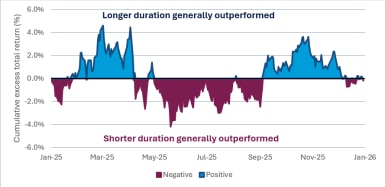
Sources: Schwab Asset Management; Bloomberg. Daily data for the 12 months ended 12/31/25. Shorter-maturity positioning is represented by the Bloomberg US Treasury 1-5 Yr Total Return Index, and longer-maturity positioning is represented by the Bloomberg US Long Treasury Total Return Index. Indexes are unmanaged, do not incur management fees, costs, and expenses, and cannot be invested in directly. For more information on indexes, please see: https://www.schwab.com/resource/index-and-investment-term-definitions. Past performance is no guarantee of future results.
Credit selection is another area where an active, disciplined approach can add value. Investment-grade corporate bonds, high-yield bonds, preferred securities, and municipal securities may each present relative opportunities, but tight spreads make careful issue selection, liquidity management, and credit research especially important. Exhibit 2 illustrates these points, offering a theoretical example of how higher- and lower-credit-quality strategies may have fared in 2025 by plotting the excess cumulative total return of the Bloomberg Baa Corporate Index minus the return of the Bloomberg Aaa Corporate Index.
Exhibit 2: The shifting performance of credit quality strategies in 2025
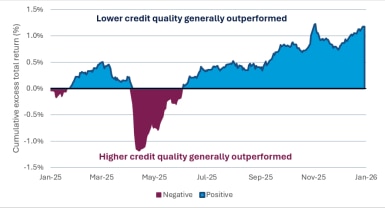
Sources: Schwab Asset Management®; Bloomberg. Daily data for the 12 months ended 12/31/25. Higher quality represented by the Bloomberg Aaa Corporate Index and lower quality represented by the Bloomberg Baa Corporate Index. Both of these indexes are part of the Bloomberg US Corporate Index. Indexes are unmanaged, do not incur management fees, costs, and expenses, and cannot be invested in directly. For more information on indexes, please see: https://www.schwab.com/resource/index-and-investment-term-definitions. Past performance is no guarantee of future results.
Active management doesn't guarantee stronger performance. Still, it can help make a bond allocation more intentional by shaping decisions about where risk may be rewarded, where it should be reduced, and where relative value may emerge as conditions change.
SMA structures can potentially strengthen advisor value
Actively managed bond SMAs offer clients customized experiences. SMAs can be selected to reflect a client’s specific tax profile, income needs, maturity preferences, liquidity requirements, credit-quality parameters, and restrictions. The structure can also provide greater transparency into the individual securities held in the account, which are directly owned by the client. This makes explaining how a client's strategy is being implemented and why specific holdings support key objectives more straightforward.
SMAs can also create meaningful leverage for advisors. Instead of focusing on the day-to-day demands of portfolio construction, security selection, credit research, trading, monitoring, and risk management for a client's fixed income allocation, advisors can turn these activities over to the SMA provider and spend more time cultivating and deepening client relationships.
When exploring actively managed bond SMA strategies, advisors might be well served by considering Schwab Asset Management's Wasmer Schroeder Strategies. These taxable and tax-exempt SMA strategies provide options across the credit, duration, maturity, and tax-efficiency spectrum. Depending on the strategy and account circumstances, certain client preferences or restrictions might also be accommodated. Although it's also important to remember that while customization and professional management may be beneficial for some clients, advisors should evaluate whether the additional costs, risks, and account-level customization offered by an SMA are appropriate for each client's unique objectives and circumstances.
Advisor workflow: From market complexity to portfolio fit
In today’s uncertain market environment, income still matters—but selectivity, structure, and client-specific needs might matter even more. A practical adoption workflow like the one suggested below can potentially help advisors move clients from product exposure to a more strategically inspired portfolio design:
- Screen for fit: Identify clients whose tax profile, income needs, liquidity requirements, restrictions, or municipal exposure might warrant a more tailored fixed income approach.
- Define whether customization adds value: Evaluate whether the client's objectives can be addressed through strategy selection alone or whether additional account-level considerations should be explored.
- Position the client conversation: Use areas such as direct ownership and security selection to explain why a tailored structure might be appropriate to help a client achieve their long-term financial goals.
- Evaluate and implement selectively: Consider actively managed bond SMAs—and providers such as Schwab's Wasmer Schroeder Strategies—when professional management, transparency, and customization might strengthen the bond allocation’s connection to the client’s objectives.
Learn more about Wasmer Schroeder® Strategies
About the author
