
What Is a Company Actually Worth? Valuing Public vs. Private Companies

Key takeaways
Two different processes: Public company valuations update throughout the trading day as buyers and sellers transact on an exchange. Private company valuations are episodic, set at the last funding round or secondary trade, and can hold steady for months until the next transaction resets them.
Private markets are catching up on data: Growing secondary platforms are bringing transparency to the private market. Better data can give everyday investors a clear, once-institutional window into the asset class.
The trade-off is patience for access: The private market can offer investors early access to category-defining companies before they ever go public. It carries real illiquidity, with steeper bid-ask spreads than those typically found for public stocks, and value tends to concentrate among a small number of top-tier firms. Like any company, private ones can stumble or fail. Understanding these trade-offs is essential so investors can determine whether private market investments align with their financial goals and risk tolerance.
Introduction
Valuation sounds like it should have a simple answer: What is this business worth? For a public company, like Apple, the market answers that quickly through a number ticking on a screen, updated throughout the trading day as buyers and sellers transact. Ask the same question about a private company and the answer works differently. The private number was set occasionally, at a funding round or a secondary sale, and usually after investors actually transacted. Both numbers are "valuations." That gap between constant and occasional valuations marks the beginnings of what separates the ability to value public and private companies and price their shares.
How a company’s price gets set
Compared to many areas of finance, finding the value of a public company can be a fairly accessible calculation: Share price multiplied by shares outstanding, supplied by an exchange matching real buyers to real sellers. A private company does not have the type of real-time, dynamic exchanges public companies do, so its price is set episodically at the last funding round, tender offer or secondary trade, and can hold steady for a year or more until someone transacts again.
A growing category of secondary trading platforms, marketplaces built for investors to buy and sell private-company shares, exists to narrow that gap. Some of these platforms also publish indicative, model-derived price estimates for late-stage private companies, blending secondary trades, funding-round data and investor bids and asks into something closer to a live quote. The underlying question is the same for public and private companies: What will this business earn, and what should someone pay for that today?
The nuts and bolts: how each price gets built
Neither number is pulled from thin air. Both are built from a small toolkit of methods:
| PUBLIC COMPANY | PRIVATE COMPANY |
| Continuous quote An exchange matches buyers and sellers all day; value = share price × shares outstanding. | Funding-round price New investors pay a price for new shares, setting the company's “post-money” valuation. |
| Comparable companies Analysts benchmark the stock's P/E, EV/EBITDA, or price-to-sales against similar public peers. | Comparable transactions Investors weigh what similar private (and recently public) companies have fetched. |
| Discounted cash flow (DCF) Estimate future free cash flow and discount it back to today's dollars. | Secondary trades & indications Investors transact on secondary trading platforms which blend trades and live bids/asks into a daily estimate. |
| Quarterly checkpoints Earnings reports test the story roughly every 90 days. | Independent appraisals Many private companies selectively disclose financials and/or commission periodic third-party (409A) valuations. |
Valuing the market, not just one company
Zoom out and the same split shows up at the market level. Public investors lean on aggregate indicators like the S&P 500's price-to-earnings ratio, currently around 23.6x (as of Sept 4, 2026) trailing earnings1, above its roughly 16.2x all-time mean2. The private market has historically lacked an equivalent indicator, mostly for lack of data, but that is starting to change. Secondary trading platforms, independent valuation services, and new benchmarks are making it increasingly visible. Because no single number captures the whole market, investors typically look at several signals together, such as the price of the most recent funding rounds, whether secondary trades are clearing above or below those prices, and how long companies go between rounds. More data flowing out of the private market can mean a clearer window into a part of the economy once visible primarily to institutional investors.
A public stock price is a snapshot taken in real-time. A private valuation is a snapshot taken every few months. The latter asks for more patience of an investor but often rewards it: Fewer moves driven by daily headlines, more tied to how the business is actually doing.
Valuing one company, up close
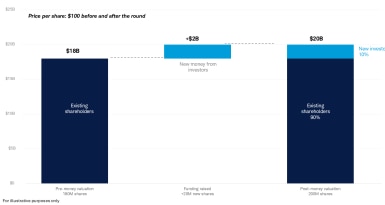
Owning a public stock means relying on a price you can check and act on immediately, informed by quarterly earnings and a constant public negotiation playing out in the price itself. Owning a stake in a private company means relying on a price closer to a professional appraisal (the venture and growth investors' collective judgment) than a stock quote set at the moment of the last round. Say, for example, a private company - call it Company XYZ - raises $2 billion at a $20 billion valuation. That figure becomes the reference valuation: the price a set of investors agreed to pay at that moment, reflecting informed judgment rather than daily public sentiment. As the chart below illustrates, those investors now own about 10% of the company. XYZ was worth $18 billion before the round (the pre-money valuation), and the $2 billion of new money brings it to $20 billion afterward (the post-money valuation). This valuation will likely hold until the next funding round, clarity from secondary market trading, or a move to IPO. It's worth remembering, though, that this is a snapshot — the next round could value the company higher or lower, and some private companies fail to reach one at all.
How a funding round sets pre-money and post-money valuation
Hypothetical example
IN PLAIN ENGLISH
- Bid-ask spread: The gap between what a buyer offers and a seller wants. Narrow in public markets (often pennies); wider in private markets, where trading is less frequent.
- Liquidity / Illiquidity: How easy or hard an asset is to sell quickly at a fair price. Private shares are less liquid than public stocks, which is why investors are typically compensated with extra expected return for holding them.
- Price discovery: How a market figures out what something is worth. Continuous for public stocks; built round by round, trade by trade, for private ones.
The private market trade-off
Patience for access
Illiquidity is a hidden fee in private markets: The average cost to trade (the bid-ask spread) is typically much steeper compared to a fraction of a penny for many stocks on public exchanges. In exchange for locking up their capital, investors accept this illiquidity with the expectation of capturing higher growth potential by targeting companies at an earlier stage.
Private companies also carry the risk of failure. Many never reach an IPO or an acquisition, and higher growth potential comes with higher risk.
Concentration and what it means for access
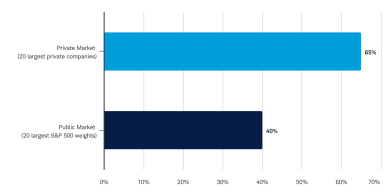
The private market is also more top-heavy: The three most valuable private companies made up 65% of the combined value of the top twenty, compared with 40% for the equivalent top three in the S&P 500. That concentration cuts both ways. It means a handful of large companies make up an outsized share of private-market value, which can offer early access to companies that may one day go public. For every category-defining success, many more private companies stagnate or fail — and without a public exchange to sell on, investors have limited options if things go wrong. As with any concentrated part of the market, diversifying exposure across a handful of companies is a common approach used to help manage single-stock risk.
Top 3 of 20 concentration ratio: public vs. private markets 3,4
Share of combined value held by the 3 largest companies
Where the two markets agree
Underneath the mechanics, public and private valuation try to answer the same question: What will this business earn, and how much should someone pay today for a claim on that? Both can run hot on sentiment as easily as on fundamentals, and both eventually face the same test: a market willing to trade. When a private company goes public, its valuation, built over years of funding rounds, is tested against public market pricing, and the two do not always converge. The IPO price can come in above, below or in line with the last private valuation, and the shares can move quickly in either direction once they begin trading.
Conclusion
In our opinion, the private market isn't simply a riskier version of the public market. It's an entirely different risk and reward profile, one that includes the possibility of losing the entire investment. As part of that unique profile, the private market prices a different kind of information, over a longer time horizon, and with increasing sources of data. Public markets require attention paid daily; the private market requires patience and homework paid gradually, in exchange for access to companies at an earlier stage of their growth. The private market, once effectively closed to individual investors, is opening up, and understanding how its prices are built is the first step to deciding whether it belongs in a portfolio.