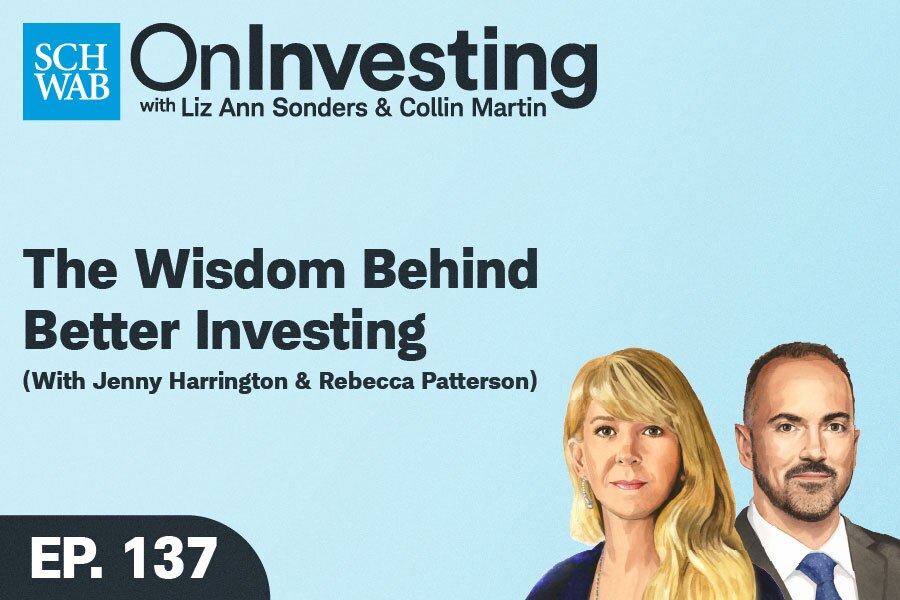
The Wisdom Behind Better Investing (With Jenny Harrington & Rebecca Patterson)
Transcript of the podcast:
LIZ ANN SONDERS: I'm Liz Ann Sonders.
COLLIN MARTIN: And I'm Collin Martin.
LIZ ANN: And this is On Investing, an original podcast from Charles Schwab. Every week we analyze what's happening in the markets and discuss how it might affect your investments.
COLLIN MARTIN: Well, hi, Liz Ann. It's been a busy week to say the least. We've gotten … there's been a lot of economic data. We'll talk about that, of course. I think it's probably a little overshadowed by the election news. We are recording this on Wednesday, November 4, so after Election Day. But we're not going to go too much into that because we have plenty of coverage here at Schwab. Check out Mike Townsend's podcast, WashingtonWise. He's going to be your source for all things elections. But we'll discuss it briefly here. Let's talk markets now.
Despite the election, there's plenty of other things that are going on right now. We're seeing action dominated by artificial intelligence, by hyperscalers, by jobs data. What are you seeing?
LIZ ANN SONDERS: Yeah, and let me just touch quickly on the election. I'm not going to try to forecast what the market is going to do beyond what we see as we're taping this with futures up significantly in advance of the open. And that may have to do with … so I've heard a lot of chatter about could the election be a clearing event? And if you want to be precise around what those tend to mean is that you have a period of weakness in the market heading into something, whatever it is, and then you get a lift in the market. And that's often described as a clearing event.
The reason why I think it maybe isn't the perfect descriptor this time is that I don't think the election, uncertainty about it, potential policy changes, were a big part of some of the underlying weakness that we have seen recently. You know, Collin, you mentioned AI and the hyperscalers. This has been an AI story in terms of where the pockets of weakness have been. Concerns about credit availability, cost of credit, the potential for a peaking in forward-earnings-growth expectations in capex spending. So what maybe the election did was, it was decisive. And it's not a drawn-out affair with contested results, and so I think that may be one of the things that the market is reacting to.
But I think this AI story is an interesting one because that's where, and we don't know the details fully yet, where the election potentially matters because of how political the issue of data centers has become, with actually it's kind of a bipartisan view on that based on constituents. So this is not just a right versus left; it's a concern about the rapid growth. All that said, this is not just about the election as it relates to data centers. I think it was yesterday I put on my X feed showing that the data center cancellations this year are up significantly. So whether it's the force of politics or maybe more that they're just not as popular or constraints in terms of a lot of what is needed to build out the infrastructure of AI, inclusive of data centers, costs going up significantly. I think there's a lot at play that had already shown some deceleration in the push higher in data centers. And I think that's part of the reason why you have not seen a significant boost to forward earnings estimates as it relates to the AI story.
In the meantime, the good news is we've seen retreats in some of the former darlings. You've seen acceleration in other areas of the market. So an improvement in breadth. You have about 75% of the S&P's constituents have outperformed the index over the past month. Just a few weeks ago that had gotten down to only 17%. So we are seeing a broadening out. Some of the, you know, I hate to use a wartime analogy, but it's a common way to think about breadth. You know, we've had some of the generals move back away from the front lines, but a lot more soldiers have moved up to the front lines.
Another interesting phenomenon is that we just saw in the last few trading days the health care sector leapfrog the tech sector to become the number-two best-performing sector on a year-to-date basis. It was as recently as October 28 when tech was the second-best-performing sector. What was also interesting in that array from a performance-ranking standpoint is, and it was through October 28 that energy and tech were the two top best-performing sectors year-to-date. The only time in the last 50 years where the two best-performing sectors had a negative correlation. Because normally your top two performers tend to have a similar kind of background story, macro story, fundamental drivers. And that has not been the case this time. And I would argue with health care now at the number two spot, that also has different drivers than what has been driving energy and what has been driving tech. And I think in the case of health care, it's not just a story of investors going a little risk-off and wanting to go into more defensive areas. I think health care is actually an example of an AI beneficiary, in terms of everything from the low-hanging fruit of inefficiency, but also the implications of AI on things like diagnostics and testing and disease prevention and cure.
So that's just what's top of mind for me as we sit here. How about you, Collin? What are your thoughts on the fixed income market? Maybe a, you know, sentence or two about the election and impact on yields and what you're paying most close attention to.
COLLIN MARTIN: Yeah, on the election, you know, like I said, things are probably going to change, but the quick kind of view that we're seeing, we're seeing yields down a little bit, but what we're probably going to see is gridlock. And if there were concerns on the fiscal side, you know, it's tough to get much done right now, if you have, you know, Democrats in Congress, President Trump saying he's going to veto anything, there's probably not much going to change there on the fiscal side, which I think is good. I think the markets are kind of breathing a sigh of relief that maybe those concerns won't become more concerning.
Now, we don't think fiscal concerns have actually been the dominant driver lately, but it does play a role, of course. So that's something that we're going to be paying attention to a lot over the next few weeks and months. In terms of other kinds of trends we're seeing in the market, there's two risks that we're focusing on. And I'll build on what you were talking first about, Liz Ann, and kind of AI and that trade because that matters with bonds as well.
You know, we've talked about this ad nauseum with the, you know, data center build-out funded by corporate bonds, and we're seeing that with performance. So if we look at investment-grade corporate bond sectors. Now we don't get into sector views with corporate bonds. It's harder to implement that than it is, say, on the equity side of the equation. But we're seeing that performance kind of play out where year-to-date, both the communications sector and the technology sector, the bonds, are underperforming Treasuries the most. And we actually see a lot of the other sectors and industries outperforming Treasuries. So it's a very bifurcated market, which is in line with, I think, what we've been highlighting, where from a tops-down look, corporate fundamentals appear to be pretty healthy, but there's clearly these risks on the tech and communication side with all the AI build-out, with supply and demand concerns, especially knowing that they're issuing so much long-term debt. Will there be enough buyers there? If there's not, sometimes you need to see yields rise to kind of get supply and demand more in equilibrium. And also just profitability concerns.
I think that's the big one. That might not be a risk for the highly rated companies in the here and now. That might take a few more years or a number of years, or maybe, maybe that risk might not come to fruition. But it's important to understand that there's layers here. And credit ratings matter. The size of the company matters. The stability of their cash flows matter. And there probably will be some winners and losers. And we're already seeing that. So somewhat of a defensive approach as it relates to corporate bonds today, specifically with those AI-related bonds.
I think that might be something that investors might want to consider when evaluating any portfolio opportunity, if it's a portfolio of individual bonds or a mutual fund, ETF, some sort of managed approach. Take a look to see what that tech exposure is. Something else that we're paying attention to, Liz Ann, is the general inflation outlook and what that means for Fed policy. And I'll highlight that as a key risk because we've been highlighting our more favorable view on bonds lately. And I say more favorable—that's a overgeneralization there—but I say that to highlight that yields are high right now. And when you look at bond investments, starting yield tends to be a very good indication of forward returns. Not that you can't see prices fall a little bit further from here, but we think the starting yield is attractive.
Our outlook, though, is based on the Federal Reserve hiking rates two more times. So once at the end of this year of the December meeting, and then one more time, likely early in 2027. But if inflation remains stickier or maybe even moves up a little bit and the Fed needs to hike a little bit more, that's clearly a risk to our view because we'd probably see Treasury yields move a little bit higher. Treasury yields are forward looking. So when you look at two-year yields, five-year Treasury yields, they're kind of already pricing in that two-ish area of rate hikes.
If the Fed needs to act more aggressively, that would be a risk to our view, and you'd likely see Treasury yields move a little bit higher. That's part of the support for our guidance of favoring short- and intermediate-term maturities versus favoring long-term maturities just yet, because we want to get a little bit more clarity on the inflation situation right now. And how's that playing in? I mean, inflation's still very much here.
LIZ ANN SONDERS: Oh yeah. So inflation is more than just an energy story, and we've talked about that on this podcast before. There's a tariff element to it. There is an AI element to it, given the rising cost of many of the inputs into the AI build-out. So I don't think the inflation story starts to fade if and when there's some sort of resolution in the war, so that there are other factors driving inflation.
But I wanted to just quickly pull on two threads of what you mentioned, Collin. One on profitability, and that's particularly important as you go down the cap spectrum. Because if you look at the Russell 2000 index of small-cap stocks and look at year-to-date performance, there is a massive spread between the profitable stocks within the Russell and the non-profitable stocks. So last year, the nonprofitable stocks had about double the performance of the profitable ones.
It's more than the opposite this year. The profitable stocks within the Russell 2000 are up more than 20% year-to-date as we tape this. And the non-profitable stocks are up only 2% or 3%, and so that, I don't know, 18-percentage-point spread is massive in favor of profitable. And you also mentioned diversification, and one important message out there to our listeners and to investors in general with regard to diversification is we talk about the merits of it, both within and across asset classes, but I think there's another step that probably is warranted in terms of the across-asset-classes diversification. Because if you're an investor that has an equity portfolio that might be very biased toward AI themes, you know, tech, communication services, Mag 7, however you want to define that, and you have corporate credit in the fixed income sleeve of your portfolio that may also have a heavy AI bias. And then let's say you also own exposure to private equity or private credit, there's often an AI theme.
So make sure that when you're thinking about diversification across asset classes, you also consider what I would call maybe attribution diversification, thematic diversification, not just asset-class diversification.
COLLIN MARTIN: No, that's a great point. And I'll build on that even a little bit more with fixed income, where not all fixed-income investments are created equally, and they're all going to respond to different things, and they have different correlations or relationships with different investments. And there are some bond investments that are highly correlated to the U.S. stock market. That includes high-yield bonds, which are sub-investment-grade-rated corporate bonds.
Preferred securities tend to have high correlations with the stock market, bank loans, another form of high-yield investment. So when you're building a portfolio, you know, I'll use air quotes. We love using air quotes here, Liz Ann. Air quotes that no one can see. You know, some bonds are going to perform a little bit differently. And if you're looking for true diversification benefits of holding bonds that tend to have a low correlation or low relationship with stocks, those would be investment-grade-rated bonds, usually more of Treasuries, agency-, mortgage-backed securities, things like that. And when you go down the risk spectrum, you'll tend to see investments that are going to move more closely with U.S. equities.
And Liz Ann, we're going to do something a little bit different this week. I'm going to turn it over to you to introduce our guests and tell us a bit about the book that they are here to discuss.
LIZ ANN SONDERS: I sure will, Collin, and I'm really, really excited about this. It's a book that I actually wrote a chapter of. And the title of the book is Investment Wisdom for Our Friends and Loved Ones. It's published by Harriman House. And the official pub date of the book is November 17, but you can pre-order it now. It's 25 essays, all by prominent women in business and Wall Street, and I am so happy to be among those asked to contribute, and it all goes to charity. So read up more about that. We are not personally making money off of this book.
And I am really thrilled to have both co-editors of the book here with me. First is Jenny Harrington. She is the CEO of Gilman Hill Asset Management and portfolio manager of the firm's flagship equity income strategy. Jenny is a sought-after expert on investing. She is featured in major business publications as well as a regular contributor on CNBC's Halftime Report.
And Rebecca Patterson is a globally recognized investor and macroeconomic researcher with nearly 30 years of experience across the U.S., Europe, and Asia, studying how politics and policy intersect with economic trends to drive financial markets.
So as mothers, I suppose one of the questions we always say we're never going to answer is "Who's your favorite child?" And I say that about our podcast here and all the incredible guests that we have had over the last couple of years. And everyone is fantastic, but I am really, really excited about this.
First of all, this is, I think, maybe the only, or maybe we've done it once or twice before, where we have two guests, and they're my friends Rebecca Patterson and Jenny Harrington. So thank you so much for joining me today.
REBECCA PATTERSON: Thank you, Liz Ann. It's great to be here.
JENNY HARRINGTON: Thanks so much for having me.
LIZ ANN SONDERS: We're really excited because we are involved in a really wonderful project. And I'm not going to ramble on about it. I'm going to toss it to you guys to talk a little bit about this little project that quite a few of us have been working on for a bit of time. So I don't know which one of you wants to start, but all right, they're both pointing. You guys can't … listeners cannot see us, but Rebecca and Jenny, you're each pointing at each other. So …
REBECCA PATTERSON: We're being unusually polite, Liz Ann. So it's Rebecca. Why don't I kick us off? So Jenny came to me about a year ago and said, "I have a great idea for a book." And she told me about a friend of hers who sadly had recently lost her spouse and was a very successful, very well-educated woman, but hadn't been in charge of her family's finances and wasn't sure where to start. And Jenny said, you know, "I was thinking about it. And there's a chapter here and a paper there, but there's not one thing I can say, 'Oh, you should read X.'"
And I agreed. I've spent over 30 years in finance. I've spent about half of that in private banking, so dealing with individuals and families. Same thing. People: "Where do I start? What should I do? What should I know?" And so we thought, "Let's put it all down on paper and try to help people." And then we thought, "Well, gosh, if we could do a decent job, maybe we know other people who could jump in." And what was so interesting, Liz Ann, obviously your name was like top of our list. We were so excited you said yes. But we quickly realized the people we knew who would be able to give wisdom to others in clear, common-sense language, no jargon, they happen to be women.
I don't know if the, you know, causation, correlation, but we ended up with 25 amazing senior women in finance and around finance, different asset classes, big firms, little firms, and we had each of them write a chapter saying, "When someone you care about says, 'What do I really need to know? What do I really need to do?' This is what they say." And they wrapped it into stories of their careers and lives. And I think the hope is that anyone who picks up this book will find at least a dozen chapters that apply to where they are in their life.
LIZ ANN SONDERS: No question.
JENNY HARRINGTON: And we have you bat cleanup Liz Ann.
LIZ ANN SONDERS: Yeah, so I'm the closing chapter.
JENNY HARRINGTON: And you're the closing chapter.
LIZ ANN SONDERS: I don't know whether that's a good thing, a bad thing, an indifferent thing, but maybe fewer people read the last chapter, but for our listeners, I say go backwards. Just throwing that out there.
JENNY HARRINGTON: You know, it's funny, though, because we felt like your chapter, where you talk about the mentors who gave you their wisdom, who paid it forward down to you, and then you're paying it forward. Your chapter we thought should have been either the first or the last, right? And so we thought Liz Ann really brings it all home.
LIZ ANN SONDERS: Oh, thank you.
JENNY HARRINGTON: Oh, you're welcome. It was very strategic. So everyone had better read the last chapter, even if you start with it. But it was an interesting thing how you said essentially like, "Look, it's the collective wisdom of others, that's what I've learned off of," and that's what this book is: the collective wisdom. Because the reality is very few people are exactly the same kind of investor. And when they ask you, "Where should I start?" Everyone thinks there's like a common starting point, but there's not. And you need to know, you know, "Am I an investor who wants to be in funds or wants to be in individual stocks? Do I lean towards income? Do I lean towards growth? You know, do I need bonds in my portfolio for the emotional stability, you know, or the financial stability?"
And so when you give someone just one investment book, they need to read 300 pages of one opinion. And the beauty of this was bringing 25 different people's opinions and thoughts on what they share so that you can say as you read it, "Hey, this resonates with me, and this doesn't." But by realizing that this doesn't, you've taught yourself something.
LIZ ANN SONDERS: So Jenny, spend a little more time talking, aside from how I introduced you both with your impressive bios, talk a little bit about how you approach your roles on a day-to-day basis, the history of your involvement in the world of finance and how you brought that to this idea.
JENNY HARRINGTON: Oh, that's a hard one. OK, I'll start at the very beginning, which goes back to, and actually might be really timely right now, which goes back to the dot-com boom when I was in private client services at Goldman. And one of the things that I think about a lot, that I share almost never, is that one of the sales assistants asked me, you know, "What should I buy in my husband's IRA?" And I didn't know any better. It was 2000.
You know, and I remember telling her something like, "ValueClick and DoubleClick seem like great companies," but I really didn't know what I was talking about. And I don't think she bought much, but I know I skunked her completely, you know, with just what I didn't know. And this is 20, almost 30 years later, and I still feel horrible about that. You know, so as time went on, I then went to Neuberger Berman, and then I became a dividend income investor.
And between Neuberger and Columbia Business School, like my investment process really refined, but mine's based around creating a really sustainable dividend income stream, because that's what I as an investor can live with from a risk perspective.
LIZ ANN SONDERS: And Rebecca, you've had an interesting path you've been on. So talk about your time both on Wall Street and what you're doing now with CFR and how you brought that background into this this book.
REBECCA PATTERSON: Sure. You know, I think if I have North Stars or something that ties my whole career together, it is teaching myself, always learning, and then educating others. I started life as a journalist, and when I would go out to research or report a story, and then I share it with others. I moved in '97 to JP Morgan as a research analyst in the investment bank, doing currencies and commodities, same thing. I'd have to dig around in the data, talk to other people within the bank, outside the bank, come up with my views and my forecasts, publish them, and then advise clients.
So throughout my career, that has been the one thing, or the two things, I guess I should say, that drive me, just learning and then educating. So I went from investment banking to running a trading floor in 2008-2009. That was a fun education. And I learned I liked managing risk. That led me to be a chief investment officer at a multifamily office called Bessemer Trust for eight years and then, most recently my investment role, chief investment strategist at Bridgewater Associates. So that was going into a hedge fund.
So I've actually seen finance from three different continents in pretty much every type of investment shop you can think of, which gives me a really interesting, I think pretty unique, perspective on the investment universe. For the last three years-ish, I've been at the Council on Foreign Relations (CFR), which is a think tank.
So I've been going back to my research and education route. So I am not currently running money. I am trying to connect the dots between geopolitics, policy, economics, and finance. So if we have a war in Iran, what does that mean for global supply chains? How does that feed into inflation? How does that affect the Federal Reserve, etc.? And I'm spending a lot of my time trying to educate the public through research I write and publish or policymakers from different countries or companies. Tonight I'll be speaking at a dinner with chief risk officers from different companies around the country about AI governance and cyber risk. I'm a macro investor, so I don't pick stocks. I look at the world from a top-down perspective and try to put all the pieces together.
LIZ ANN SONDERS: Yeah, very much what I do, too. I literally and figuratively fly around at about 30,000 feet and also very much believe in the education piece of this, as we do at Schwab, as you probably know, where we're big proponents of financial literacy and really being a force around providing that education, particularly to younger people, which I guess is maybe a good segue to talk a little bit about where the proceeds of our book sales are going to go.
REBECCA PATTERSON: So we asked our authors if they had thoughts, and we ended up with two nonprofits we're very excited to support, the Boys and Girls Club of America, which I know Charles Schwab is heavily involved with.
LIZ ANN SONDERS: Heavily involved, and as am I.
REBECCA PATTERSON: Yes, you're on the board.
LIZ ANN SONDERS: So I am on the board, national board of trustees for Boys and Girls Club of America, and I'm also vice chair of Nantucket's Boys and Girls Club. So I was obviously thrilled. On behalf of just me, our clubs, and our company, that that was one of the choices. So thank you.
REBECCA PATTERSON: And it's a great tie-in because our whole goal is to educate others and pay it forward. So we're going to pay it forward with them. And then the other nonprofit is one where Jenny and I sit on the board. I chair the board, and it's called the Council for Economic Education. And it is all about K through 12 economic and personal finance literacy. So we train teachers, we work directly with students, and then we advocate states to pass requirements. So hopefully, when kids finish high school, they have this foundational knowledge, and they understand what a credit score is. They understand the importance of investing early so they can get the benefit of that compounding over their lifetimes. So any profits we make as authors here, we're going to put towards both of those institutions, and hopefully some other people will benefit.
JENNY HARRINGTON: I think what we all three share is that we know that financial and economic education is the ultimate equalizer. If you can speak money, like, it just levels the playing field.
LIZ ANN SONDERS: No question. So Jenny, talk a little bit about the outreach. How did you sort of cull the list of women to whom you … I, you know, for me, I heard the pitch, so to speak, proverbially raised my hand, said "I'm in," and it was a very short exchange. So how did you come up with the list? And I assume you had the vast majority were positive, "Yes, count me in."
JENNY HARRINGTON: Almost everybody. There were a few who I was surprised who were too busy or frankly too shy. But for the most part, it was a very easy ask. And Rebecca and I were very strategic with asking people who aren't just superb investment business professionals, but we know have an extraordinary ability to communicate and communicate in straightforward, no jargon, super authentic, super human terms, and weren't going to bring any sales or any angle to it. And that was really important.
And just bring like their whole selves. And it's funny because when you read the book, in some ways, you know, thanks to Rebecca and her extraordinary brain and her original journalism background, she was able to see the cohesion and put the chapters in the right order, which I could not have done. So you see the flow, but to some degree there's not a lot of cohesion behind the chapters because no one was given instructions. You know, they were just asked, "Please write how you feel." And you get like, I mean, some of the chapters, Liz Ann, they almost make you cry.
They're so personal and they're so authentic. And so that's what we went for. And just not everybody's good at that. You know, that communication skill is pretty unique. So you really feel it. And that was a huge part. The talent and the skill, that was more common, or that is more common than the ability to communicate.
LIZ ANN SONDERS: And you know what's nice about a book like that where every chapter is quite different. I mean, the overarching message of what we want to impart is the same, but everybody approaches it in a different way. And I know, myself included, that there's a lot of people that don't have a ton of time to read books. I drink from a fire hose of information every day, so I'm reading constantly, but a sit down and read a book from beginning to end is very difficult. This is not one of those books where, "Boy I really need to devote the time because what if I forget what I read in chapter three and I'm now in chapter five?" These are almost like a bunch of short stories put together in a single volume. And I think it's therefore digestible for everybody.
REBECCA PATTERSON: That's a great way of putting it. And we even went a step further, because rather than having to download the book into your favorite AI model and have it give you a summary, we put a summary at the back of the book on all the specific action items from each chapter. So if you literally had five minutes, you could go to the back of the book and just say, "OK, here are the pieces of investment wisdom that they're sharing in one quick place."
So it's within each chapter, but you can also refer to that if you forgot what was in chapter five, page 78, paragraph three.
LIZ ANN SONDERS: And as a reminder, "Investment Wisdom" is the first part of the title of the book. The second part is "For our Friends and Loved Ones." So who came up with that title? Because I love the fact that the first part just is what it is. But the second part is, I think, what pulls on the heartstrings and probably gets people to open the book.
JENNY HARRINGTON: So it's funny. There was so many iterations because at one point it was "For our Loved Ones." And then the publisher said, "Oh no, that sounds kind of creepy. It sounds romantic." And then we said, "For our Friends and Family." OK, but that sounded like a coupon for a sale. So it went through … Rebecca, how many iterations did that simple title go through?
REBECCA PATTERSON: Way too many.
JENNY HARRINGTON: Way too many. So we ended up with "Friends and Loved Ones," you know, so it didn't sound romantic or salesy, hopefully.
LIZ ANN SONDERS: One other thing I wanted to ask both of you, and I know it gets woven throughout many of these chapters, and it's something that I think about quite often when I am sitting down with either a large group of our clients or sometimes individually, is, you know, we all believe in literacy and education, and in particular, that the key to success in investing is to have some semblance of a plan, that this is not about winging it, it's not about gambling.
And I think the whole notion of the blurring of the lines between investing and gambling is certainly very paramount for us as a firm and me personally. I've been writing quite a bit more about it. But one of the things that I find in hearing stories about investors and maybe some of the mistakes that were made or lessons that they learned was misunderstanding that financial risk tolerance and emotional risk tolerance can often have a yawning gap between the two.
So financial risk tolerance is something that ostensibly is what we put on paper. It's our time horizon, our perceptions around risk tolerance, need for income. What are the uses for this money? Are we living on the income? I mean, the list goes on and on and on. But then we're hit with something dramatic in the market, particularly a bear market, and we find that our emotional risk tolerance is not at all connected to our financial risk tolerance. So I know that that's a thread woven into this in a number of different ways, but talk about each of your experience with either that specifically or just the concept of how we think about risk tolerance.
JENNY HARRINGTON: So once a year I teach a class at Baruch. And what I do is I start … I have all the students send in their favorite investment quote. And one of the things I love about your chapter too, Liz Ann, is how many beautiful quotes you bring in. And throughout the book, you'll see we ask each author, give us your favorite quote. And what you see from all of those is the best investment wisdom, most investment wisdom, doesn't talk about valuing a company, doesn't talk about asset allocation, it talks about behavior and good investment behavior. And I think that's something that we try … that not only do many of the authors talk about in their chapters, but we talk about cohesively throughout the book is this: It's all about behavior. It's all about knowing yourself. Again, if you know yourself, you know, if you know that you're an income, a wimpy income investor like me, you know, and you're invested correctly for your emotional constitution, you will get through whatever nasty bear market comes your way.
If you can't stand missing out on the huge market swings because you're an innate growth investor, great, but you have to figure that out. And the effort of the book really is to help people figure out truly, you know, whether they've been investing for a while or whether they're just starting off, like who are you as an investor? And we give 25 different thoughts on like different investing styles and pathways, because if you can get to who you really are, then you can behave well.
LIZ ANN SONDERS: Right. Rebecca?
REBECCA PATTERSON: No, that was a great answer. The only thing I'd add to that is you started off talking a little bit about investing versus some of the trading gamification of finance, prediction markets, gambling that have become so, so popular, especially with younger people today. And sometimes you hear a narrative that this is the new way of investing. I agree with you, Liz Ann. To me it's reminiscent of building a portfolio, knowing what your goals are, knowing what your emotional tolerance is, but you're someone who loves to trade, and you're a short-term trader, that's fine. But figure out what percent of your total wealth you can afford to put in that bucket, knowing that it might go through the roof, and it might go to zero.
It's your money, but know how much you can afford to lose, put it in a bucket, and understand the difference between that and what, I think, the three of us would agree is investing. Investing is a plan. It's long term. It's to make sure you have a healthy financial life. And I do think we try very hard in the book to explain those differences without casting judgment. Again, if you want to use some of your money for that and you understand the risks you're taking, fine, fine. But it is different.
LIZ ANN SONDERS: The way to think about this in simple terms is investing is about owning. Gambling is about hoping. Those are two distinctly different things. As an investor, you are also a participant. You're a participant in wealth creation. As a gambler, again, it's about hope. And you're a spectator more than you are a participant. So I'm always a big believer that anything we collectively can do that understand the difference between those two and understand the necessity of financial literacy and education. That was the reason why I raised my hand so quickly in contributing to this book.
LIZ ANN SONDERS: Jenny and Rebecca, thank you so much for being here today. This has been wonderful.
COLLIN MARTIN: All right, Liz Ann, as we always do, let's look ahead to next week. So real quickly, what's on your radar?
LIZ ANN SONDERS: Yeah, well, the day this episode drops, we will have had the jobs report, so we'll all be dissecting that. We get the National Federation of Independent Business, which is a think tank around small businesses, and probably the big ones being the Consumer Price Index and the Producer Price Index. I assume those two are top of mind for you too, Collin. Anything else?
COLLIN MARTIN: No, it's all about the Consumer Price Index, the CPI. That's going to be very important for the Federal Reserve. One little interesting thing, there will be no year-over-year number reported because of the government shutdown last year.
LIZ ANN SONDERS: Oh that's right, right.
COLLIN MARTIN: So there will be no year-over-year number reported. There we go. A little fun fact for our listeners.
LIZ ANN SONDERS: That's right. Interesting. Yeah. OK. Fun fact, yeah.
COLLIN MARTIN: Don't know if that's ever happened before. And then on the bond theme, we get a couple bond auctions, Treasury auctions. We get the 10-year auction on Tuesday, and we have the 30-year bond auction on Thursday. Will be interesting just to kind of see with yields still elevated, what sort of demand is out there. Generally speaking, if you get a weak demand, that can be a little bit concerning. But demand has generally held up, and I think that that should continue given the relative attractiveness of where yields are today.
LIZ ANN SONDERS: Well, that's it for this episode. Thanks as always for listening. We really do appreciate it. And another shameless plug here. You can learn more about the Investment Wisdom book at investmentwisdombook.com. We made that easy for you. And you can, of course, keep up with me and Collin in real time on social media. I'm @LizAnnSonders on X and LinkedIn. My usual PSA: Make sure you are following the real me, a massive rash of impostors, beyond the norm very recently.
COLLIN MARTIN: And I'm @CollinMartinCS on both X and LinkedIn. That's Collin with two Ls, and the CS is for Charles Schwab. And you can find all of our written reports, which include lots of charts and graphs and visuals, at schwab.com/learn. And if you haven't already, please consider leaving us a review on Apple Podcasts, a rating on Spotify or feedback wherever you listen. And we will be back with a new episode next week.
LIZ ANN SONDERS: For important disclosures, see the show notes, or visit schwab.com/OnInvesting, where you can also find the transcript.
Follow Collin and Liz Ann on social media:
" id="body_disclosure--media_disclosure--304911" >Follow Collin and Liz Ann on social media:
Liz Ann Sonders and Collin Martin discuss a busy week for markets, including the election results, the continued evolution of the AI trade, improving market breadth, inflation risks, and the outlook for interest rates and bonds. Liz Ann highlights the recent rotation beyond technology, including strength in healthcare and profitable small-cap stocks, while Collin examines growing risks in AI-related corporate bonds and explains why elevated yields continue to make short- and intermediate-term bonds attractive.
Liz Ann then welcomes investors and authors Jenny Harrington and Rebecca Patterson to discuss their new book, Investment Wisdom for Our Friends and Loved Ones. Featuring essays from 25 prominent women in finance, the book brings together practical, jargon-free perspectives designed to help readers better understand investing and find an approach that fits their individual goals, personalities, and circumstances. Harrington and Patterson share how their careers shaped the project, why financial education can be an equalizer, and how the book's contributors use personal stories and lessons learned to make investing more approachable.
The conversation also explores the importance of understanding both financial and emotional risk tolerance, recognizing how investor behavior can shape long-term outcomes, and building an investment plan that reflects who you are rather than simply following someone else's strategy. The guests also discuss the importance of financial literacy and paying that knowledge forward, with proceeds from the book supporting the Boys & Girls Clubs of America and the Council for Economic Education.
Finally, Collin and Liz Ann discuss the upcoming economic indicators and data that matter most for investors.
You can learn more about the book at InvestmentWisdomBook.com.
On Investing is an original podcast from Charles Schwab.
If you enjoy the show, please leave a rating or review on Apple Podcasts.
About the authors
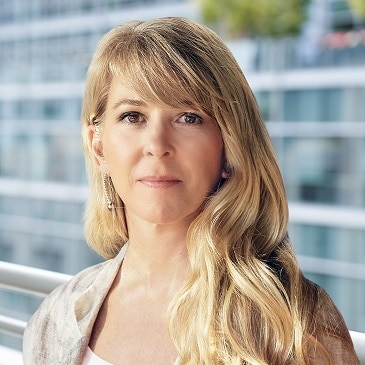
Liz Ann Sonders