How the Evolving Energy Shock May Impact Markets
Key takeaways
- Nine months into the Iran war, the oil shock has evolved. Oil production and flows have improved and demand has adjusted, bringing the market into better balance. But depleted inventories, expensive freight, and tight refined-product markets may leave prices vulnerable to renewed disruption.
- Persistently expensive energy would likely keep inflation and interest-rate pressure elevated. A durable peace could reverse that mix quickly, supporting consumers, bonds, and broader equity participation while challenging the Energy-sector leadership since the Iran war started.
- Exposure to the U.S. Energy sector remains useful as a potential geopolitical and inflation hedge, but the opportunity has become more selective as earnings expectations have risen. The key risk to Energy stocks in 2027 may not be recession, but a resolution of the Iran war.
The oil shock is changing
Nine months into the Iran war, the most surprising development may be what has not happened. Early in the conflict, the sudden halt of oil flows through the Strait of Hormuz led many forecasters to warn that a prolonged disruption could significantly weaken global growth and raise inflation. For example, the International Monetary Fund's (IMF) April World Economic Outlook estimated that under a prolonged-disruption scenario, global gross domestic product (GDP) growth could slow to 2.5%, and inflation could rise to 5.4%. Its latest forecast, released in October, puts 2026 GDP growth at 3.1% and inflation at 4.7%. Growth has been more resilient than initially feared.
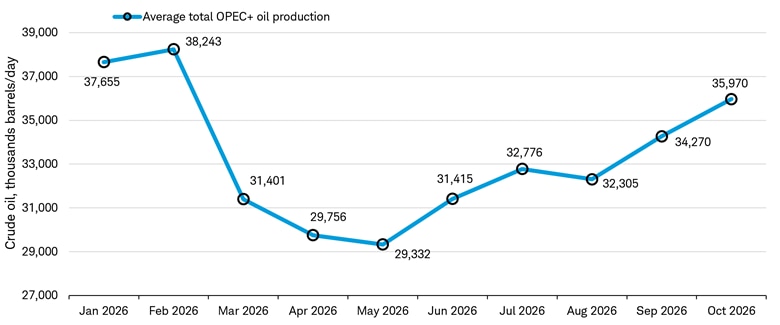
Several adaptations could help explain that resilience. Persian Gulf exporters found alternative routes outside the Strait of Hormuz, non-Persian Gulf producers increased output, and governments drew down strategic reserves. These adjustments likely helped contain crude prices relative to early fears. Flows through the Strait remained weak, even when including estimated "dark transit" flows, in which a vessel's exact route cannot be confirmed through public tracking systems. Production by OPEC+, which includes the 11 members of Organization of the Petroleum Exporting Countries (OPEC), plus 10 oil-producing alliance members, has recovered to levels close to pre-war levels.
OPEC+ oil production has recovered to near pre-war levels
Source: Schwab Center for Financial Research and BloombergNEF analysis of industry surveys, including the U.S. Energy Information Administration, International Energy Agency, OPEC, and Argus Media.
As of 11/8/2026. For illustrative purposes only.
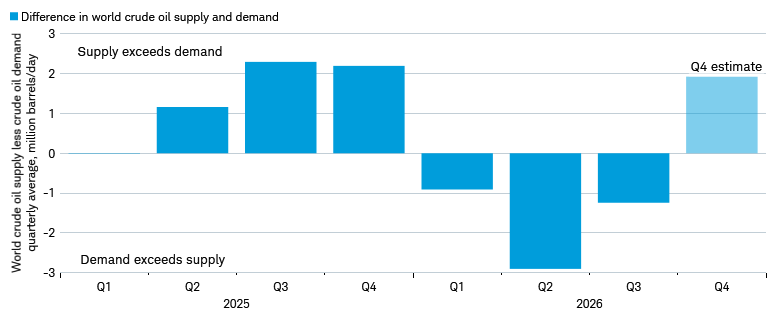
These adaptations do not necessarily amount to normalization. In its November Oil Market Report (released November 13, 2026), the International Energy Agency (IEA) estimates that global oil supply rose by 2.3 million barrels per day in October, enough for supply to exceed demand for the first time since the war began. Yet observed global oil inventories remain 462 million barrels below their prewar level. Land-based inventories are the lowest since at least 2016, while diesel prices remain far above prewar levels. In other words, the market has moved from acute shortage toward better balance, but with little cushion.
Global supply is estimated to exceed demand in the fourth quarter
Source: Schwab Center for Financial Research, Bloomberg, IEA, and Macrobond.
Data as of 11/18/2026. Forecasts contained herein are for illustrative purposes only, may be based upon proprietary research and are developed through analysis of historical public data. For illustrative purposes only.
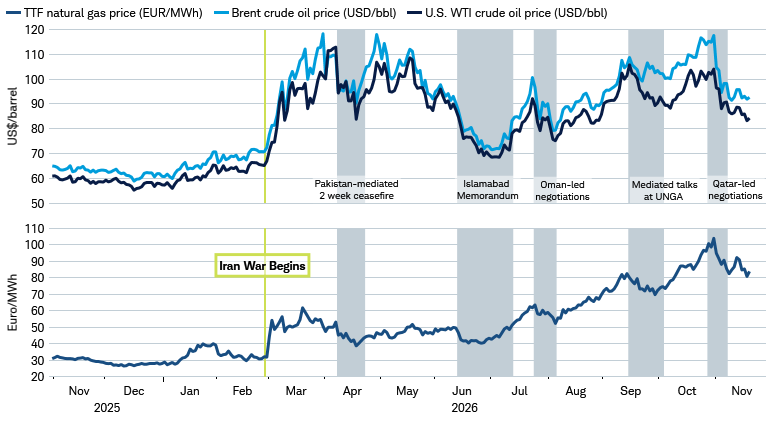
The shift in oil supply dynamics matters for investors. Oil prices reflect both physical fundamentals, including supply and demand, as well as a risk premium tied to geopolitical conflict and other uncertainties. Energy prices have swung with perceptions of risk surrounding the Iran war, periodically falling on news of a potential resolution. Prices also fell after the U.S. midterm election, with many political strategists and press reports from major news sources citing voter disapproval with the Iran war as a factor in the election outcome—a development that may be an incentive for the U.S. administration to pursue a resolution more quickly.
Energy prices have dropped periodically on news of potential conflict resolution
Source: Schwab Center for Financial Research, Bloomberg, and Macrobond.
Data from 11/1/2025 through 11/18/2026. Euro per megawatt-hour (Euro/MWh) is a standard unit for pricing electricity and natural gas in European energy markets. For illustrative purposes only. Past performance is no guarantee of future results.
The economic shock has moved beyond crude
The first-order hit from higher oil is visible in gasoline prices and household energy bills. The longer-lasting risk runs through diesel, freight, chemicals, and other inputs embedded across the economy. Higher transportation and production costs can initially compress margins and, over time, reach consumers through higher prices for goods and services. That is how an energy shock can migrate from headline inflation into core inflation.
While oil prices are set globally, global impact is uneven. The United States and Canada both have domestic production and are likely better positioned to absorb inflationary impacts than large energy-importing economies. Europe remains exposed via its imports of refined products and liquefied natural gas. Japan, India, and emerging Asia could face a larger external-income shock because they import more of their energy. Exporters, such as Canada, Brazil, Norway, and parts of Latin America may see more income from improved terms of trade. These diverging outcomes are likely to reinforce the geopolitical fragmentation of energy supply, trade routes, and investment.
Crude oil production has rebounded, and flows have adapted by finding new transit routes. However, energy inventories are depleted, transportation costs remain expensive, and refined-product prices are elevated, leaving the global economy vulnerable to renewed disruption.
U.S. enters 2027 with a smaller strategic petroleum reserve
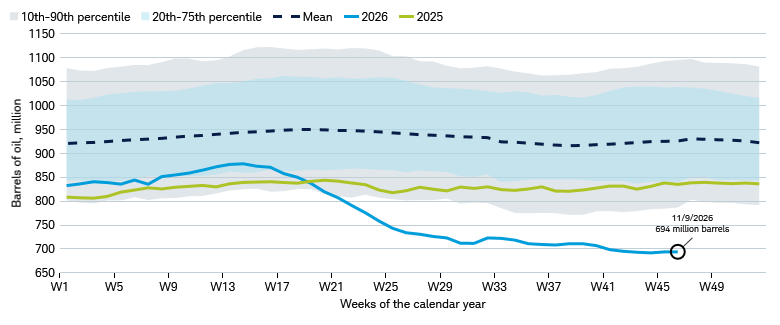
Source: Schwab Center for Financial Research, Energy Information Administration (EIA), and Macrobond.
Data from 1990-2026, as of 11/2/2026. For illustrative purposes only.
Europe's natural gas inventory is at a historic low for this time of year
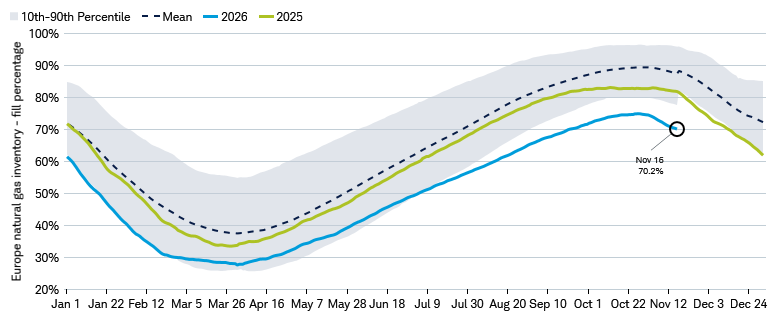
Source: Schwab Center for Financial Research, Gas Infrastructure Europe (GIE), and Macrobond.
Data from 2011-2026, as of 11/16/2026. For illustrative purposes only.
Prepare for divergent outcomes
The surge in artificial intelligence (AI)-related investment and broader business spending has helped global growth offset the drag from the energy supply shock. The IMF projects that global GDP growth will improve from 3.1% in 2026 to 3.4% in 2027, with the Middle East rebounding from slow growth due to the war in 2026. The principal macro risk is likely not an outright recession, but a less favorable policy mix in which inflation remains above target, central banks retain a tightening bias, and interest rates move higher. Tighter financial conditions can weigh on financial-asset prices and AI-related technology investment.
Should oil remain elevated while growth holds, the inflationary expansion may continue. Such environments can support risk assets when earnings growth offsets the drag from higher interest rates.
However, if growth slows, the risk of a stagflationary contraction, characterized by weak economic growth, increasing unemployment, and persistent high inflation, may increase. Based on our analysis, this macro environment has been a difficult one for risk assets because high inflation and weak or declining growth can pressure valuations and force difficult monetary policy decisions. In this scenario, commodities and real assets, such as real estate and infrastructure, may outperform financial assets, such as equities and fixed income, but come with their own risks. Within equities, companies with pricing power may outperform businesses with high fuel intensity and limited ability to pass on costs.
A resolution to the Iran war could produce a more durable decline in energy prices. Although that would weigh on energy companies, it could support broader financial markets by boosting consumption. Lower inflation expectations could also reduce pressure on central banks and improve inflation-adjusted household income. Bonds and rate-sensitive equities may outperform, while market leadership could broaden toward consumer, industrial, and other cyclical areas. Physical normalization is likely to take months because damaged infrastructure, depleted inventories, and shipping-insurance costs would likely not reset overnight.
Energy sector has outperformed, but expectations have risen
The Energy sector in developed markets has outperformed broad indexes this year as high oil prices led to strong earnings growth. Those conditions could remain intact if conflict in the Middle East persists or worsens.
Energy stocks outperformed their broad index in developed markets, but not emerging markets
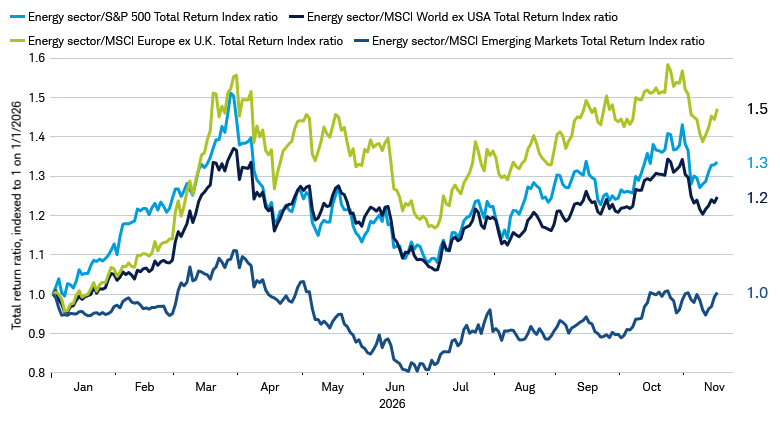
Source: Schwab Center for Financial Research, Bloomberg, S&P Global, MSCI, and Macrobond.
Data from 1/1/2026-11/18/2026. For illustrative purposes only. Indexes are unmanaged, do not incur management fees, costs, and expenses and cannot be invested in directly. Past performance is no guarantee of future results.
However, consensus expectations for energy-sector earnings have increased with strong earnings estimates through the remainder of the year before moderating slightly in 2027.
Energy earnings estimates closely follow changes in oil prices
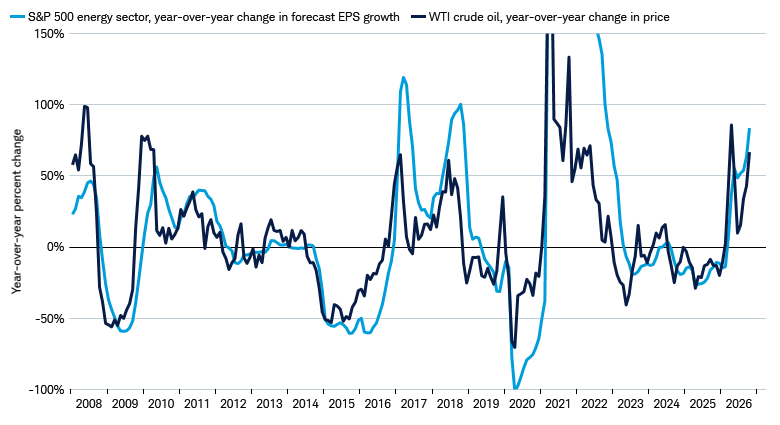
Source: Schwab Center for Financial Research, Bloomberg, S&P Global, and Macrobond.
Data from 1/1/2008 to 11/17/2026. Values in 2021 and 2022 are truncated for visualization purposes with a high on 4/2021 of 237% for WTI crude and 5,670% for the S&P 500 Energy sector earnings. For illustrative purposes only. Indexes are unmanaged, do not incur management fees, costs, and expenses and cannot be invested in directly. Past performance is no guarantee of future results.
Within Energy sector industries, a resolution of the Iran war could negatively affect earnings expectations for oil refiners, which have strongly outperformed this year on higher refined-product prices. Midstream companies, which transport, process, store, and market oil and natural gas, may be more resilient. Equipment and services companies could outperform as the industry shifts toward repairing infrastructure and rebuilding productive capacity.
S&P 500 refiners led Energy-sector performance
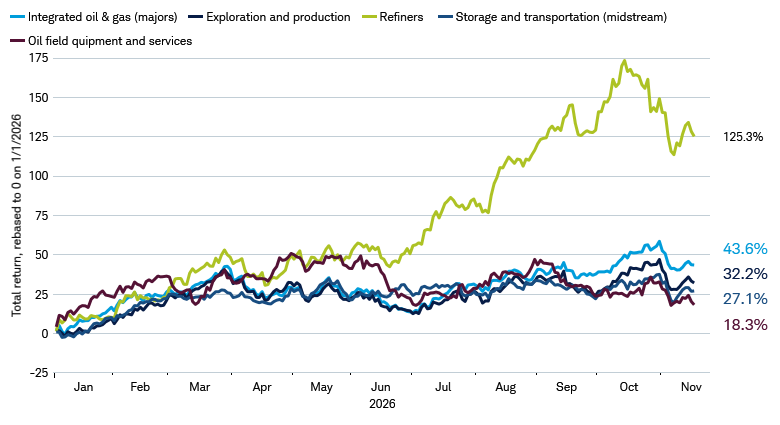
Source: Schwab Center for Financial Research, Bloomberg, S&P Global, and Macrobond.
Data from 1/1/2026 to 11/18/2026. S&P 500 energy subindustry constituents are market-weighted and include reinvested dividends. For illustrative purposes only. Indexes are unmanaged, do not incur management fees, costs, and expenses and cannot be invested in directly. Past performance is no guarantee of future results.
Investment implications
Investors should understand and appropriately size positions that depend on any single oil-price forecast. A more pragmatic approach is to prepare for a range of outcomes.
- Persistent conflict: Broad commodity and Energy exposures may act as inflation and geopolitical hedges. We would suggest focusing on companies with healthy balance sheets, relatively strong free cash flow, and pricing power.
- Renewed escalation: Bond yields could move higher if oil prices and inflation expectations increase. This outcome may also put relative pressure on consumers, energy-intensive industries, and energy-importing countries. Energy and defensive equities may outperform on a relative basis, but broad risk assets could weaken.
- Durable peace: Oil prices could decline, providing some relief for inflation expectations and bonds. This outcome would likely support risk assets broadly, including equities. Market leadership may shift away from the most oil-sensitive Energy stocks toward industries and companies supported by lower interest rates and lower energy-input costs.
When considering how to manage energy-sector exposures, it may be advantageous to shift from a broad sector call toward industry selection. We suggest favoring durable cash flows today while retaining flexibility to rotate exposures as outcomes become clearer. For example, conflict resolution may support the relative performance of the energy equipment and services industry that is exposed to infrastructure rebuilding.
Bottom line
The oil market has adapted enough to avoid the severe shortages and global recession envisioned by the downside scenarios that prevailed at the start of the war. But the global energy market has not adapted enough to eliminate the risk of another price spike. Meanwhile, the economic effects have broadened from crude prices to freight, refined products, inflation, and interest rates. That leaves investors with a two-sided setup for 2027. Continued conflict may support inflation hedges and selective Energy exposure. Peace could support the global economy and broader equities, but it could challenge the sector that benefited most from the shock. The key is not to predict how the conflict ends or where oil prices trade, it's to build a portfolio that does not depend on a single outcome.
About the authors

Chris Ferrarone